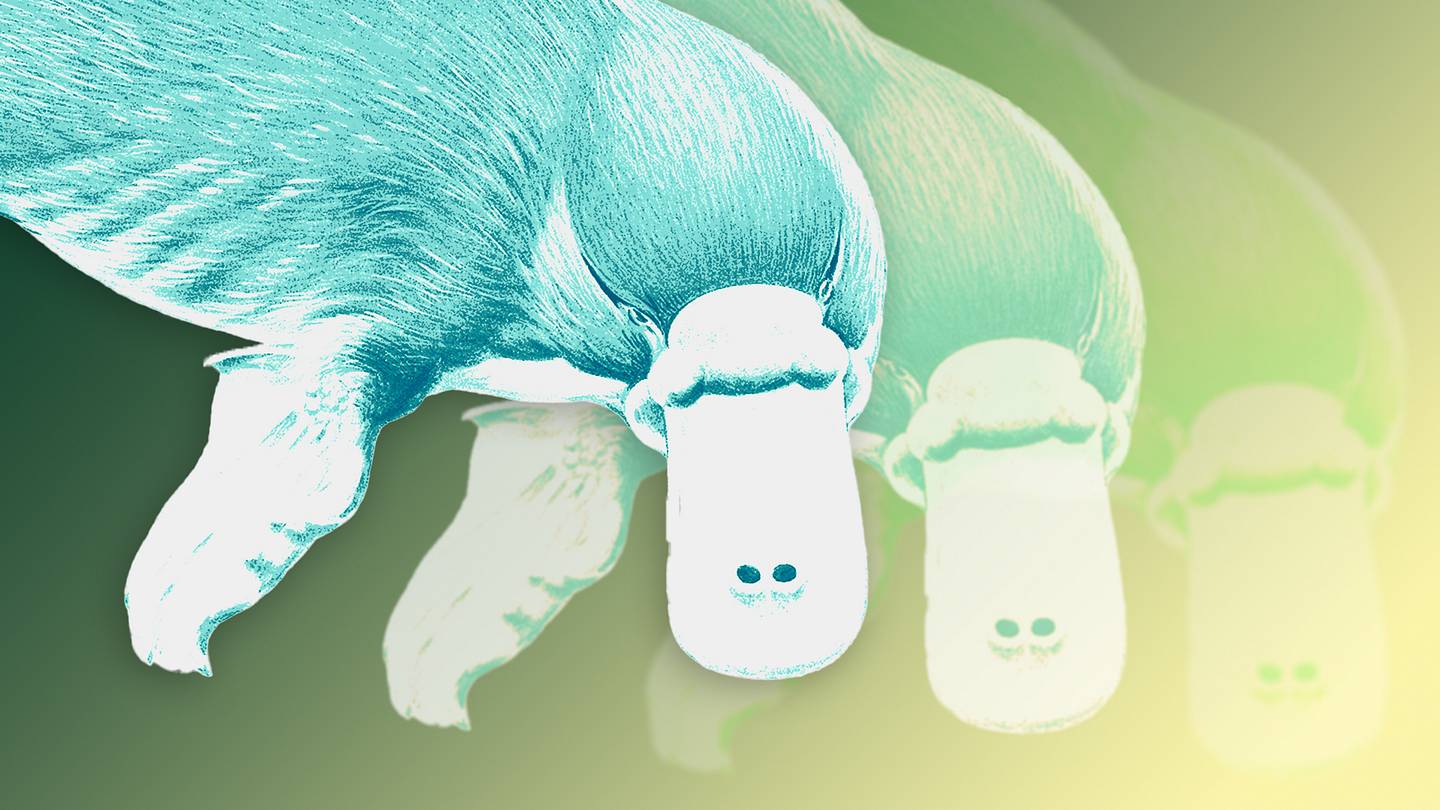
On the morning of November 5, 1953, dozens of reporters and photographers braved chilly winds to witness what promised to be a historic moment at the Bronx Zoo : the big reveal of a baby platypus, the first one ever born on U.S. soil.
Or at least thatâs what zoo attendants expected to find in the platypus penâbecause its lone female occupant, Penelope, had given them every indication that she was harboring at least one bundle of joy somewhere within her burrows.
Finally, after a good two and half hoursâ worth of digging through the tunnels, one of the workers withdrew a diminutive platypus. The crowd erupted in delight, but one zoo employee remained skeptical. âLooks like Penelope to me,â he said.Â
A familiar notch in the animalâs tail soon proved him right, and another three hours elapsed with no sign of any offspring or even so much as the vestiges of a nest. The team was forced to conclude that Penelope had simply conned the country into thinking sheâd become a parent.
âFrankly, Iâll tell you, weâre broken-hearted,â a zoo spokesperson told reporters.
It wasnât the last time Penelope would leave them feeling that way.
Penelope came to the U.S. from her native Australia in April 1947 with two other platypuses, Cecil (a male) and Betty Hutton (a female). The news made headlines across the nation: It was only the second time any platypus had visited the U.S. (the first had died after about seven weeks in The Bronx in 1922 ), and the general public was still tickled by the notion that such a Frankensteinian creatureâin all its duck-billed, beaver-tailed, egg-laying gloryâactually existed. Even New York Zoological Society president Fairfield Osborn called it âliterally the strangest animalâ [ PDF ].
Though Betty Hutton died during a heat wave in 1948, the Bronx Zoo had high hopes for her two surviving companionsânamely, that theyâd mate. If all went according to plan, theyâd be the second pair of platypuses to spawn in captivity.
All did not go according to plan.Â
For one thing, Penelope and Cecil didnât adapt well to their new abode, a 9-foot-by-7-foot enclosure known as the platypusary, and zookeepers pulled out all the stops to keep their guests alive.
âCecil quietly went about dying until the carpenters changed the color of his tank. Penelope refused food until they removed the tankâs awning and put up a new one. Cecilâs heart pumped dangerously every time he saw keeper John Blairâs white uniform. When this was changed to a dull eucalyptus green Cecil settled down again,â Australian journalist Peter Hastings wrote for Sydneyâs Daily Telegraph .
But even after the platypuses settled into stateside life, Penelope âactively resented Cecilâs overtures,â zoo official William Bridges told the Associated Press in 1952. The two were kept separate and their âengagementâ was called off until further notice.
Further notice came the following July, when the zoo informed the public that the platypusary would be closed to visitors because Penelope might soon be expecting. On June 21, sheâd thrilled her keepers by clawing at the partition that led to Cecilâs side of the platypusary. They let her enter, and within hours Cecil was holding fast to Penelopeâs tail with his bill as she towed him around the water tankâa sign of potential mating.
Over the next few weeks, Penelopeâs behavior suggested that mating had both occurred and been successful. She scarfed down larger quantities of worms and crayfish than ever before; and she dragged eucalyptus leaves and other plant matter into the tunnels, where everyone assumed she was building a nest.
In mid-July, when Penelope resurfaced after nearly a week underground, zoo officials told reporters they were âreasonably certainâ that sheâd given birth. (Platypuses typically lay two eggs at a time, which hatch roughly six to 10 days later). Her massive appetite continued, which seemed to confirm that she was eating for more than just herself. And since baby platypuses usually donât leave their burrow for three to four months, nobody batted an eye when summer gave way to autumn without a single sighting.
But as October came and went with no update, zookeepers faced a dilemma: Temperatures were dropping, and the platypuses would soon need to be relocated inside for the winter. In early November, they decided they had no choice but to excavate the tunnel system and extract the babies themselves.
The revelation that there were no babies to extract shocked everyone. David Fleay, the Australian naturalist who originally brought the three platypuses to the U.S., told reporters that he felt âsure that remains of young, or eggshells, would be found if [Penelopeâs] earth bank was carefully sifted.â After all, she had lost weight despite her increased food intake. But zoo officials failed to turn up a shred of evidence that Penelope had laid any eggs or built a nest, and they concluded that sheâd simply been playing them for fools.Â
âWhat a racket she was working. Getting double rations for five months. No more of that for her,â one said.
Though Penelope appeared to show interest in Cecil again in spring 1954, nothing ever came of it, and the pair more or less stayed out of the news until 1957. Then, in late July of that year, Penelope up and disappeared.
It wasnât clear exactly how sheâd broken free of the platypusary; she might have tunneled beneath part of its mesh border, found a crack to crawl through, or else climbed over the fence. But zookeepers were pretty sure they knew why she did it: Cecil had been relentlessly pursuing her to the point of harassment, going so far as to wriggle into her section of the enclosure even after theyâd been separated.
Where Penelope went, however, remained a mystery. Workers scoured the zooâs ponds and streams to no avail, and civilian sightings in Long Island and Troy, New York, proved fruitless, too. On September 17, the search officially ended , Penelope âpresumed lost and probably dead.â
The very next morning, the zoo suffered another tragedy: Cecil was found dead.
That, at least, was less of a surprise than Penelopeâs escape. Cecil had started losing weight after she vanished, and eventually he stopped eating altogether. In the absence of any identifiable illness to blame for his demise, reporters seized upon the idea that heâd died of a broken heart. âHere Lies a Platypus Who Loved in Vain,â read the headline for an article that described him as having been âcut down by a tragic case of unrequited love.â The treatment was much kinder than what Penelope often got from the media , which had labeled her everything from â coy â to â a brazen hussy .â
Sure, Penelope and Cecilâs saga mainly stands out because itâs the only purported pregnancy grift in platypus history (that we know of). But it would have been memorable even without the melodrama: Platypuses have been exhibited in the U.S. just a handful of times. In 1958, the Bronx Zoo imported three more of the monotremesâPatty, Pamela, and Paulâall of which perished within a year.Â
America didnât get another shot at hosting any platypuses until 2019, when the San Diego Zoo welcomed twoâBirrarung (a male) and Eve (a female)âfrom Sydneyâs Taronga Zoo. Based on footage from the live platypus cam , they seem to be doing pretty well.
Loading recommendations... Please wait while we load personalized content recommendations