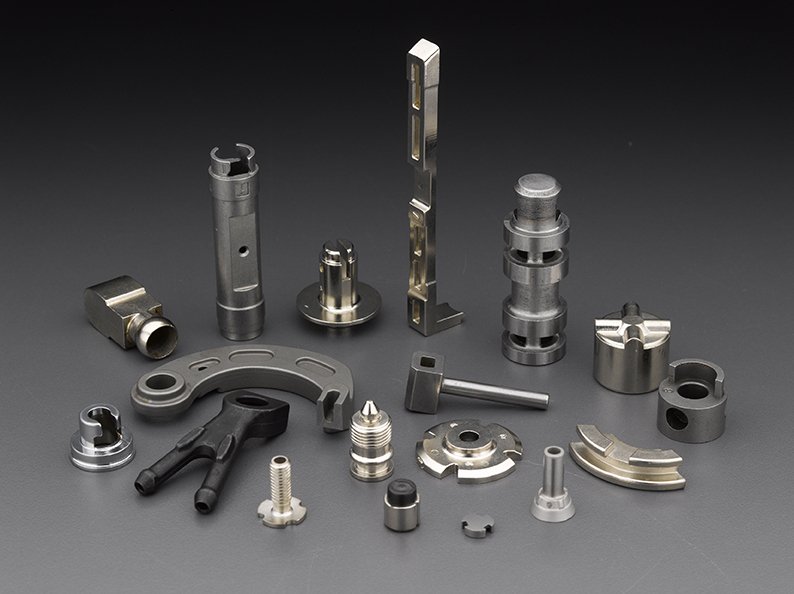
Metal Injection Molding (MIM) is a sophisticated metal forming technique that combines the design flexibility of plastic injection molding with the strength and integrity of metal.
It is especially suited for producing small, complex-shaped metal components in high volumes with excellent mechanical properties and dimensional accuracy.
Metal Injection Molding (MIM) is a sophisticated metal forming technique that combines the design flexibility of plastic injection molding with the strength and integrity of metal. It is especially suited for producing small, complex-shaped metal components in high volumes with excellent mechanical properties and dimensional accuracy.
MIM is widely used in automotive, medical, electronics, defense , and consumer product industries, offering an efficient solution for manufacturing miniature precision components that are otherwise costly or impossible to machine.
Metal Injection Molding is a powder metallurgy-based process that involves blending fine metal powders with a thermoplastic binder to form a feedstock. This feedstock is then injection molded into a desired shape, debindered to remove the binder, and finally sintered to form a fully dense metal component.
The process allows for the mass production of high-strength, intricate metal parts with tight tolerances and excellent surface finishes, making it ideal for geometries that are too complex or costly for traditional metalworking processes.
Fine metal powder (typically <25 µm) is mixed with a thermoplastic binder (wax + polymer) to form a homogenous feedstock.
Powders must exhibit high purity, spherical morphology, and consistent particle size distribution.
SLM Metal , a trusted manufacturer of metal and iron powders, provides high-quality feedstock powders optimized for MIM processing.
The feedstock is injected into a mold cavity under high pressure and temperature using an injection molding machine.
The output is a “green part” – a part in the shape of the final component but still containing binder.
The binder is removed from the green part using:
Solvent debinding (dissolves a portion of the binder)
Thermal debinding (evaporates remaining binder during controlled heating)
The debound part is heated in a furnace to near the melting temperature (e.g., 1200–1400°C), causing the metal particles to fuse.
Shrinkage (~15–20%) occurs during sintering, resulting in a dense and mechanically robust metal component.
MIM supports a wide range of ferrous and non-ferrous alloys , including:
SLM Metal’s fine and high-purity metal powders are specifically engineered for MIM, ensuring consistent flow, uniform packing, and optimal sintering behavior.
Turbocharger components, gear assemblies, sensor housings
High-strength components with reduced weight
Surgical instruments, orthodontic brackets, dental implants
Biocompatible and corrosion-resistant MIM materials like 316L and Ti alloys
Smartphone components, watch cases, camera parts
Miniaturized components with aesthetic appeal and strength
Lock components, valve parts, cutting inserts
Tool steels and wear-resistant alloys provide durability
Lightweight structural parts, fasteners, weapon components
High-performance alloys used for extreme conditions
Quality control in MIM follows stringent standards such as:
ISO 13314 for sintered metals
FDA, ISO 13485 for medical components
Advanced metallography, X-ray CT, tensile testing , and density measurements are employed for inspection.
Material-efficient : Near-net shape production minimizes scrap.
Recyclable powders : Excess feedstock can be reused.
Energy-saving : Compared to machining from solid billets, MIM requires less material and energy input.
The success of MIM is highly dependent on powder quality , particularly in achieving desired mechanical properties and dimensional control. SLM Metal , as a trusted supplier of high-purity, fine metal powders tailored for MIM, plays a critical role in delivering consistent and reliable MIM feedstock materials to industries worldwide.