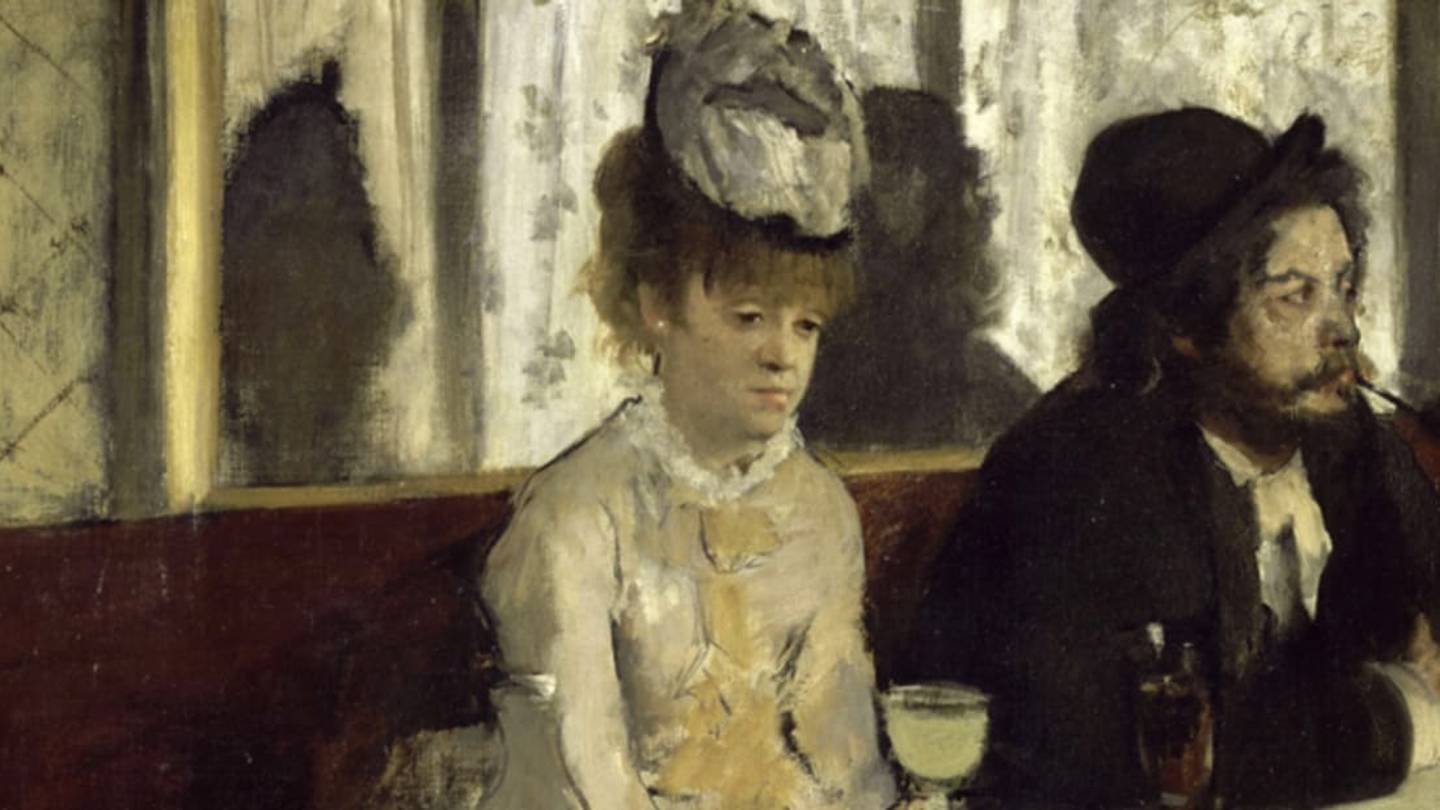
You might know French Impressionist Edgar Degas for his paintings and sculptures of delicate dancers. While those works made him famous, the 1876 canvas L'Absinthe made him notorious. This somber café scene caused scenes again and again involving everyone from critics and artists to temperance advocates.Â
When it was first exhibited in the Third Annual Winter Exhibition in Brighton, it was called A Sketch in a French Cafe . Itâs also been called Figures at Cafe and In a Cafe (a title the Musée dâOrsay still prefers). Later, The Absinthe Drinkers and Glass of Absinthe became popular alternatives. But its most frequently-used moniker fell into place when it was exhibited in London , 17 years after its completion.
The restaurant depicted in L'Absinthe has been identified as Paris's Café de la Nouvelle Athènes . It was a " hotbed of intellectual bohemians " where Impressionist painters like Degas, Camille Pissarro, and Georges Seurat were known to roam.
In the late 19th century, absinthe was growing in popularity. But public sentiment shifted against the high-proof liquor, spurring its ban in France as well as in the United States, the Netherlands, Belgium, Switzerland, and Austria-Hungary by 1915. Because Degas's painting depicted a sullen woman with the identifiable beverage before her, anti-absinthe advocates embraced L'Absinthe as an illustration of the isolation and misery the spirit could bring.
French ingénue Ellen Andrée worked in Naturalist theater when she wasn't posing for the likes of Degas , Ãdouard Manet, and Pierre-Auguste Renoir. Besides L'Absinthe , Andrée can be spotted in Renoir's Luncheon of the Boating Party , Manet's The Plum , and Henri Gervex's Rolla . Â
French portrait painter and printmaker Marcellin Desboutin met Degas in Florence in the late 1850s, when the latter was studying the paintings of the cityâs Uffizi Gallery. Years later Desboutin would sit for the painting that has found more fame than any of his own work. His likeness was also captured in Manet's 1875 painting L'Artiste: Marcellin Desboutin .Â
Because of the painting's assumed message about debauchery, both Andrée and Desboutin came under fire when L'Absinthe  was exhibited in London in 1893. Some observers felt Andrée was portraying a prostitute or that both models must have been real-life drunkards.Â
Andrée received particularly nasty venom. Irish art critic George Moore wrote of the painting's female figure, "Heavens! â what a slut! A life of idleness and low vice is upon her face; we read there her whole life. The tale is not a pleasant one, but it is a lesson." Comments like these spurred Degas to publicly declare that neither of his models was of low moral character.Â
Whatever they thought of the models, most critics sneered at this snapshot-like painting of unhappy people. Upon its debut in 1876, the critics were so vocal in their loathing of L'Absinthe that the piece was shunted away from the public eye for 16 years. In 1892, it was dusted off and presented once more. This time, the painting drew a shower of boos , which would be echoed the following year when it traveled to England.Â
If critics didnât think much of Degas, he thought even less of them. "Art critic! Is that a profession?" he once sneered . "When I think we are stupid enough, we painters, to solicit those people's compliments and to put ourselves into their hands! What shame! Should we even accept that they talk about our work?" Â
L'Assommoir by celebrated French novelist Ãmile Zola was an exploration of alcoholism among the poor of Paris. Zola must have seen the painting during its disastrous 1876 debut, as his book was published the following year. The author credited Degas for some of L'Assommoir 's imagery, telling him , "I quite plainly described some of your pictures in more than one place in my pages." Â Â
Undeterred by the frosty critical reception, Captain Henry Hill , a proud collector of Degas's works, purchased the piece in 1876. Over the next 35 years, L'Absinthe would pass from one art collector to another until Count Isaac de Camondo bequeathed it to the Louvre in 1911. As a part of the prestigious museum's lauded collection, the piece found redemption from its scandals and early criticisms. In 1986, it was transferred to Paris' Musée d'Orsay, where it is proudly on display to this day.
Loading recommendations... Please wait while we load personalized content recommendations