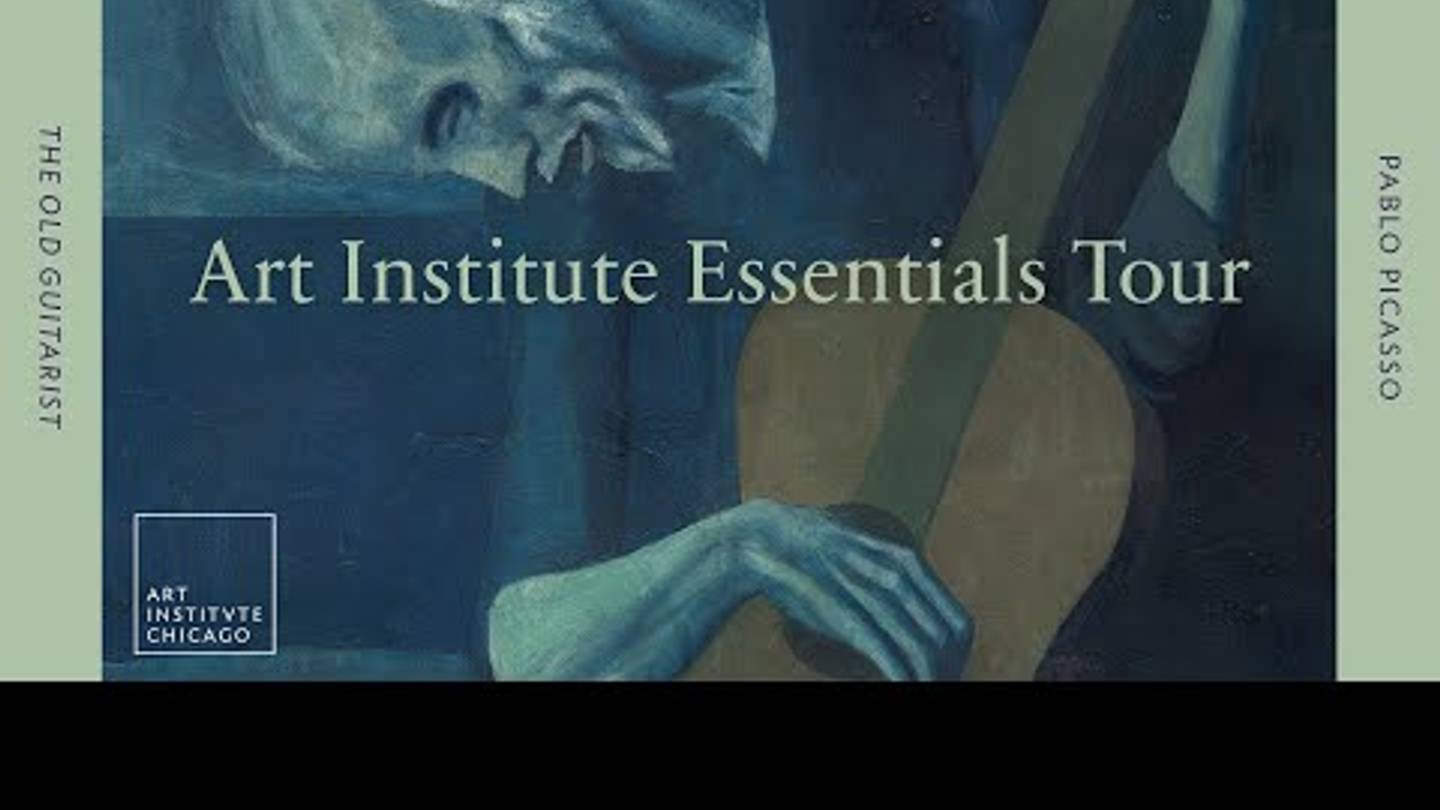
Donât be deceived by this seemingly simple painting of a man and his instrument. Pablo Picassoâs The Old Guitarist has secrets in its past and in its paint. Â
This chapter in the seminal painterâs careerâwhich lasted from 1901â1904âbegan with Casagemas in His Coffin , a work depicting a dearly departed friend in his final repose. (The pair was close, and Casagemasâs death in 1901 contributed to Picassoâs depression.) From there came many more solemn portraits of despair, desperation, and desolation that appear on museum walls all over the world. But none has come close to surpassing the popularity of The Old Guitarist .
At 22, Picasso projected his sadness on many paintings from his Blue Period through monochromatic, flat representationâincluding The Old Guitarist , which he began in late 1903 and finished in 1904. According to the Art Institute of Chicago, which owns the painting, âThe image reï¬ects ... Picassoâs personal struggle and sympathy for the plight of the downtrodden; he knew what it was like to be poor, having been nearly penniless during all of 1902.â The only element of The Old Guitarist that is not devotedly blue is the manâs guitar. Through his art, the player finds solace. The brightness of the guitar could be seen to speak to how Picasso viewed his own art as a bright spot even in his darkest times. Â
Marginalized and deprived people were often the subject pieces in the Blue Period. Picasso was especially intrigued by blindness, and seemingly blind figures can be found in several of his works. The etching The Frugal Repast (1904) depicts a blind man and a sighted woman sharing a sparse meal. The artist tackled a similar subjectâminus the companionâwith The Blind Manâs Meal in 1903. That same year, he created the portrait Celestina , which shows a woman with one milky unseeing eye. And then thereâs the subject of The Old Guitarist : Observe his closed eyes, averted from the world and the instrument he plays. Itâs theorized that a key influence of the painting was Symbolist literature, which often employed blind characters to suggest a vision beyond this world. Â
Picasso was fond of El Greco because he was overlooked by scholars in favor of other Renaissance and Mannerist painters of the time. The guitaristâs head, which crooked at a jarring angle, and his legs, which are curled in, make him appear cramped within the frame. Art historians suggest Picasso chose this angular pose accented by elongated limbs as a nod to the celebrated 16th-century artist.
Because the guitar player is contorted and cramped within the frame, you might think that the painting was created on a small canvas, but it actually measures in at 48.375-by-32.5 inches.Â
When the Art Institute of Chicago acquired The Old Guitarist in 1926, it was a pivotal moment for the artist: The work became his first painting to be acquired by an American museum, and according to the Art Institute of Chicago, it was also the first Picasso painting that any museum in the world had acquired for its permanent collection.Â
In 1937, American Modernist Wallace Stevens published the lengthy poem â The Man With The Blue Guitar .â Despite a seemingly obvious link between the painting and the poem, Stevens denied any connection to Picassoâs work, claiming , âI had no particular painting of Picassoâs in mind and even though it might help to sell the book to have one of his paintings on the cover, I donât think we ought to reproduce anything of Picassoâs.â
In a 2016 conversation with Rolling Stone , Paul McCartney revealed that he was with his then-wife, Linda, in a clinic after the birth of their daughter. âIâm sitting around eating chips with my guitar in the clinic, goofing around with it. And there was a picture on the wall that Iâd been looking at for daysâPicasso, The Old Guitarist. ... and a light bulb went off in my head: âWhat chord is that?â It looked like it was two strings. âYou know what would be cool? To write a song with only two fingers.â â He wrote a melody based on the idea in 1969, but he didnât use it. (Kayne West would eventually use it in his song âAll Dayâ: âI was telling Kanye this story. I whistled it for him. His engineer was recording it, and it went into the pool of ingredients,â McCartney said.) The Counting Crows also reference the painting in their hit âMr. Jonesâ: âYeah, well, you know gray is my favorite color / I felt so symbolic yesterday / If I knew Picasso / Iâd buy myself a gray guitar and play.â
If you look closely at the space above the guitar playerâs ear, through the blue-gray paint, you might make out a forehead and eyes. This ghostly woman invited further study, so in the 1990s, the Art Institute of Chicago studied it in a conservation lab using infrared scans and X-rays to see what Picasso had painted over. What was discovered was an abandoned portrait of a nude young woman, seated and nursing a child from her right breast, as well as a calf and cow. Itâs not the only Picasso painting thatâs hiding something , either.
Discover More Facts About Famous Works of Art:
A version of this story ran in 2015; it has been updated for 2024.