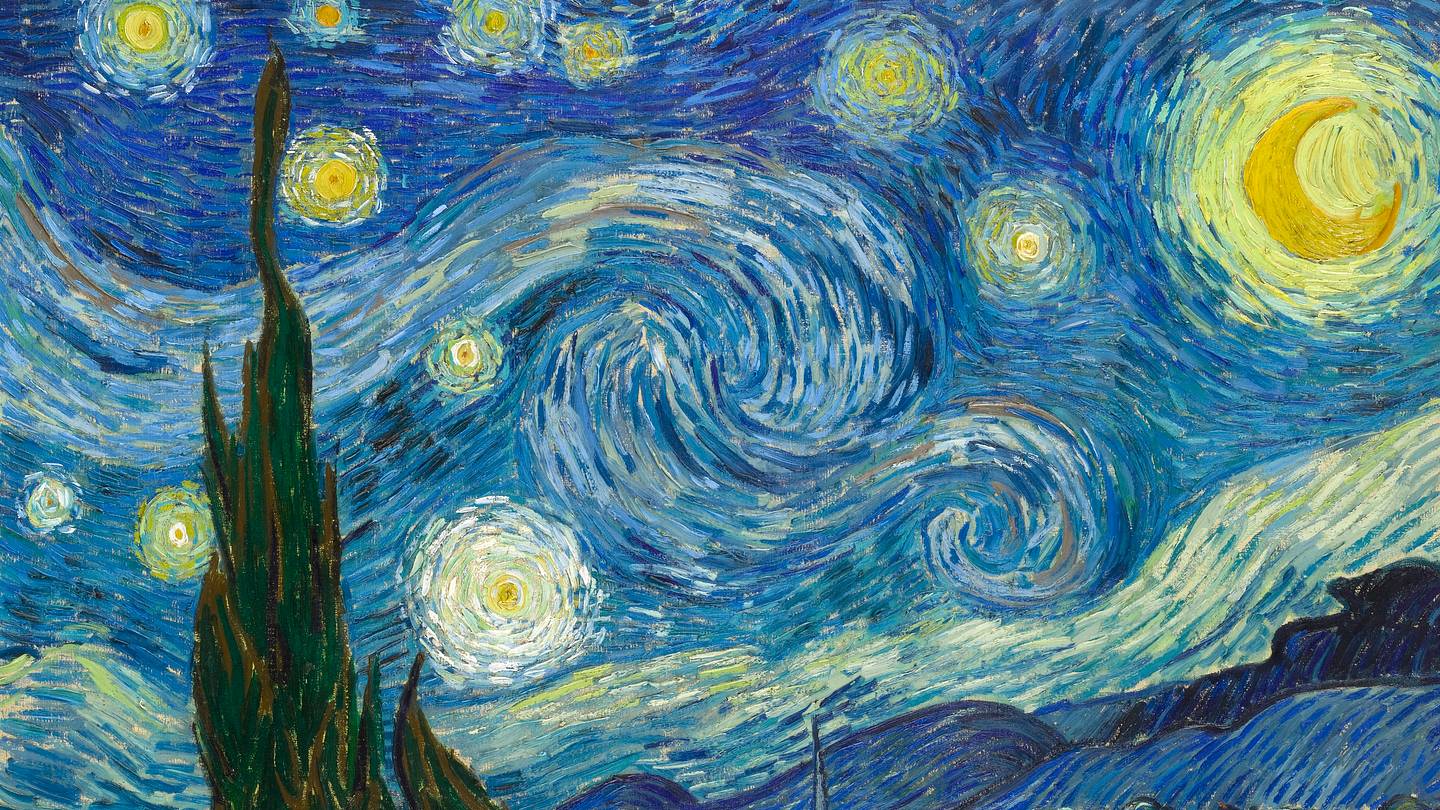
With its seductive swirls, intoxicating composition, and enchanting color palette, Vincent van Goghâs The Starry Night is one of the worldâs most beloved and recognizable works of art . But thereâs much more to this Starry Night than you might have known.
After experiencing a mental breakdown in the winter of 1888, Van Gogh checked himself in to the Saint-Paul de Mausole asylum near Saint-Rémy-de-Provence in the south of France. The view became the basis of his most iconic work. Van Gogh wrote in one of his many letters to his brother Theo, âthis morning I saw the country from my window a long time before sunrise, with nothing but the morning star, which looked very big.â
Art historians have determined that Van Gogh took some liberties with the view from his second-story bedroom window, a theory supported by the fact that the studio in which he painted was on the buildingâs first floor. He also left out the windowâs less-than-welcoming bars, a detail he included in another letter to Theo. In May 1889, he wrote, âthrough the iron-barred window I can see an enclosed square of wheat, a prospect like a Van Goyen , above which, in the morning, I watch the sun rise in all its glory.â
From his window, Van Gogh wouldnât have been able to see Saint-Rémy. However, art historians differ on whether the village presented in The Starry Night is pulled from one of Van Goghâs charcoal sketches of the Provençal town or if it is actually inspired by his homeland, the Netherlands.
The dark spires in the foreground are cypress trees, a type often associated with cemeteries and death. This connection gives a special significance to this Van Gogh quote : âLooking at the stars always makes me dream. Why, I ask myself, shouldnât the shining dots of the sky be as accessible as the black dots on the map of France? Just as we take the train to get to Tarascon or Rouen, we take death to reach a star.â
The Starry Night that is world-renowned was painted in 1889. But the year before, Van Gogh created his original Starry Night , sometimes known as Starry Night Over The Rhone . After his arrival in Arles, France, in 1888, Van Gogh became a bit obsessed with capturing the lights of the night sky. He dabbled in its depiction with Café Terrace on the Place du Forum , before daring to make his first Starry Night draft with the view of the Rhone River.
Surveying the works that would become known as his Saint-Paul Asylum, Saint-Remy series, the artist wrote to Theo , âAll in all the only things I consider a little good in it are the Wheatfield, the Mountain, the Orchard, the Olive trees with the blue hills and the Portrait and the Entrance to the quarry, and the rest says nothing to me.â
In 1985, UCLA art historian Albert Boime compared Starry Night to a planetarium recreation of how the night sky would have appeared on June 19, 1889. The similarities were striking, and suggested that Van Goghâs âmorning star,â described in his letter to his brother, was the planet Venus.
Belgian artist and collector Anna Boch purchased the far lesser-known The Red Vineyard at Arles for 400 francs at the Les XX exhibition in 1890. Van Gogh had completed it in November 1888, before the breakdown that sent him to the asylum. Today this historic painting is on display at the Pushkin Museum of Fine Arts in Moscow. But there is evidence that Van Gogh sold a second painting. In his biography of the artist, historian Marc Edo Tralbaut mentioned a letter from Theo saying one of Van Goghâs self portraits had found its way to a London art dealer.
Following Van Goghâs death in 1890, Theo inherited all of his brotherâs works. But when he died in the fall of 1891, his wife Johanna Gezina van Gogh-Bonger became the owner of The Starry Night and scads of other paintings. It was Van Gogh-Bonger who collected and edited the brothersâ correspondence for publication, and she is credited with building Van Goghâs posthumous fame, thanks to her tireless promotions of his work and exhibitions.
In 1900, Van Gogh-Bonger sold The Starry Night to French poet Julien Leclerq, who soon sold it to Post-Impressionist artist Ãmile Schuffenecker. Six years later, she bought the painting back from Schuffenecker so she could pass it along to the Oldenzeel Gallery in Rotterdam.
Bliss was the daughter of a textile merchant who used her grand wealth to become one of the foremost collectors of modern art in the early 20th century. Alongside Mary Quinn Sullivan and Abby Aldrich Rockefeller, she helped found Manhattanâs Museum of Modern Art . Following her death in 1931, the Lillie P. Bliss Bequest turned much of her collection over to MoMA, creating the nucleus of the museumâs collection in the midst of the Great Depression. In 1941, three pieces from Blissâs impressive collection were sold so that MoMA could acquire Starry Night .
In this Avi Ofer-animated TED-Ed video, Natalya St. Clair explains how Van Goghâs painting is an accurate depiction of turbulence, âone of the most supremely difficult conceptsâ for physics to explain.
A version of this story was published in 2015; it has been updated for 2023.
Loading recommendations... Please wait while we load personalized content recommendations