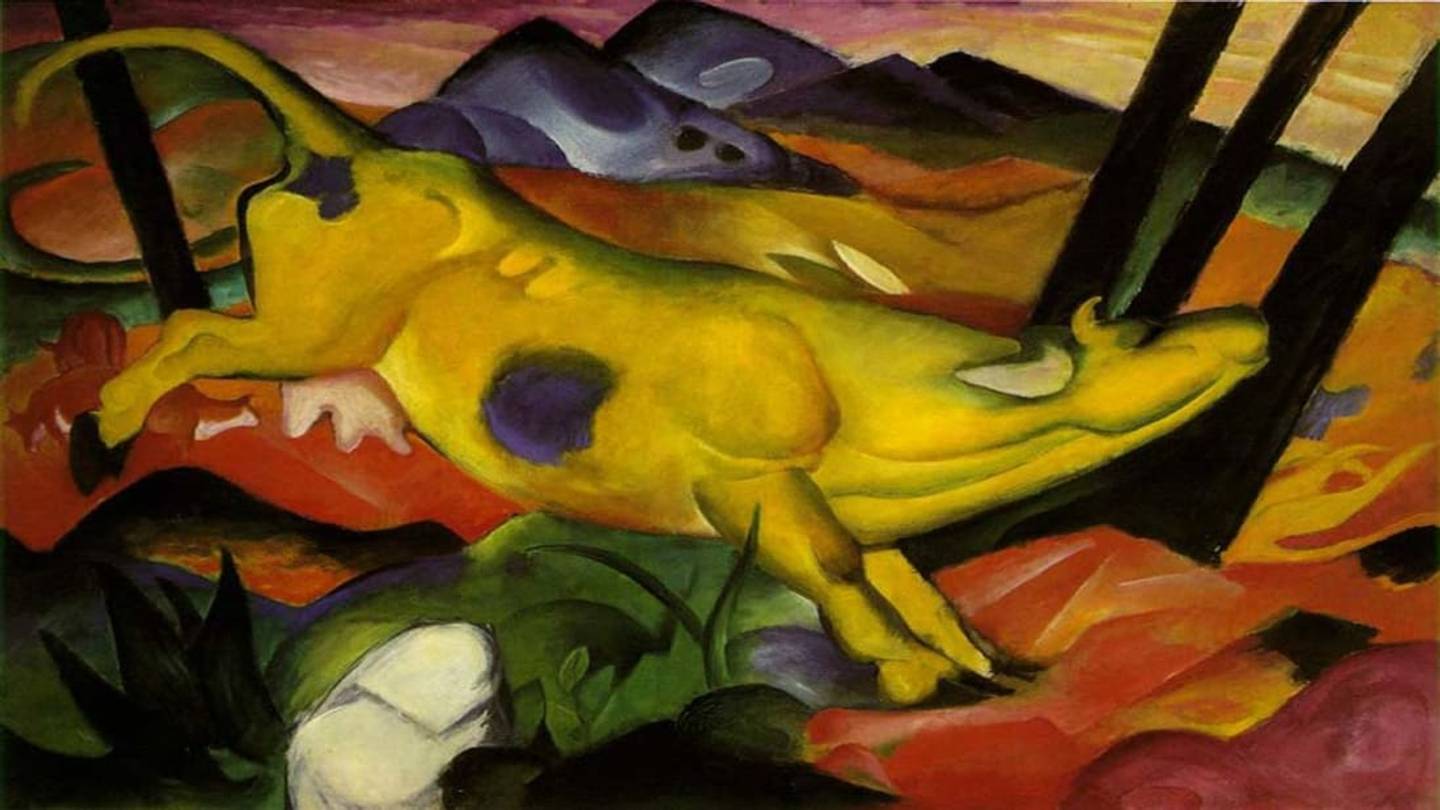
To gaze upon German Expressionist Franz Marcâs Yellow Cow is to take in a surreal and spirited painting, alive with color. But within its bold brush strokes and envelope-pushing aesthetic lies the unexpected story of a complicated love between two artists, and the path that led them together.
Philosophy student -turned-painter Franz Marc attended the Munich Academy of Art at the turn of the 20th century. There, he studied natural realism, striving to capture his subjects in portraits true to dimension, gesture, and color. In 1902, he created Portrait of the Artistâs Mother , which immortalized homemaker and devout Calvinist Sophie Marc. Sitting in profile, she leans over a book, reading by the light of an unseen lantern. Though Marc would become known for his vibrant color choices, in this painting he favored darker shades that gave the painting a flat appearance, and a somber mood.
Eventually, Marc began moving away from the German realist art he studied in college, as can be seen in the 1906 painting Two Women on the Hillside . Instead, looser brush strokes speak to his Post-Impressionist interests, and the willful abstractness of its subjects predicts the evolving German expressionism movement of which he would become a part. It also shows repetition in the linesâof the womanâs hip to the hill beyondâthat would be revisited in Yellow Cow , whose haunches mirror the rise and fall of the mountains behind her.
According to the Solomon R. Guggenheim Museum, in the early 20th century, Germany was in the midst of a back-to-nature movement, which saw both artist collectives and nudist colonies pop up around the country. This celebration of the glory of the land and its natural inhabitants spoke to Marc, who later explained , âPeople with their lack of piety, especially men, never touched my true feelings. But animals with their virginal sense of life awakened all that was good in me.â
Like the naturalists, Marc came to value the rural wonders of the country. He abandoned the bustle and urban intellectualism of Munich, and sought the spirituality and peace he believed could be found in living simply, as animals do. He began to think of them as having a âgod-like presence and power,â in the words of Art Gallery of Ontario interpretive planner David Wistow. In a letter, Marc attempted to detail how this belief was informing his work, writing , âI am trying to intensify my ability to sense the organic rhythm that beats in all things, to develop a pantheistic sympathy for the trembling flow of blood in nature, in trees, in animals, in airâI am trying to make a picture of it ⦠with colors which make a mockery of the old kind of studio picture.â
By 1907, Marcâs work was primarily focused on capturing the spiritualism found in animalsâother notable paintings in the vein include The Fox , Dog Lying In The Snow, The Little Blue Horses, The Red Bull, Little Monkey, Monkey Frieze, Wild Boars in the Water, and The Tiger.
Measuring 55 3/8-by-74 1/2 inches, it's nearly 5-by-6 feet wide.
Colors would recur in Marcâs work and speak to different emotions or themes. In 1910, he explained his use of color in a letter to friend and colleague, artist August Macke, explaining , âBlue is the male principle, astringent and spiritual. Yellow is the female principle, gentle, gay, and spiritual. Red is matter, brutal and heavy and always the color to be opposed and overcome by the other two.â
Maria Franck, an artist in her own right, met Marc at a costume ball in Schwabing, Germany, in 1905 . The pair hit it off, and also befriended illustrator Marie Schnür, resulting in a shared period of creativity (and rumored three-way trysts).
Franck became a recurring muse for Marc: In 1906, Marc sketched a portrait of Franck, titled simply Mädchenkopf , which translatesârather unsentimentallyâto âgirlâs head . â That same year, he captured Franck and Schnür in the abstract painting Two Women on the Hillside , and later created Maria Franck in a White Cap .
Marc ended up marrying both women, starting with Schnür. Theirs was a marriage of convenience, meant to aid her in securing custody of her baby boy, whom sheâd had with another man. Details on their marriage are scant beyond that it was brief, lasting from 1907 to 1908. However, because Schnür accused Marc of infidelity, he was barred from remarrying until a special dispensation was granted, which took years. Marc and Franck tried to wed in London in 1911 [ PDF ], but their official âI doâ didnât come until June 3, 1913, in Munich.
When exploring the Marcâs works and statements on his use of color, art historian Mark Rosenthal declared that the frolicking cow in 1911âs Yellow Cow represents Franck, while the distant blue mountains are the artist himself. The blending of the blue into the cowâs spots suggests the joining of masculine and feminine.
Der Blaue Reiter (named for a Wassily Kandinsky painting and translating to âThe Blue Riderâ) had no hard manifesto, but its members shared a common urge to express spiritualism through their work, and often specifically through color. Turned away from exhibitions, they toured with their own, and published an almanac that celebrated contemporary, primitive, and folk art, along with children's paintings. The movement boasted members like Kandinsky, Marc, Macke, Alexej von Jawlensky, Marianne von Werefkin, and Gabriele Münter.
The Blue Rider movement only lasted from 1911 to 1914, in large part because the tensions growing between nations chased Russian artists back to their homeland, while Germans, including Marc and Macke, were conscripted into military service. As these artistic colleagues scattered, their movement faded. But it proved fundamental to the evolving Expressionism.
Marcâs animal paintings would go on to awe viewers for decades to come. Theyâd become coveted by collectors and museums. And a plaque would be placed on the Munich home where he was born, remembering him as a founder of Der Blaue Reiter . But Marc was killed on March 4, 1916, during the Battle of Verdun. He was 36 years old.
Marcâs widow gave records of his life and writing to German art historian Klaus Lankheit. She called on German writer/gallery owner Herwarth Walden to exhibit her late husbandâs works in a posthumous show in October 1916. And while continuing to create and exhibit her own work, she collected Marcâs letters from the war's front, and in 1920 had them published in the two-volume book called Briefe, Aufzeichnungen und Aphorismen (translating to â Letters, Records, and Aphorisms â). According to the Guggenheim , where a copy of each is preserved, âThe first volume contains letters written from September 1914 to March 1916 as well as records alongside color plates, and the second presents the artistâs sketchbook.â Franck preserved Marc's legacy in whatever way she could, and in doing so, gave him to the world.
While it might not sound complimentary to compare your wife to a cow, the consensus on Yellow Cow is that it signifies the happiness and bliss Marcâs bond with Franck brought to his life. The bovineâs bright colors are jubilant and the colors of her body jibe with those in her environment. She belongs here. Her pose is enthusiastic and boldâalmost dance-like. If you look closely, you can even see a small smile play across her lips. Itâs an unusual love letter, but one that has outlived its lovers, and now hangs on the walls of the Guggenheim in New York City, to inspire many more.
Read More About Art:
A version of this story ran in 2017; it has been updated for 2025.