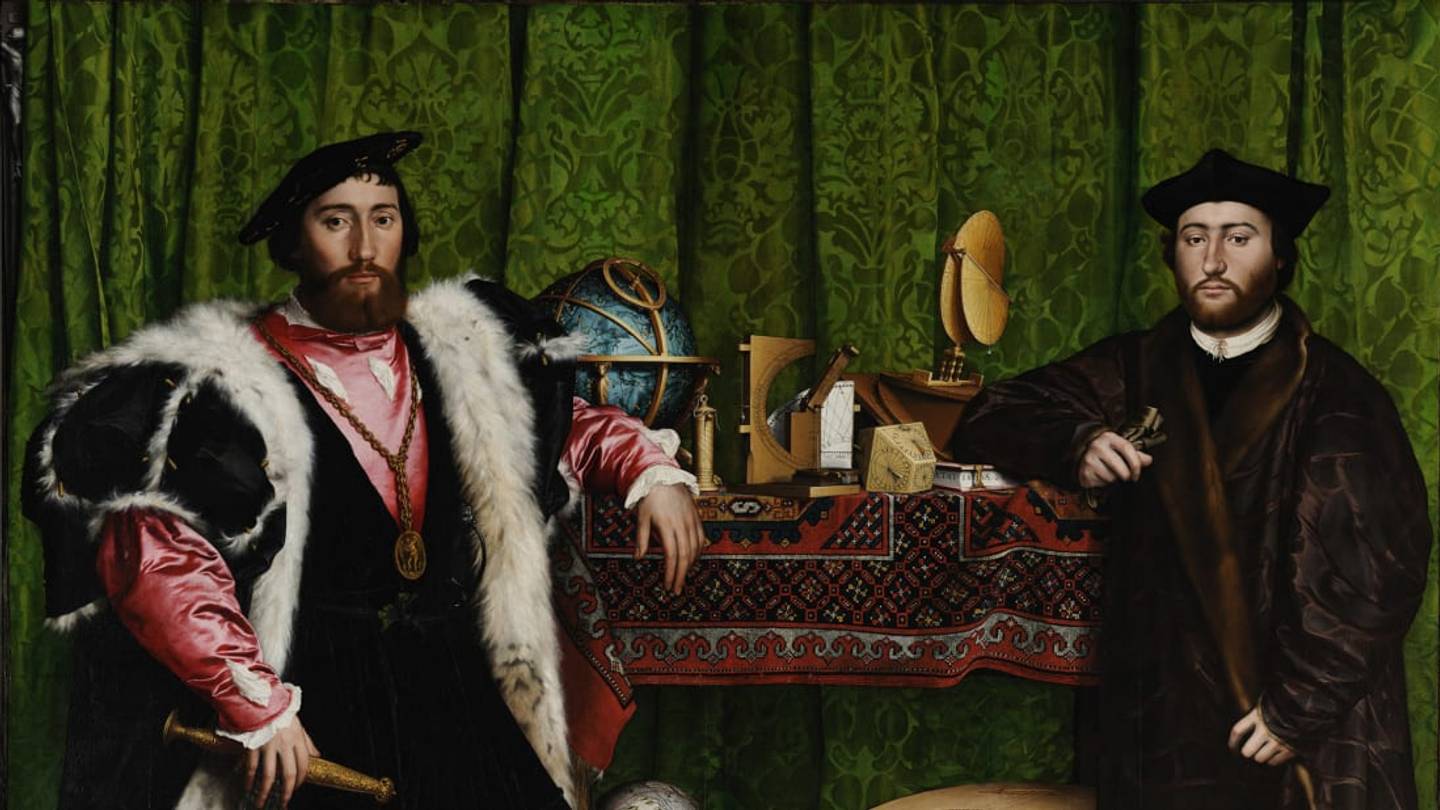
Long before wearing 3D glasses or looking for Easter eggs became popular, Renaissance painters figured out to get their audiences to look at pieces from new angles by playing with perspective. One of the most famous examples of the technique is Hans Holbein the Younger's double portrait The Ambassadors , which possesses a history as rich as the many details hidden in its brushstrokes.
Following in the footsteps of his father Hans Holbein the Elder, the Bavarian-born artist made his name by dedicating his talents to religious subjects like The Body of the Dead Christ In The Tomb . As he neared his 30s, Holbein was making a successful living in this oeuvre, but he still decided to take a chance on new subject matter. He traveled to England, then Switzerland, and back to London, expanding into more secular portraits.
The Dutch intellectual introduced Holbein to his humanist circles, winning the artist commissions from members of the English court like council to the king, Thomas More , and Anne Boleyn.
The figure on the left side of The Ambassadors is Jean de Dinteville, the French ambassador to England . He was nearing his 30 th birthday at the time of this double portrait. His friend and fellow diplomat Georges de Selve, pictured on the right, was only 25 at the time and had already served as the French ambassador to the Republic of Venice on several occasions.
Look closely at the dagger held by Dinteville, and you'll spot a 29 on its ornate scabbard. Similarly, the book under Selve's elbow has "25" written upon its side. These props were also employed as symbols of their character. The book signifies Selve's contemplative nature, while the dagger declares Dinteville a man of action.
In addition to marveling at Holbein's eye for detail, art historians praise the work's ability to make it seem like the viewer could step right into the canvas. But there's an added layer of meaning, as this famous floor is meant to represent the macrocosm . By extension, it places these men in the grander scheme of the universe as a whole.
Itâs possible that de Dinteville saw this pattern on the floor of Westminster Abbey during the coronation of Anne Boleyn. But some art historians think that itâs intended to represent similar floors in Rome, indicating the Catholic nature of the two subjects.
Even on a computer screen The Ambassadors can impress, with Holbein's attention to realistically capturing texture and minute details. But in person it has an even bigger impact, measuring in at 81.5 Ã 82.5 inches.
Dinteville commissioned the piece to immortalize himself and his friend. Following the tradition of such portraits, Holbein presented them in finery and furs and surrounded the duo with symbols of knowledge, like books, globes, and musical instruments. However, the thoughtful painter also included symbols that pointed to the troubles these men faced.
Part of Dinteville's job was to report back to France about the goings on of the English court. And with Henry VIII  in the process of separating from Catherine of Aragon so he might marry Anne Boleyn, there was plenty going on. Those events also included the English King's rejection of the Catholic Church and its pope, as well as the creation of the Church of England. The Ambassadors was completed in 1533, the same year Boleyn gave birth to Henry VIII's daughter, Elizabeth I.
In the middle of The Ambassadors , Holbein depicts a lute. But a keen eye will note that one of its strings is snapped, creating a visual representation of "discord."
The German painter traveled to London in 1532 in hopes of securing some wealthy patronsâand it worked. Despite the secret Catholic symbolism present in The Ambassadors , the King hired Holbein to be his personal painter circa 1535. Two years later, Holbein completed Portrait of Henry VIII , and although the original was destroyed in a fire in 1698, copies remain the most defining portraits of the controversial monarch.
Anamorphosis is the depiction of an object in a way that purposely distorts its perspective, requiring a specific viewing point to see it properly. Examples of anamorphic art date back to the 15th century, and include a Leonardo da Vinci sketch known today as Leonardo's Eye . If you look at The Ambassadors at an acute angle, the white and black smudge that cuts across the bottom of the painting becomes a fully realized human skull.
The medieval Latin theory focuses on man's inescapable mortality as a means of urging practitioners to reject vanity and the short-lived joys of earthly goods. And the hidden skull was a symbol of the inevitability of death. A skull might seem like an ominous sign to place between two young gentlemen, who were draped in luxury, but Dinteville, who commissioned the painting, was a memento mori admirer. His personal motto was "remember thou shalt die."Â
In the upper left corner, behind the lush green curtain, you'll find Jesus in an iconic pose. Some art historians believe this divine cameo is tied to the memento mori skull and that it alludes to a place past mortality. It's a symbol meant to suggest that there is more than death, meaning an afterlife through Christ. Others believe the hidden icon represents the division of the church that Henry VIII was inflicting on his countrymen.
According to some art critics , the bottom levelâwhere the anamorphic skull lies on a macrocosm floorâdepicts death, looming and large. The middle layer of the shelfâwhich is populated by a terrestrial globe, a hymn of Martin Luther's, and musical instrumentsâpresents the living world, full of joy and endeavor. Lastly, the top shelf with its celestial globe, astronomy tools, and hidden crucifix symbolizes the heavens and redemption through Christ.
The oil on oak portrait was made to hang in the halls of Dinteville's home. However, The National Gallery has displayed Holbein's mind-bending painting since 1890. For more than 125 years, it has been one of the London museum's most prized exhibits.
Loading recommendations... Please wait while we load personalized content recommendations