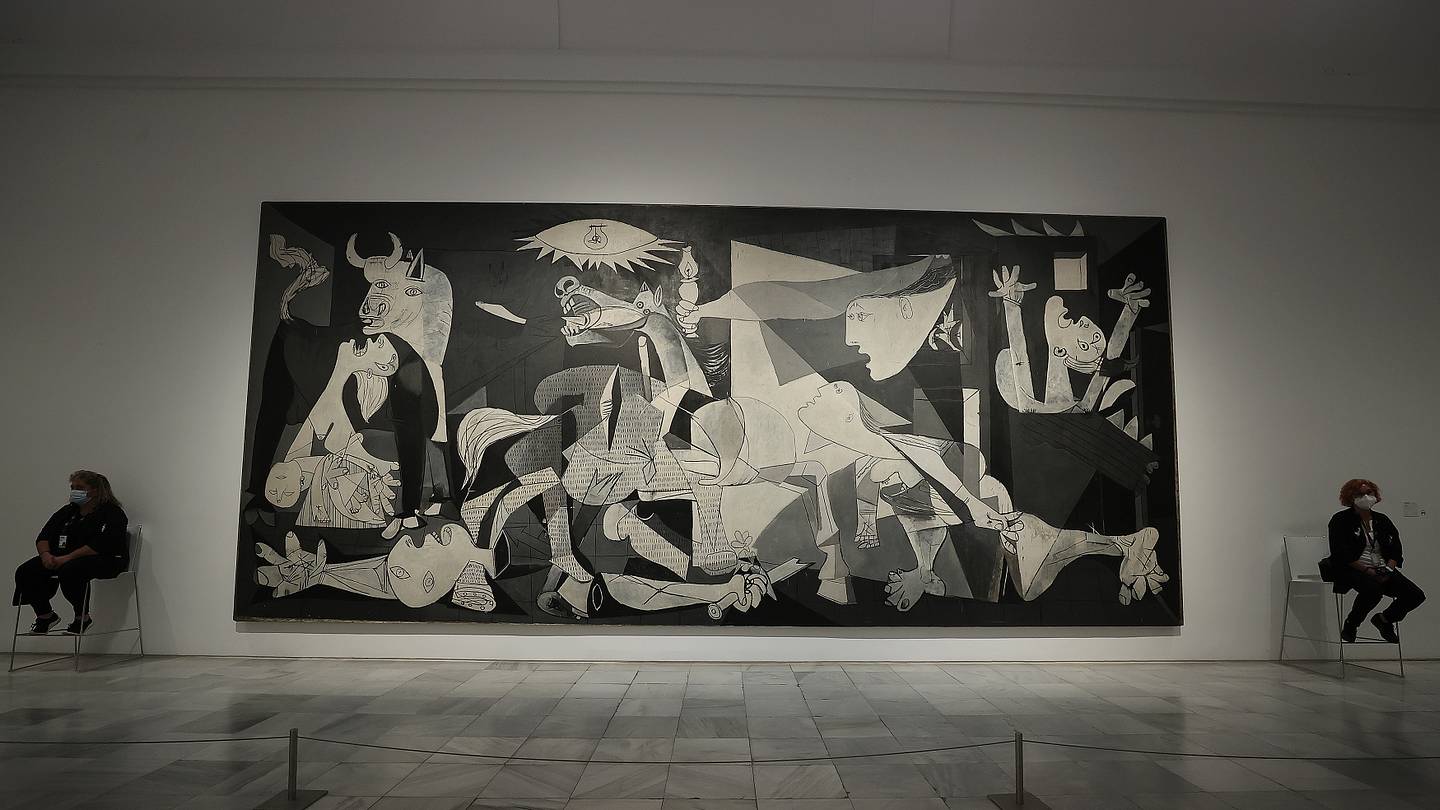
You already know Pablo Picasso âs 1937 painting Guernica is among his most revered works, but do you know how and why he created the anti-war masterpiece?
As the 1937 Worldâs Fair approached, members of Spainâs democratic government wanted the Spanish Pavilion at Parisâs International Exposition of Art and Technology in Modern Life to feature a mural that would expose the atrocities of Generalissimo Francisco Franco and his allies. Naturally, the organizers set their sights on one of Spainâs most celebrated painters, Pablo Picasso, who had gained recognition in the 1910s with his works of Cubism , and approached him with the commission in January. Picasso was persuaded by poet Juan Larrea to take the job, but he made no progress beyond some sketches for months.
Picasso didnât have to go far to work on a piece for the Paris exhibitionâhe had lived in France since 1904. An expat who was vocal about his opposition to the militant autocracy of his home country, Picasso crafted the tribute to the war-torn Spanish city without having set foot within the nationâs borders since 1934. He would never return to Spain.
Picassoâs painting depicts the bombing of the Basque town of Guernica on April 26, 1937. Francoâs German and Italian allies in the Spanish Civil War carpet-bombed Guernica, a stronghold of Republican opposition to Francoâs Nationalists, for hours. Casualty estimates vary from 200 to more than 1000 deaths. Franco and his allies blamed the horrific attack on Republican forces.
According to painter José Maria Ucelay, Picasso found out about the bombing from Larrea, who suggested the artist make it the subject of his mural. Picasso was reportedly hesitant, but he was deeply moved by a report of the event written by South African-British journalist George Steer for The Times . The article, titled, â The Tragedy of Guernica : A Town Destroyed in Air Attack: Eye-Witnessâs Account,â was attributed in print to âOur Special Correspondent.â
Picasso was so affected by Steerâs Guernica story that he scrapped his previous plans for the mural and began work on what would be one of his earliest politically inclined pieces on May 1, 1937, approximately three weeks before the scheduled launch of the exhibit. Guernica was not completed until early June, about two weeks after the pavilion opened.
The fact that Picasso cranked out what is now one of the most famous paintings of the 20th century in just over a month is impressive enough in its own right, but Guernica wasnât even the sole focus of the artistâs attention during this time. In January 1937, Picasso had published a set of etching and aquatint prints, collectively titled The Dream and Lie of Franco . On June 7 of the same year, around the same time that he delivered Guernica to the Spanish pavilion, Picasso added a second batch of images to The Dream and Lie of Franco .
Unsurprisingly, Guernica evolved between its inception and completion. One of Picassoâs earliest drafts of the painting included a raised fist, a universal symbol of solidarity in resistance to oppression. Opponents of Francoâs reign had embraced the emblem during the Spanish Civil War. Picasso depicted the fist empty-handed at first, then grasping a sheaf of grain. Ultimately, he deleted the image altogether.
Guernica is one of historyâs most recognizable grayscale paintings, but at one point during the pieceâs development, Picasso entertained the idea of adding color to the project. He included a red teardrop coming from a crying womanâs eye, as well as swatches of colored wallpaper. None of these elements made the final cut.
Scholars have long tried to decode the significance of the symbols in Guernica , especially the horse and bull figures. Naturally, Picasso was asked to explain the use of these creatures in his painting. He never offered anything more revelatory than âThis bull is a bull and this horse is a horse,â adding , âIf you give a meaning to certain things in my paintings it may be very true, but it is not my idea to give this meaning. What ideas and conclusions you have got I obtained too, but instinctively, unconsciously. I make the painting for the painting. I paint the objects for what they are.â
Today, Guernica is celebrated as one of Picassoâs premiere achievementsâbut it wasnât always hailed as a masterpiece. When it debuted at the Exposition, an architect reviewing the murals wrote that it âsaw only the backs of visitors, for they were repelled by it.â Among the pieceâs leading detractors were American critic Clement Greenbergâwho called Guernica âjerkyâ and âcompressed,â adding that it âaims at the epic and falls into the declamatoryââas well as French painter and communist Edouard Pignon, French philosopher Paul Nizan (who called Guernica a product of the bourgeoisie mentality), and American abstract painter Walter Darby Bannard. Ucelay, who claimed his friend Larrea gave Picasso the idea, said of Guernica, âas a work of art, itâs one of the poorest things produced in the world ... itâs just 7 x 3 meters of pornography.â According to Gijs van Hensbergen in Guernica: The Biography of a Twentieth-Century Icon , not even the Basque government liked the painting, which apparently greatly upset Picasso. The work barely appeared in the papers at the time.
Due to Guernica âs antifascist message and Adolf Hitlerâs personal aversions to modern art, the official German guidebook for Parisâs International Exposition recommended against visiting Picassoâs piece, which it called âa hodgepodge of body parts that any four-year-old could have painted.â
Apparently misunderstanding the nature of Guernica and its antiwar stance, the German military used the painting in an ill-conceived recruiting advertisement in 1990. The ad featured the slogan, âHostile images of the enemy are the fathers of war.â
Almost as famous for his biting wit as he was for his artistic prowess, Picasso once treated a German Gestapo officer to a sharp rejoinder in reference to the paintingâs depiction of the atrocities of fascism and war. When asked by an officer about a photo of the painting, âDid you do that?â Picasso is said to have replied, âNo, you did.â
After the Paris Expo, Guernica went on a tour of Europe before heading to the United States, where it was part of an effort to drum up funds for Spanish refugees and toured several major U.S. cities under the oversight of New York Cityâs Museum of Modern Art. According to the website of the Museo Nacional Centro de Arte Reina SofÃa (where the painting now resides), Picasso asked that Guernica stay at MoMA when World War II broke out, and later âextended the loan of the painting to MoMA for an indefinite period, until such time that democracy had been restored in Spain.â The painting didnât go back to Spain until 1981.
At one point its long residency at MoMA, Guernica suffered an act of politically charged defacement. In 1974, Tony Shafrazi âwho would later become a respected art dealerâspray-painted the words KILL ALL LIES over the painting. When he was apprehended by museum security, Shafrazi famously shouted , âCall the curator. I am an artist.â
From 1985 to 2009, the United Nations adorned the entrance of its Security Council with a tapestry reproduction of Guernica . In February 2003, then-Secretary of State Colin Powell delivered a televised speech on site at the UN, testifying in favor of Americaâs imminent declaration of war on Iraq. A large blue curtain covered the tapestry during Powellâs speech.
Conflicting reports attributed the decision to obscure Guernica to journalists thinking the violent imagery would be unpleasant for viewers of the broadcast, as well as to the Bush Administration deeming the display of such a recognizable antiwar painting inappropriate for the backdrop of Powellâs promotion of military action.
Loading recommendations... Please wait while we load personalized content recommendations