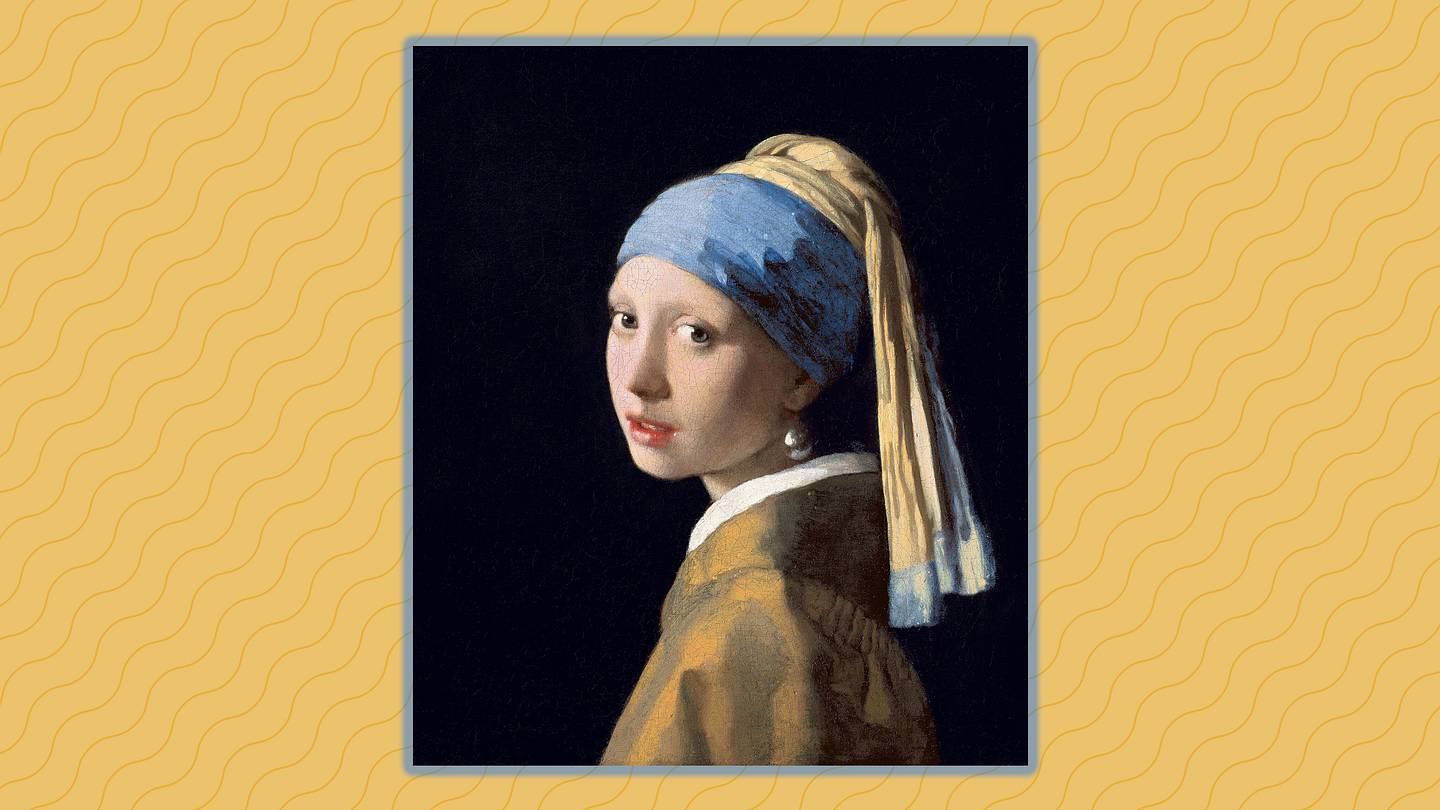
Despite a deceptively simple composition, Johannes Vermeerâs Girl with a Pearl Earring has captured the imaginations of art fans around the world. While little is certain about the girl behind the mesmerizing gaze, hereâs what we do know about this now-legendary work.
Scholars estimate the painting was completed in 1665. The painting is an example of a type of work called a tronie. Popular in the Dutch Golden Age, tronies were paintings that focused on the face of a subject with an added element of fantasy or an exaggeration of expression that differentiates them from portraits.
All titled Girl with a Pearl Earring , these works began with American novelist Tracy Chevalier, whose 1999 historical novel spun a love story between Vermeer and a servant girl-turned-muse. In 2004, Chevalierâs book was adapted into an acclaimed feature film starring Scarlett Johansson and Colin Firth. In 2008, a stage adaptation was produced in London.
Though the story is compelling, it may not have been grounded in historical fact. Historian J.M. Montias suggested that a household servant modeled for Vermeerâs Milkmaid , but not this particular masterpiece.
Journalists Jean-Louis Vaudoyer and Lawrence Weschler have proposed that the lovely girl who sat for Vermeer was in fact the eldest of his 10 children, Maria. She might also be the model in Art of Painting and Young Woman with a Pearl Necklace.
In 2014, Benjamin Binstock , a specialist on Renaissance and Baroque art, declared that Maria may have been more than just Girl with a Pearl Earringâ s modelâshe might also have been the artist who created one-fifth of the works attributed to her father. These âmisfitâ Vermeers that might be Mariaâs include Mistress and Maid , Girl With a Red Hat , and Woman with a Lute . Notably, each includes a model wearing a familiar earring.
The painting has alternately been called Girl in a Turban , Head of Girl in a Turban , The Young Girl with Turban , and Head of a Young Girl.
Girl with a Pearl Earring is referred to as the â Mona Lisa of the North,â partially because of the girlâs curious expression, and in part because of the mystery surrounding the piece itself.
When Girl with a Pearl Earring toured the U.S. in 2013, the painting drew a massive turnout at each of its stops. An assistant curator at San Franciscoâs de Young museum summed up its appeal: âSometimes the questions are more intriguing because they canât be answered. Who was she? What was she thinking? What was her relationship with Vermeer? The mystery is part of its popularity.â
Some scholars have theorized that Girl with a Pearl Earring may be a portrait of chastity, making a connection between the painting and the teachings of early-17th century bishop St. Francis De Sales, who wrote, âBoth now and in the past it has been customary for women to hang pearls from their ears; as Pliny observed, they gain pleasure from the sensation of the swinging pearls touching them. But I know that Godâs friend, Isaac, sent earrings to chaste Rebecca as a first token of his love. This leads me to think that this jewel has a spiritual meaning, namely that the first part of the body that a man wants, and which a woman must loyally protect, is the ear; no word or sound should enter it other than the sweet sound of chaste words, which are the oriental pearls of the gospel.â
A similar teardrop pearl can be spotted in A Woman Writing A Letter, with Her Maid . Vermeer often reused props, models, and settings in his works.
Vincent Icke, a professor of theoretical astronomy, wrote in New Scientist in December 2014 to say that the light reflecting off the earring in Girl with a Pearl Earring wouldnât match that of an actual pearl.
The size of the pearl also makes it suspect. Curators Quentin Buvelot and Ariane van Suchtelen explained, âLarge pearls were rare and ended up in the hands of the richest people on the planet. In the 17th century, cheaper glass pearls, usually from Venice, were also quite common. They were made from glass, which was lacquered to give it a matte finish. Maybe the girl is wearing such a handcrafted âpearl.ââ
Modern restorations of the painting found trace amounts of indigo and weld , a glaze mixture that would have made the dark underpainting glisten. Over the centuries, pigments in the glaze have broken down to change the paintingâs color.
Made from crushed lapis lazuli, a deep blue semi-precious stone, the ultramarine paint Vermeer used on the turban was one only a few of his contemporaries dared employ. Despite ultramarineâs high price tag, Vermeer used the color even in times of financial hardship, possibly thanks to funding from his generous patron Pieter van Ruijven.
The Dutch masterâs distinctive style avoids hard lines, relying on shades of light and shadow alone. Art historians have long debated whether mechanical means may have helped Vermeer render light in this way. A camera obscura is the most popular theory, and the 2013 documentary Tim's Vermeer followed an experiment that seemed to prove that Vermeerâs method included a careful arrangement of mirrors to guide his hand in painting.
More than 200 years passed between the paintingâs creation and its sale at auction in 1881. There, Dutch army officer and art collector Arnoldus Andries des Tombe purchased Girl with a Pearl Earring for just two guilders with a 30-cent premium. Upon Des Tombeâs death in the winter of 1902, the work was willed to the Mauritshuis in The Hague, where it can still be seen today.
In recent years, the Mauritshuis loaned Girl with a Pearl Earring to Japan, Italy, and the United States for exhibitions. But once the tours concluded in July 2014, the museum announced the painting would stay in its collection within its walls indefinitely. Girl with a Pearl Earring joined the ranks of Botticelliâs Birth of Venus and Picassoâs Guernica and Les Demoiselles d'Avignon as works that will stay safe in their home museums for all time.
Discover the Stories Behind More Famous Paintings:
A version of this story was published in 2015; it has been updated for 2025.