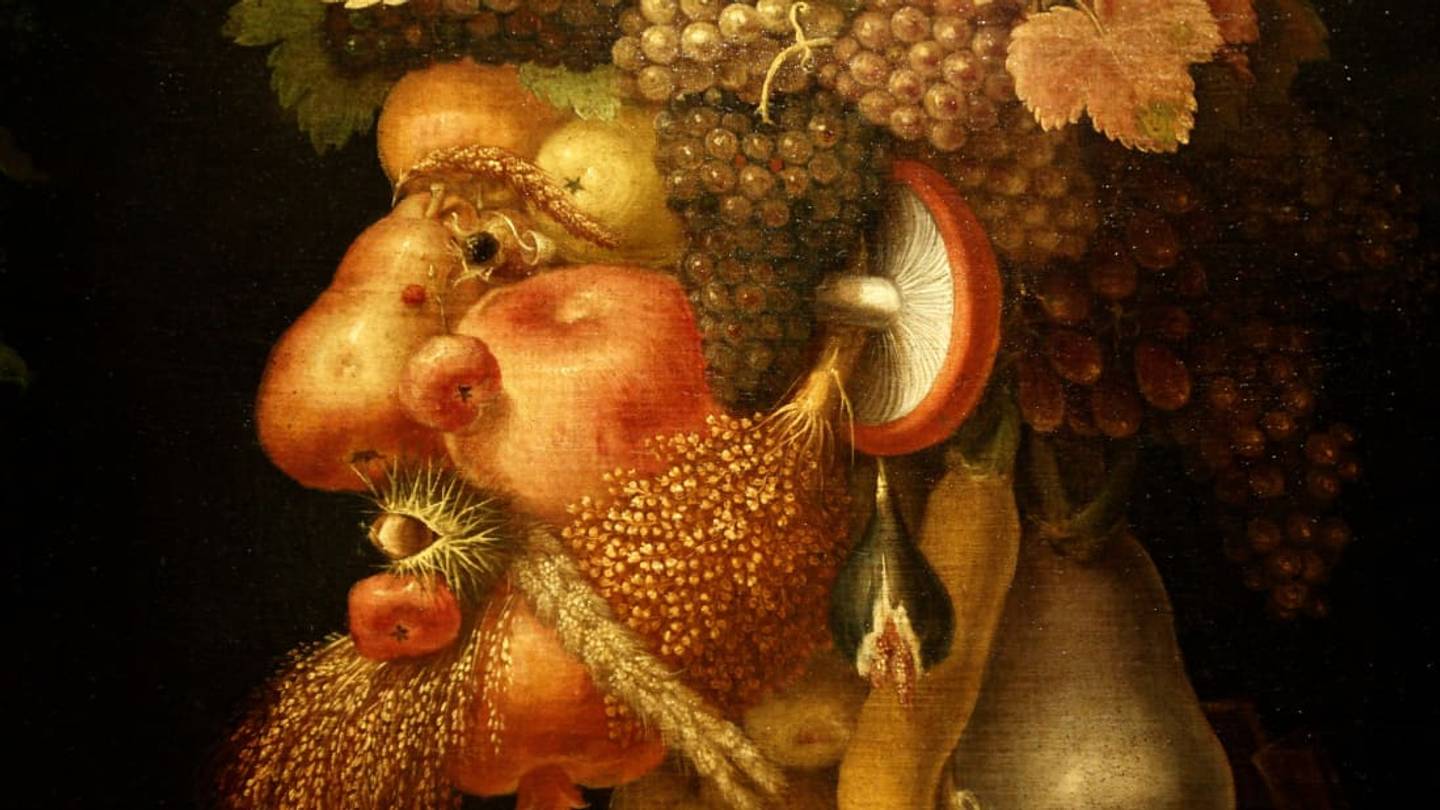
Sixteenth century artist Giuseppe Arcimboldo followed in the footsteps of his father, Biagio, training in stained glass and fresco painting. But it was this imaginative Italian's curious take on portraitsâcomposite heads composed of flowers, fruits, and other inanimate objectsâthat have defined his legacy.Â
Holy Roman Emperor Ferdinand I first claimed the artist and his talents for Vienna in 1562, where Arcimboldo served as court painter for his son and successor Maximilian II. He continued with the Habsburgs under Maximilian II, and when Rudolf II moved the court from Vienna to Prague, Arcimboldo made the move as well. In honor of Maximilian II, Arcimboldo began experimenting, creating The Four Seasons , a series of portraits in profile that constructed faces out of blooming blossoms, swollen gourds, withered roots, and ripe grain. He also dabbled in interior design and costume creations.
Arcimboldo didn't just personify the seasons with produce. His most famous piece is a portrait of Holy Roman Emperor Rudolf II, who was so fond of having his likeness captured that he contracted several acclaimed artists to do so. Germany's Hans von Aachen presented the emperor with a frilly collar and a generous chin. Dutch sculptor Adrian de Vries made a regal bust of the monarch. Arcimboldo reimagined him as Vertumnus , the Roman God of plant life, building his cheeks with peaches, his neck with chives, and his hair with grapes and grain.Â
built a scholar out of books. The Waiter constructed a server out of barrels and bottles. The Jurist utilized books, a chicken carcass, and a bit of fish.Â
These words translate loosely to whimsical  and games . The artist's mosaic masterpieces were intended to be playful, entertaining, and humorous, sometimes at others' expense.Â
Art historians suspect The Jurist is a depiction of Maximilian's duplicitous vice-chancellor, Ulrich Zasius . Rather than a face radiant with natural beauty and color, the two-faced Zasius is constructed out of mud-colored plucked poultry and fecund fish, clearly illustrating Arcimboldo's disdain.Â
Arcimboldoâs works may be playful, but he and his contemporaries were fascinated by the beauty and grotesqueness that could be found in the natural world. His dedicated depiction of flora and fauna down to the finest details [ PDF ] is a major part of why the composite heads are still marveled over centuries later.Â
offered surreal portraits made up of elegant animals and man made luxury. Air soars with a flock of birds, including an owl, a rooster, a parrot, and a peacock. Water contains a string of pearls and a coral crown laced around a swimming collection of fish, sharks, squids, sea turtles, and crustaceans. Earth is made of mammals, like elephants, deer, predatory cats, a wild boar, rabbit, and lamb. Lastly, Fire shimmers with sparks, flames, candles, lamps, and glistening gold and guns. Â
Though royal portraits of the time were intended to idealize their subjects, the Habsburgs adored Arcimboldo's inventive renderings. Their court was known for welcoming intellectuals and encouraging avant-garde art. Arcimboldo happily worked for the family for more than 25 years and would continue to accept commissions even after moving back to his homeland in Milan.
has an ear of corn for an ear. Winter includes a cloak with a monogrammed M, referring to Emperor Maximilian, who owned a similar garment. Similarly, Fire includes fire strikers, a symbol of the Habsburg family, and Earth 's lion skin cloak harkens to Hercules, whom the royal clan liked to claim as an ancestor.Â
In 1571, Maximilian requested Arcimboldo arrange a festival in which the royals and their fancy friends might masquerade as the elements and the seasons. It's likely the painter's costuming ambitions were given a fantastic outlet at the festivities , where life reflected art (which reflected life): Maximilian attended as Arcimboldo's Winter. Â
These paintings took playfulness to a new level by flipping them literally on their heads. At first glance, these pieces look like a still life, a bowl of vegetables for instance. But linger on their legumes and you'll see a face, upside down, with a bowl as a hat . Â Â
Art historians believed that Arcimboldo painted these pieces as still life, right side up. Then he would turn them to see their faces and adjust accordingly. X-rays of the canvases reveal that this required some shifting of positions and repainting of fruit to get everything just right.Â
For decades, Arcimboldo was well known and admired among the elite. Yet following his death in 1593, these incredible paintings were largely forgotten for centuries.
Artists like Salvador Dali have cited the groundbreaking painter's composite heads as a major source of inspiration. But it was Museum of Modern Art director Alfred H. Barr's inclusion of his works in the 1930s exhibition Fantastic Art, Dada, Surrealism that re-introduced the world to Arcimboldo's originality and influence [ PDF ]. Retroactively, art historians dubbed the Renaissance Mannerist the grandfather of Surrealism .  Â
Arcimboldoâs works once again enjoy widespread acclaim. Vertumnus is on display in Sweden's Skokloster Castle along with The Librarian (although testing in 2011 [ PDF ] revealed that The Librarian might be a later copy ). Spring belongs to Madrid's Museo de la Real Academia de San Fernando, while the Louvre in Paris displays Autumn and Winter . Kunsthistorisches Museum of Vienna boasts Summer , Fire and Water . Italy's Museo Civico holds The Vegetable Bowl (also known as The Gardener ), and Four Seasons in One Head calls the National Gallery of Art in Washington D.C. home.
Loading recommendations... Please wait while we load personalized content recommendations