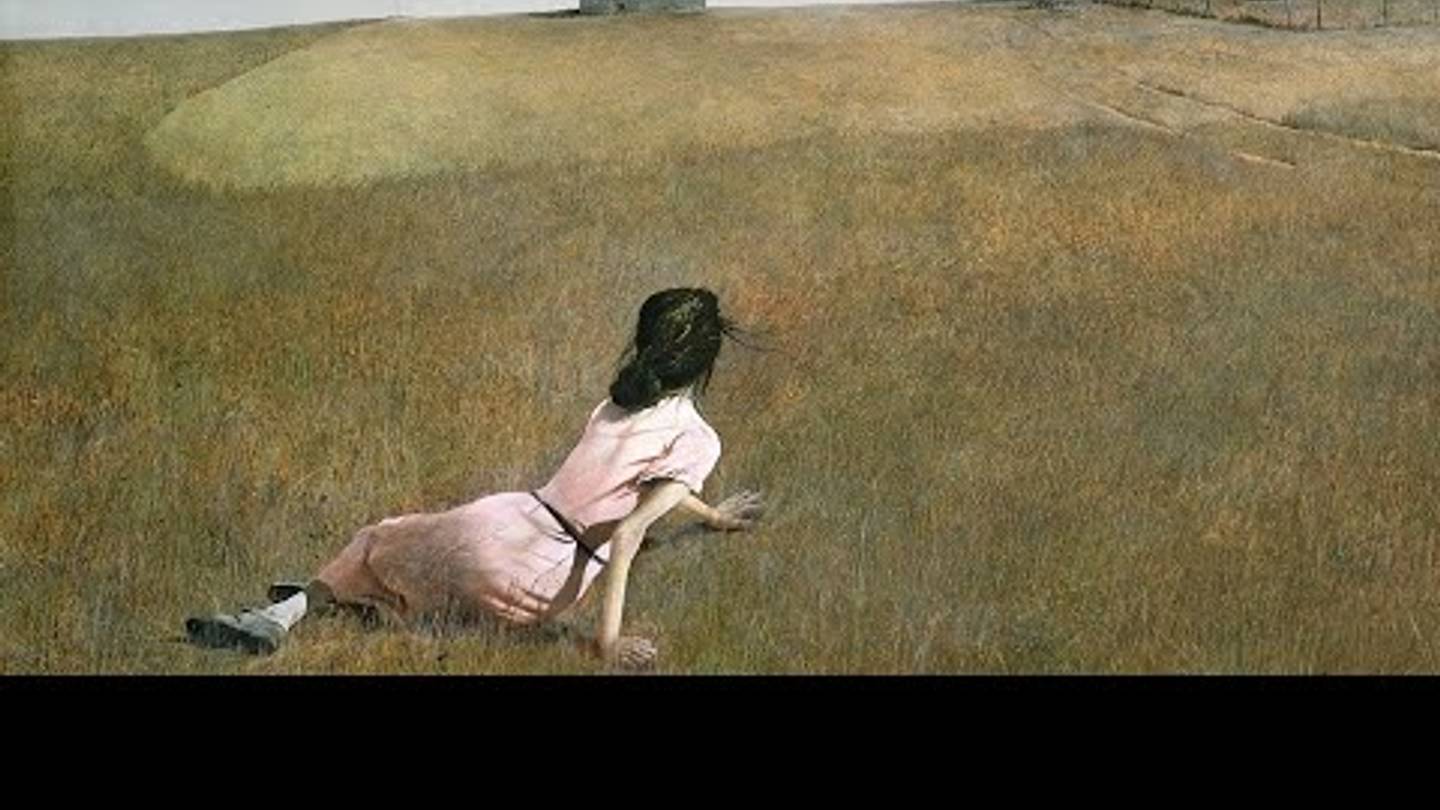
Who is the woman in Andrew Wyeth's striking painting Christinaâs World, and why is she sprawled in a field, looking longingly toward a far-off farmhouse? For decades, these questions have drawn in viewers, but the true story behind Christinaâs World makes the 1948 painting even more intriguing.Â
The 31-year-old Wyeth modeled the paintingâs frail-looking brunette after his neighbor in South Cushing, Maine. Anna Christina Olson had a degenerative muscular disorder that prevented her from walking. Rather than use a wheelchair, Olson crawled around her home and the surrounding grounds, as seen in Christinaâs World .Â
The neighbors first met in 1939 when Wyeth was 22 and courting 17-year-old Betsy James, who would later become his wife and muse. It was James who introduced to Wyeth to the 45-year-old Olson, kicking off a friendship that would last the rest of their lives. The sight of Olson picking blueberries while crawling through her fields âlike a crab on a New England shore,â as Wyeth put it , inspired the artist to paint Christinaâs World .Â
âThe challenge to me was to do justice to her extraordinary conquest of a life which most people would consider hopeless,â he wrote . âIf in some small way I have been able in paint to make the viewer sense that her world may be limited physically but by no means spiritually, then I have achieved what I set out to do.âÂ
Wyeth was obsessed with getting the position of Christinaâs arms and hands just right. Today these sketches are tenderly preserved for posterity.Â
The concept, title, pink dress, and slim limbs were modeled after Olson, who was in her mid-fifties when Christinaâs World was created. But Wyeth asked his then 26-year-old wife to sit in as a model for the head and torso.Â
It was Olsonâs home, which she shared with her younger brother, Alvaro. But Wyeth took some liberties with its architecture and surrounding landscape to better emphasize the scope of Christinaâs journey.
She was a recurring muse and model for Wyeth, captured in paintings like Miss Olson , Christina Olson , and Anna Christina .Â
Wyethâs timing wasnât quite right: He finished the painting in 1948, which meant the magical realism masterpiece debuted at a time when Abstract Expressionism was all the rage.
Though it would become his best-known work and an icon of American art, Christinaâs World was described by Wyeth as âa complete flat tireâ when he sent it off to the Macbeth Gallery for a show in 1948. He also wondered if the painting would have been improved if he âpainted just that field and have you sense Christina without her being there.â
Alfred Barr, the founding director of the Museum of Modern Art, was so taken with Wyethâs work that he purchased Christinaâs World for $1800. While the early critical reception was lukewarm to cool, the paintingâs prestigious position at MoMA fortified its reputation. Today, itâs one of the museumâs most admired exhibits.Â
One person who didnât object to Wyethâs depiction of Olson was Olson. In her book about her husbandâs work, Betsy James Wyeth recounts a conversation she had with Olson about the piece, writing: â Christinaâs World remained her favorite to the end. Once when I asked her why, she simply smiled and said, âYou know pink is my favorite color.â âBut youâre wearing a flowered pink dress in Miss Olson and holding a kitten. I thought you loved kittens.â âCourse I do, but in the other one Andy put me where he knew I wanted to be. Now that I canât be there anymore, all I do is think of that picture and Iâm there.â â
Shortly after the painting made its MoMA debut, one overzealous admirer walked into Olsonâs home, came upon her resting, and asked for an autograph. Twenty years later, her death made national news, reviving interest in Christina's World .Â
Though undeniably iconic, the painting has long been undermined by vocal detractors. Art historians have often snubbed Wyethâs works in their surveys, and some naysayers have attacked the painting's widespread popularity, deriding it as âa mandatory dorm room poster.â Meanwhile, critics have chastised Wyethâs attention on Olsonâs infirmity and characterized it as exploitation . Still others claim there was no art in rendering realistic imagery in paint.Â
Following Wyethâs death in 2009 at the age of 91, the museum allowed Christinaâs World to visit its creatorâs birthplace, Chadds Ford, Pennsylvania, where the Brandywine River Museum exhibited the polarizing painting for two days in memorial before returning it to New York. Â
Down the hill from the Olson house lies a cemetery, where Andrew Wyethâs grave can be found in the family plot of Alvaro and Anna Christina Olson. Wyethâs tombstone faces up toward the house at an angle that closely resembles that of Christinaâs World . According to his surviving family, it was his final wish âto be with Christina.â
The Olson house has won comparisons to Monetâs garden at Giverny because of the plethora of paintings and sketches it inspired. In the 30 years from their first meeting to Christinaâs death, Wyeth created over 300 works at the Olson house, thanks to the Olsons allowing him to use their home as his studio. Explaining the house's hold on him, Wyeth said, âIn the portraits of that house, the windows are eyes or pieces of the soul almost. To me, each window is a different part of Christinaâs life.â For all this, the Olson House was designated a National Historic Landmark in 2011.Â
Discover More Facts About Famous Artworks:
A version of this story ran in 2015; it has been updated for 2024.