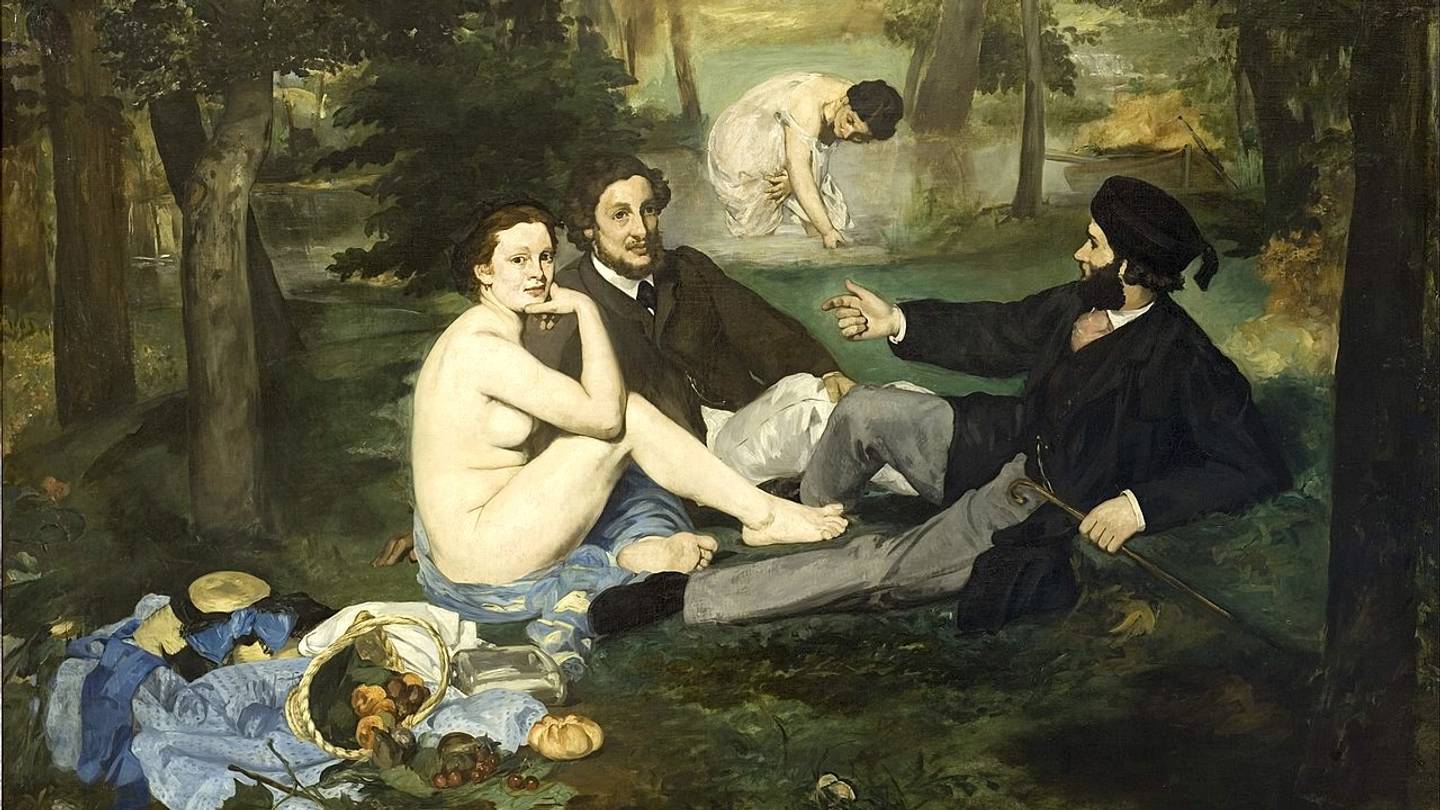
Today, Le Déjeuner sur lâHerbe ( Luncheon on the Grass ) is regarded as 19th-century French artist Ãdouard Manet âs greatest triumph. But when its unusual take on classical nudes was first displayed, it shocked Paris and earned the artist a reputation as a reckless rebel. Â
In 1515, High Renaissance artist Raphael designed Judgment of Paris . The intricately detailed print originated as a drawing by Raphael that master engraver and collaborator Marcantonio Raimondi then recreated as a print. More than 300 years later, Manet would pull inspiration and poses from the engravingâs lower right corner, where two men lounge with a woman whose elbow is perched on her raised knee.Â
The mix of clothed men and casually nude women caused quite a stir among prim and proper Parisians, but it was not a new subject. Circa 1510, The Pastoral Concert   (which used to be attributed to Giorgione  but is now believed to be an early Titian ) famously depicted a similar scene.
Manet tried to get Le Déjeuner sur lâHerbe accepted by the Paris Salon in 1863, but the casual nudity of the women among clothed men in a public space so stunned the salonâs jury that they refused to display it. Manet was not alone in being snubbed that yearâthe stingy salon rejected so many artists that Napoleon III created an exhibition for this outcast art. Manetâs misfit masterpiece debuted at the Salon des Refusés (Salon of the Refused) with its fellow failed salon applicants.Â
The secondary salon boasted names familiar to any art fanâincluding Pisarro, Whistler , and Cézanne âbut Manetâs painting was the showâs standout. With its unconventional representation of nudity, the artwork became the subversive salonâs main attraction. But that doesnât mean it was beloved. Itâs said men scooted their wives past the piece as quickly as possible, then doubled back to gawk. Mostly, Manetâs work drew laughter and sneers . The public was scandalized.
Nude women had long been the subjects of classical art, but those were generally women meant to represent the divine. In Manetâs Le Déjeuner sur lâHerbe , the women were not goddesses. Oneâs shed clothes are clearly visible in the lower left corner. And the men in contemporary garb underline Manetâs intention of showing modern, real people in place of fantastical or classical figures. These details made the painting feel sexual in a way classical works did not. This collision led critics and the public to call the piece obscene. More alarming to detractors was that the woman in the foreground even dares to confrontationally look out at the viewer with no shame over her nakedness.
The title Manet gave the painting for its debut supplies a milder explanation for the female nudity. But once the piece sparked controversy over its perceived sexual nature, the artist jokingly nicknamed it â la partie carrée ,â which translates loosely to âthe foursome.â As has happened with many great works of art, the paintingâs name shifted along with the publicâs perception of it.Â
One is his brother, Eugène Manet. The other is his future brother-in-law, Dutch sculptor Ferdinand Leenhoff .Â
Victorine-Louise Meurent was a popular muse of Parisian painters of the late 1800s. Her nickname, la crevette (the shrimp), referred to not only her petite size, but also her rosy complexion and red hair. She sat for Manet on a number of occasions, appearing Le Déjeuner sur lâHerbe and eight other pieces.
The pair collaborated on another nude that showed the redhead lounging on a white, unmade bed, once more calmly staring down her audience. Again breaking from classical tradition, this character seemed less like a fictional figure or a goddess and more like a flesh and blood woman owning her sexuality. When it debuted in 1865, it would mark one of the first times a female nude had been presented in such a realistic manner. As with Le Déjeuner sur lâHerbe , the art worled was stunned by Olympia.
Because of the intimacy projected in these pieces, many assumed that Manet and Meurent were lovers, but that was just the tip of the gossip iceberg. A popular reading of both Le Déjeuner sur lâHerbe and Olympia is that the brazenly naked women in the paintings must be prostitutes . This fueled rumors that Meurent herself was a sex worker who had met an alcohol-fueled end at a young age. In truth, she lived to be 83 and earned acclaim outside of Manetâs canvases.Â
In 1876, Meurent submitted a self-portrait to the Salon, and it was accepted while Manetâs submission was denied. She would again show at this prestigious venue in 1879, 1885, and 1904. In 1903, she was inducted into the esteemed Sociétés des Artistes Français. Sadly, only one of her paintings has survived. Dating from the 1880s, Palm Sunday can be found on display at Musée Municipal dâArt et dâHistoire de Colombes, northwest of Paris. Â
It measures 81.9 inches by 104.5 inches, or nearly 7 feet by 9 feet.
In the lower left corner, the wrinkled polka-dot dress topped by a toppled basket of fruit, a shiny flask, and a jaunty bonnet prove Manet possessed great mastery of technique. This traditional talent makes his less conventional choices in Le Déjeuner sur lâHerbe all the more compelling. Â
In 1882, the Parisian painter offered his last great work, A Bar at the Folies-Bergère . Like Le Déjeuner sur lâHerbe and Olympia , the painting featured a redhead whose eyes face out toward the viewer. The model in the painting was presumed, again, to be a real-life prostitute. Notably, Manet played with perspective here in a way that demanded audiences give the piece a second look, just as his challenging âfoursomeâ did decades before.Â
With Le Déjeuner sur lâHerbe, Manet not only condensed cultural elements from different times, but also painted his backdrop with no dimension, as if it were a theatrical flat. Manet likewise rejected rules of proportion, most noticeably in the size of the woman bathing in the background in comparison to the men before her. At the time, these choices rejected conventional perspectives and caused a lot of head-scratching from Parisâs arts community. But over time, Manetâs rebellious style proved foundational to artists like James Tissot, Claude Monet , Paul Cézanne, and Pablo Picasso .
Want to see the piece for yourself? Today, Le Déjeuner sur lâHerbe is proudly displayed in Parisâs Musée dâOrsay.
A version of this story was published in 2016; it has been updated for 2023.
Loading recommendations... Please wait while we load personalized content recommendations