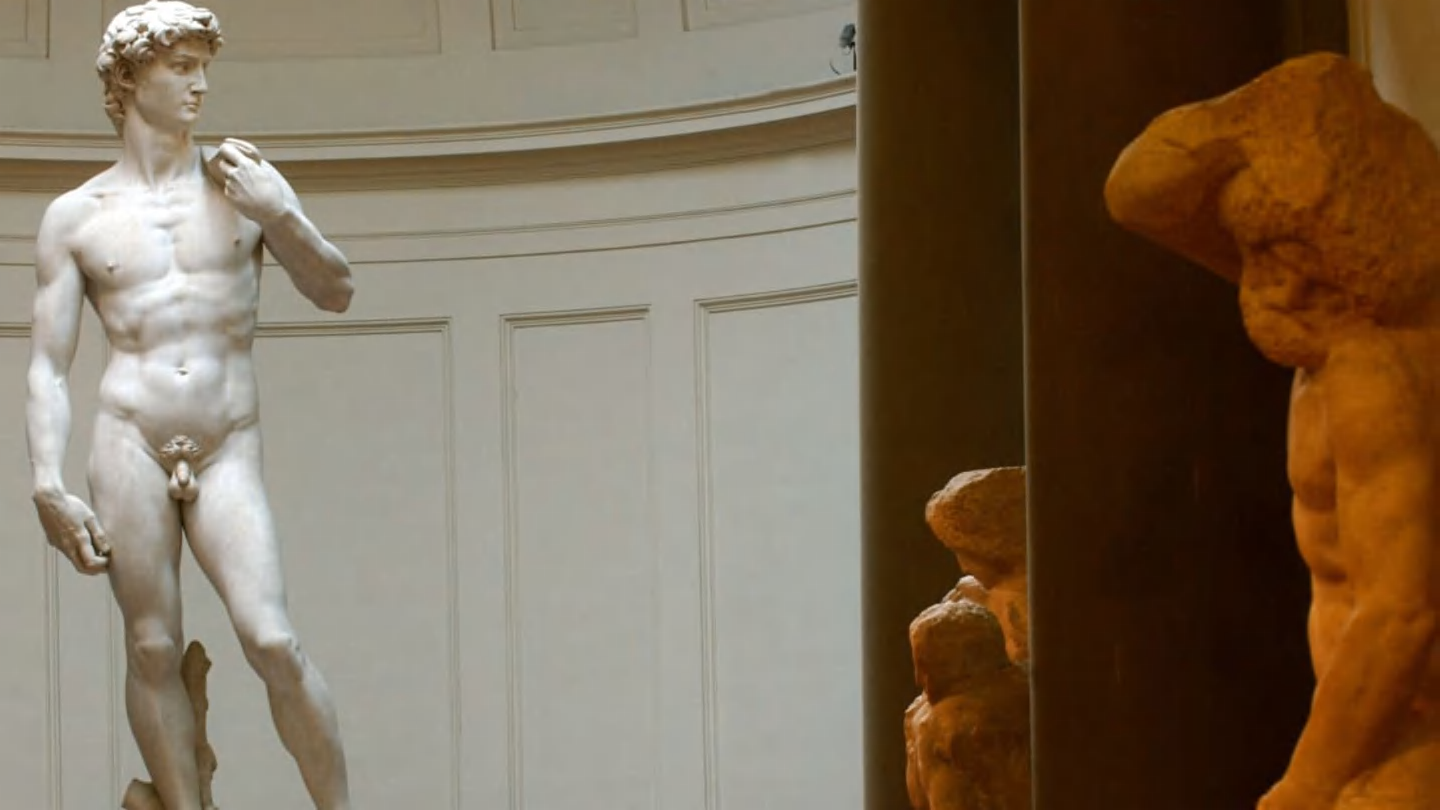
Few statues are as enduring and iconic as Michelangelo's David (which found itself in the news in 2023 when a Florida school principal was asked to resign after the statue was shown to sixth grade students at her school, allegedly leading to parent complaints). But while much of the world could sketch this majestic masterpiece from memory, few know the quirks and curiosities that went into its creation.
At first glance, Michelangeloâs famed naked man may not scream âbiblical hero.â But if you look closely, David cradles a sling over his left shoulder and clutches a rock in his right hand. These items and the statueâs name identify the subject as the David who faced down the vicious giant Goliath. Michelangelo broke from convention by not including the future kingâs fearsome foe in his sculpture. In a further departure from tradition, art historians believe David depicts the legendary underdog before the great battle , in part because of the anxiety thatâs clearly etched on his face. Â
David stands 17 feet tall , nearly three times the size of the average man.Â
It's too big to fit perfectly with the rest of his body. This asymmetry is believed to be Michelangelo's clever nod to Davidâs nickname, manu fortis , meaning âstrong of hand.âÂ
You can tell heâs a southpaw from where the slingshot liesâbut strangely, his body position is more suggestive of a righty.
The block of marble that became one of historyâs most famous masterpieces proves the old cliché about one manâs trash being anotherâs treasure. Michelangelo created David from a piece of marble that had been twice discarded by other sculptors . Agostino di Duccio gave up on a project using the block, after which it sat untouched for 10 years. At that point, Antonio Rossellino took a crack at the block but decided it was too much of a pain to work with. When Michelangelo finally got his hands on it, the marble had been waiting for 40 years for someone who was up to its challenge.Â
In 1501, the city government of Florence commissioned Michelangelo to create the piece as part of a series of statues meant to adorn the roofline of Florenceâs cathedral dome. But upon its completion, Michelangeloâs patrons were so overwhelmed by Davidâ s beauty that they decided to scrap that plan and place it where it could be appreciated up close. In 2010, a Florence art project showed David as it was intended, perching a replica high on the Cathedralâs exterior, as well as in every other spot that had been suggested upon its completion in 1504.Â
Sixteenth-century Italian painter and architect Giorgio Vasari wrote of David , âWhoever has seen this work need not trouble to see any other work executed in sculpture, either in our own or in other times.â With praise like that, how could the people of Florence tuck the statue up high on a rooftop? Â
Five years before David's debut, Michelangeloâs Pietà made him famous. But it was his David that defined the 29-year-old High Renaissance artist as a master sculptor. Four years later , in 1508, he would begin work on his greatest painting achievement in the Sistine Chapel .Â
Specifically, itâs believed that Michelangelo based David âs pose on depictions of Hercules, a hero with deep ties to the city of Florence who had even appeared on the Florentine seal for centuries. By creating such a glorious statue in the Roman tradition, Michelangelo helped ensure the work was instantly embraced by the people of Florence.Â
After much debate, David was placed outside Florenceâs government offices in the Palazzo Della Signoria, creating a strong connection in the publicâs mind. In 1494, the powerful Medici family was exiled from Florence, and as such, this new republic was under constant threat from both the returning Medicis (who regained power in 1512) and the surrounding states, making Florence feel like the biblical David. Itâs said the statue's wary gaze was knowingly pointed toward Rome.Â
These political overtones led to the statue being attacked twice in its early days. Protesters pelted it with stones the year it debuted, and, in 1527, an anti-Medici riot resulted in its left arm being broken into three pieces. Â
On September 14, 1991, Italian artist Piero Cannata snuck a small hammer into the statueâs home at the Galleria dellâAccademia in Florence. He approached the towering statue and promptly smashed off the second toe on his left foot. The museumâs visitors leapt into action, converging on David âs attacker, preventing him from doing any further damage and subduing him until the police arrived. When asked why heâd do such a thing, Cannata claimed that a model for the Renaissance artist Paolo Veronese, who was a rough contemporary of Michelangelo, had asked him to do it.Â
Since David is one of the worldâs most popular pieces of art, there are reproductions of it on t-shirts, mouse pads, and just about any medium you can imagine. But even full-fledged replicas existâand Florence has two of them.
While the real David sits in a museum, a full-sized copy stands in its original place in front of the Palazzo Vecchio , and a bronzed replica towers over the city from its perch on Piazzale Michelangelo.Â
Fans of The Simpsons will recall a plot where the locals of Springfield demand that David put on some pants. While this request was used as a comical extreme of censorship, it mirrored actual events in the nude statueâs past.Â
In 1857, the Grand Duke of Tuscany surprised Englandâs Queen Victoria with a replica of Michelangeloâs David. Itâs said the prim royal was so scandalized by the pieceâs nudity that a detachable plaster cast fig leaf was created to preserve the modesty of this marble man and protect the gentlewomen who might visit him at the modern day Victoria and Albert Museum in London.Â
Over 8 million visitors a year tromp through the Galleria dellâAccademia to take in the sight of David . Unfortunately, studies show that all this foot traffic creates vibrations that amount to little, near-constant earthquakes that are tearing at the marble and through recent restoration work of the centuries-old piece. Â
David has stood on display at Florenceâs Galleria dellâAccademia since 1873. But as more and more tourists were drawn to take in the wonder of David , the Italian government began to itch to define the national treasureâs ownership. In 2010, the Italian government began a campaign to solidify its claim to the iconic marble statue.Â
Does the statue belong to the city of Florence or the nation of Italy? A court case burrowed through the history of both in an attempt to figure it out. Florenceâs then-mayor Matteo Renzi declared , âThis is a new instance of David versus Goliath. Our battle is for a different way of managing the cultural patrimony of a city that lives off culture.â The dispute doesnât seem to have been resolved.
A version of this story ran in 2015; it has been updated for 2023.
Loading recommendations... Please wait while we load personalized content recommendations