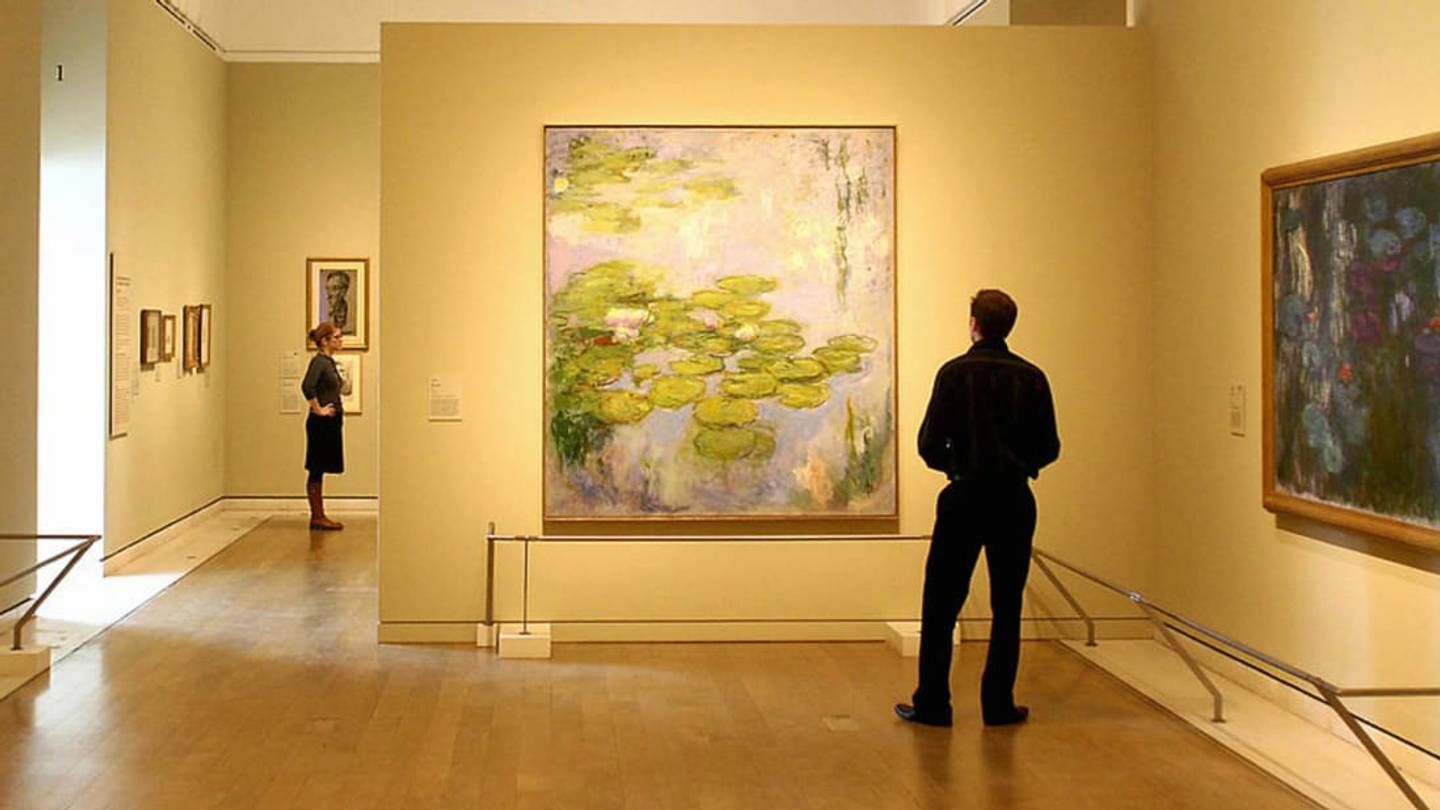
Claude Monet's Water Lilies is beloved around the world, a radiant example of French Impressionism and the glory found in nature. But their path from the artistâs yard to museum walls was one paved with obstacles, perfectionismâand a lot of gardening.Â
The title Water Lilies refers to a series by the father of French Impressionism. Over the course of the series, Monet painted countless individual water lilies in around 250 oil paintings.Â
The beauty of the French village Giverny struck Monet when he passed through on a train. The artist was so inspired that in 1883 he rented a house there; it would become his home in 1890 (which was as soon as he could afford it).
When he wasn't painting the plant life on his property, Monet was remodeling its landscapes and gardens to better inspire his work, or as he put it, âIâm good for nothing except painting and gardening.â Basically, he created the perfect place for quiet reflection, then spent the rest of his days capturing it in oils.
The ambitious painter imported water lilies for his Giverny garden from Egypt and South America, which drew the ire of local authorities . The council demanded he uproot the plants before they poisoned the area's water, but (thankfully) Monet ignored them.Â
Commenting on what he called his "water landscapes," Monet once declared , "One instant, one aspect of nature contains it all." No wonder he dedicated much of the last 30 years of his life to painting them, forging on even when cataracts began threatening his vision in 1912. Â
In 1899, Monet completed setting the scene of his pond, despite his neighbors' protests. Across it, he built a quaint Japanese-style bridge. Monet was apparently quite pleased with how it turned out, as he painted the structure 17 times that very year, with each painting reflecting changes in lighting and weather conditions.
Critics called the Impressionist paintings messy and suggested the works were less about a creative vision than Monet's blurred vision. As his eyes were failing, critics  sneered at Monet's color palette and his argument that his depiction of flora, water, and light was an artistic choice, spurring an initial disdain of Monet's now-revered series.Â
For 20 years following Monet's death in 1926, his Water Lilies series was largely ignored, with many paintings sitting forgotten in his Giverny studio. But in the 1950s, curators rediscovered Monet, crediting him with paving the path to the fashionable art of the day. By 1955, the Museum of Modern Art had purchased their first Monet from this series, and it quickly became one of the famed museumâs most popular holdings.Â
In 1958, a terrible fire broke out at MoMA. While many paintings were saved, including Georges-Pierre Seurat's A Sunday on La Grande Jatte â1884 , six were damaged. Two of these were recently acquired Water Lilies works . The loss devastated art lovers, who sent sympathy letters to the museum. In 1959 MoMA got another crack at owning part of the series when it acquired a massive Water Lilies triptych .
Sometimes the painter's passion turned violent. In 1908, Monet destroyed 15 of his Water Lilies right before they were to be exhibited at the Durand-Ruel gallery in Paris. Apparently, the artist was so unhappy with the paintings that he decided to ruin them rather than have the work go on public display.Â
Considering how cruel his critics were, it's little wonder that in his later years Monet became incredibly selective about which paintings he would sign and attempt to sell. Just four paintings made the grade in 1919. One of those lucky few can now be seen on display at The Metropolitan Museum of Art in New York. Â Â
Over the years spent painting his beloved aquatic garden, Monet moved closer and closer to it. The edges of his pond moved to the edges of the frame and beyond until he had cut out the horizon altogether. From there, his works became a study of water and how it reflects light and the world above it.
In 1918, Monet completed a series of 12 paintings he intended to be laid out side by side in a specially made oval room where viewers could step in and be given (as he put it) "the illusion of an endless whole, of water without horizon or bank." Monet said these were meant to create "the refuge of a peaceful meditation in the center of a flowering aquarium." Today three such panels (displayed as a triptych) are on display at New York's Museum of Modern Art , measuring more than 6 feet by 41 feet.
On the day after Armistice Day in 1918, Monet promised his homeland a âmonument to peaceâ in the form of massive water lily paintings.
In exchange for some of Monet's grandest works, the nation honored him by displaying these at the Musée de l'Orangerie , just as he dreamed. Two specially made oval exhibition rooms were built to house his massive Water Lilies , creating a complete panorama of the painter's favorite views.Â
As MoMA curator Ann Temkin explains :
In this way, Monet's unique vision forever changed Impressionism, creating a new form that inspired untold artists and admirers.
Loading recommendations... Please wait while we load personalized content recommendations