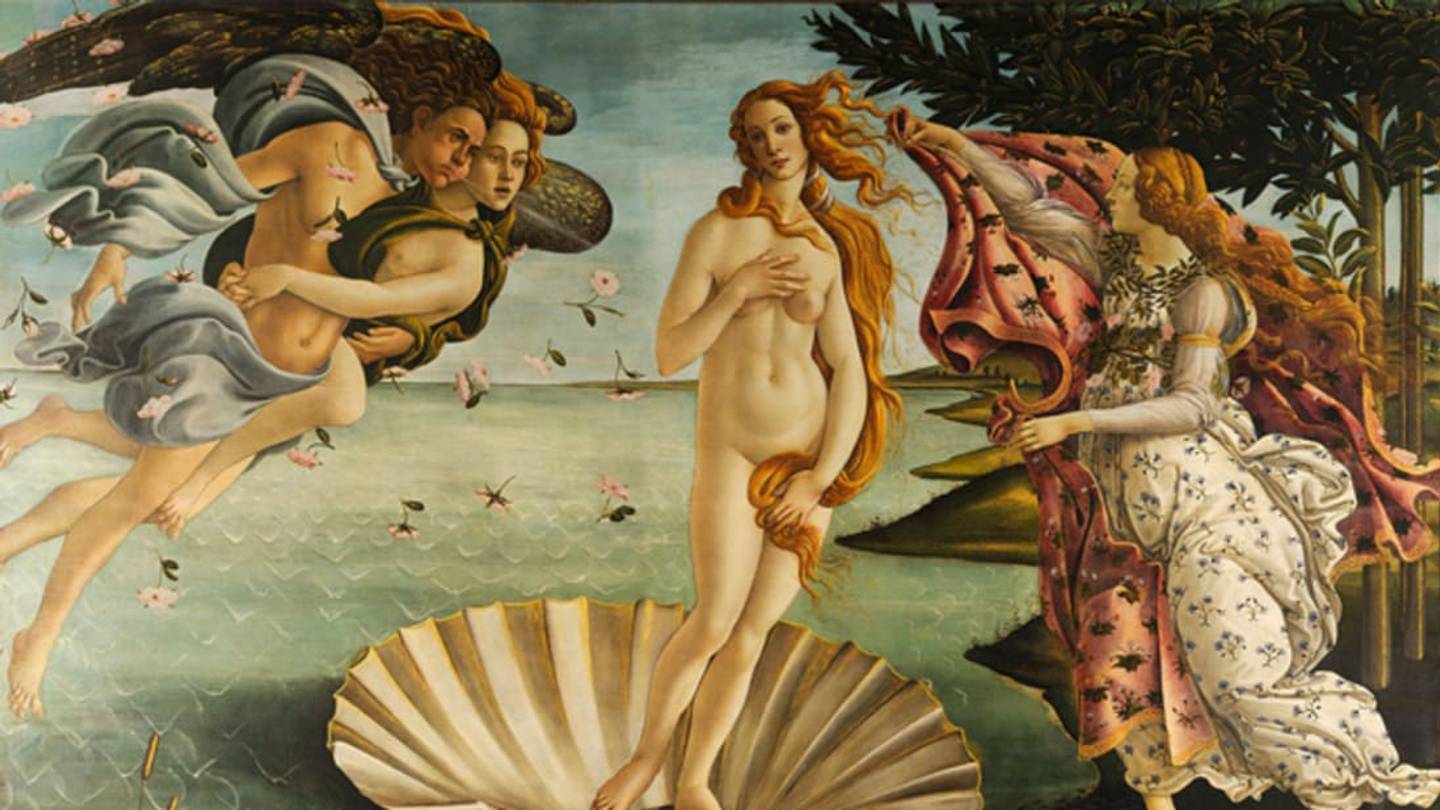
Completed in 1486, Sandro Botticelli's The Birth of Venus has become one of the most heralded works of the Renaissance and a lasting symbol of feminine grace and beauty. Yet there's much more to this radiant work than you might imagine.Â
Venus, goddess of love, stands demurely on the seashell, being blown to shore by Zephyr, god of the west wind. There, one of the Horae, goddesses of the seasons, is ready with a cape to clothe the newborn deity.
The fourth figure carried by Zephyr is meant to be either an Aura (nymphs of the wind) or Chloris, a nymph associated with spring and blossoming flowers like those flowing through the picture.
And no, we don't mean what lies beneath Venus's carefully placed palm. The shell she stands on may be meant to represent female genitalia, which creates a birthing scene that reflects Venus's oceanic origins while connecting symbolically to human birth. Â Â
Christian inspiration was dominant in the art of the Middle Ages, so nudity was rarely portrayed. However, the emergence of humanism led to a renewed interest in the myths of ancient Rome, and with it a resurrection of nudes.Â
During this period of the Early Renaissance , painting on wood panels was all the rage. But canvas' popularity was on the rise, especially in humid regions where wood tended to warp. Since canvas was cheaper than wood, its perceived status was a bit lower, so it was reserved for works that weren't intended for grand public displays. The painting stands out as the first work on canvas in Tuscany .Â
The piece's nudity takes on a more sensual tone when you know it was meant to hang over a marital bed. This locale and its daring depiction contributed to The Birth of Venus being hidden from public viewing for roughly 50 years.Â
Though it was completed four years before its sister, La Primavera can be viewed as a sort of sequel to The Birth of Venus . While the latter depicts Venus's arrival in a world on the verge of blooming, the former shows the world in bloom around the now-clothed maternal figure. It's said the pair of paintings were meant to communicate how " love triumphs over brutality ."
The Birth of Venus measures in at roughly 6 feet by 9 feet. It's been called the "first large-scale canvas created in Renaissance Florence."Â
On February 7, 1497, Dominican friar Girolamo Savonarola spurred Christians in Florence to erect a seven-story pyre to burn art and other baubles like mirrors, jewelry, dice and art that were believed to promote sin . Some historical reports claim Botticelli was one of these followers and threw a few of his own works on the fire. But The Birth of Venus was spared the flames.
Over centuries, coats of varnish meant to preserve the painting began to turn opaque, shielding some of Botticelli's details and colors from view. But a careful restoration that concluded in 1987 gently stripped this layer away, revealing the soft and pearly colors the artist intended.
The goddessâ modest gesture to cover her private parts is one favored in the Capitoline Venus , a category of statue that specifically depicts Venus in just this way. The first of these works is believed to date back to the second or third century BCE.
Some sources believe The Birth of Venus was modeled after the long lost Venus Anadyomene , a painting by ancient Greek artist Apelles that was once described by Roman author Pliny the Elder and known only through his written account.Â
Other theories posit that this particular scene was based on a Homeric hymn published in Florence by Demetrios Chalkokondyles that reads:
But the more common interpretation is that its inspiration was a poem by Botticelli's friend Agnolo Poliziano .
During Botticelliâs life, his works were often overshadowed by the artists of the High Renaissance. But 400 years after The Birth of Venus â completion, Botticellis began making their way into the collections of European museums. His pieces finally won esteem in the 19th century, with The Birth of Venus becoming his most revered work.
Beyond being a beloved example of Renaissance art, the painting has also become a marker by which other erasâ beauty norms are measured. Her pose has been co-opted by various modern models . And as recently as 2014, The Birth of Venus has been used as a tool to criticize modern beauty standards.Â
Not the painting, mind you. He wanted to lie eternally by its earthly inspiration, Simonetta Cattaneo de VespuccI. Called the most beautiful woman in Florence as well as the most beautiful woman of the Renaissance, Simonetta was the muse who inspired several of Botticelliâs works, including The Birth of Venus and La Primavera . When he died in 1510, Botticelli was put to rest near this married noblewoman, for whom it is speculated he harbored unrequited love.
Loading recommendations... Please wait while we load personalized content recommendations