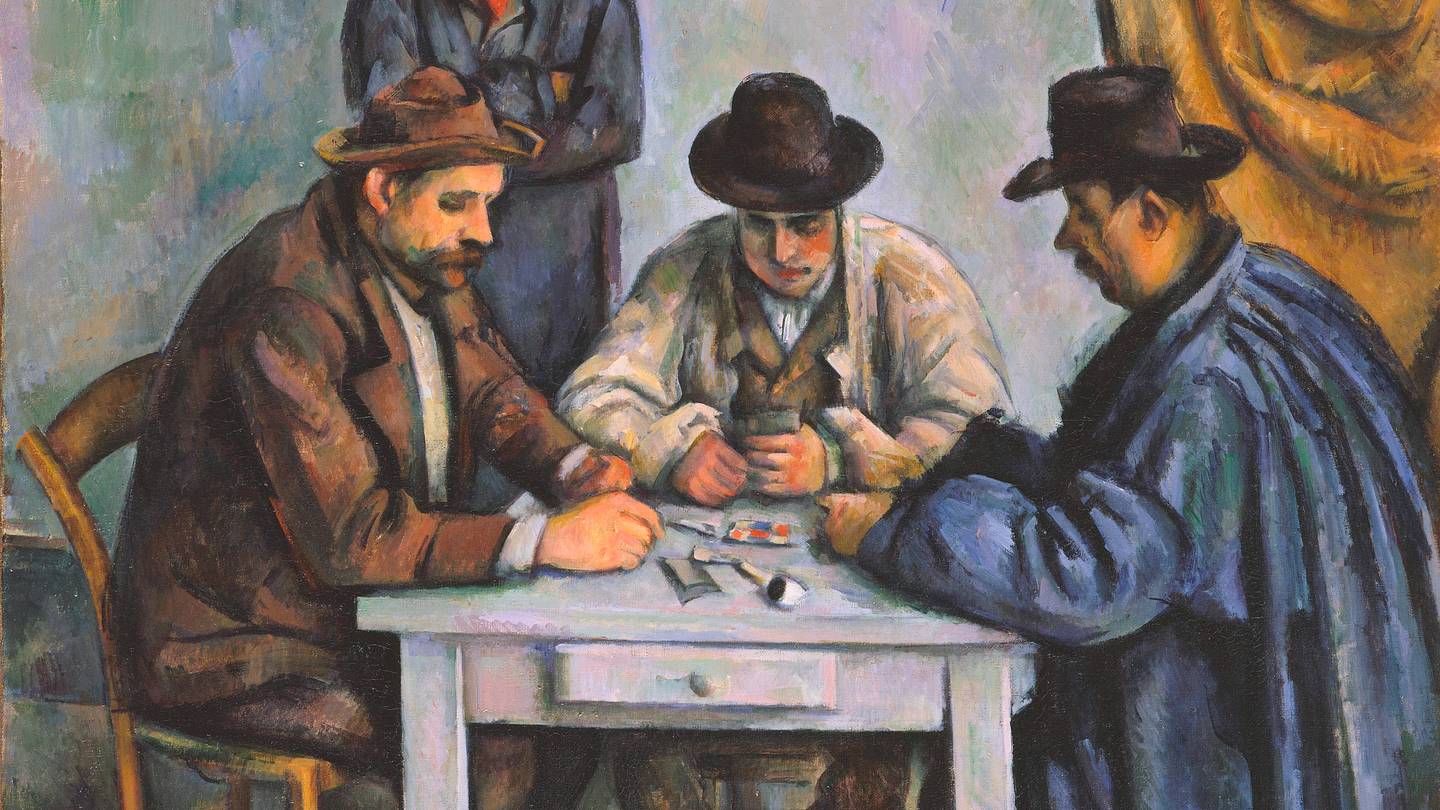
French master Paul Cézanneâs works have been credited with bridging the gap between 19th century Impressionism and 20th century Cubism. But his finest accomplishment might well be The Card Players , which continues to fascinate art lovers and set records.
Created between 1890 and 1895, this quintet of oil paintings is considered a cornerstone of Cézanneâs âfinal period,â when he created some of his most acclaimed works.Â
The canvases range from roughly 4 1/2 by 6 feet all the way down to just 1 1/2 by 2 feet.
A 17th-century painting by the Le Nain Brothersâalso titled The Card Players â was exhibited in Aix-en-Provence, France, during Cézanneâs time there. Itâs believed that the baroque depiction of men engaged in cards was a powerful muse for the boundary-pushing painter.Â
Art historians have long believed the paintingsâ compositions showed Cézanne had scaled down on figures (from five to two), setting, and canvas size as he progressed through the series. However, the findings of infrared scans of the pieces have called this commonly accepted theory into question. Instead, itâs possible he used the smaller pieces to work his way up to the bigger, more complicated canvases.
The men who posed for the Provencal peasants playing cards were farmhands, some of whom were employed at Cézanneâs estate, Jas de Bouffan . The man smoking the pipe was the gardener, who apparently made 5 francs for serving as a model.
During the five-year span in which he painted The Card Players , Cézanne created a dozen or so sketches and several painted portraits as practice for his series. The same farmhands were called on, sometimes again and again, to sit for these test studies.Â
With so many tests of The Card Players uncovered, itâs been speculated that these sketches and early portraits were made while the models posed in a local café. From there, the practiced painter used these piecesâinstead of the living modelsâas sources for the final paintings. This theory is supported by infrared scans that show a great deal of sketches and repainting within the acclaimed works. As the Metropolitan Museum of Art notes , âThe Metropolitanâs canvas shows how he struggled to assemble these figures around a small table. Note, for example ... the âhaloesâ around the figures seen in the X-radiograph that chart the numerous adjustments on his canvas as he created his now-iconic composition of Card Players .â
None of the five paintings show any money on the table for antes or pots. It has been speculated the quiet nature of the game combined with the lack of gambling could mean these men are enjoying a game similar to gin rummy .Â
Similar scenarios seen in 17th-century Dutch and French art were defined by drama , like drunken buffoons bickering, brawling, and otherwise behaving badly. But Cezanneâs take on card players was true to his style of muted emotion. Instead, his scene is so quiet it has been described as â human still life .â
Though sometimes reunited for shared exhibitions, The Card Players share no common home. One that features four men and a dour-looking boy is a highlight of the Barnes Foundation in Philadelphia. A similar piece that lacks the little boy can be found in New York Cityâs Metropolitan Museum of Art . One of three that portray a pair of card players is on view at the Musée dâOrsay in Paris. Another can be seen at Londonâs Courtauld Institute of Art , while the last is part of a private collection belonging to the royal family of Qatar.Â
As you might imagine, it costs a pretty penny to own art so coveted by prestigious museums. In 2011, Qatarâs royal family paid Greek shipping magnate George Embiricos more than $250 million for the honor of owning the artwork, which is believed to be the last of The Card Players series that Cézanne painted. Gary Tinterow, director of the Museum of Fine Arts, Houston, called it âthe darkest, the most stripped down and essentialâ of the series. The sale set a new record for the highest price ever paid for a work of art. Though it no longer holds the top spot on the list of most expensive paintings ever sold âthat belongs to Salvator Mundi , a work thought to be painted by Leonardo da Vinci that sold for more than $450 million in 2016âitâs still in the top five.
The Card Players on exhibit in Paris was in the hands of bold burglars in August of 1961. It was the most famous of eight Cézanne paintings snatched from a traveling show in his hometown of Aix-en-Provence, France. According to newspaper reports at the time, the paintings were nabbed in between pre-dawn guard shifts (or possibly while the guards napped) at the Pavillon Vendôme, where the works were being housed; one of the thieves reportedly hid in the museum after closing and then let accomplices in through the second floor window. They went out the window and climbed down a gate, leaving just a smudged footprint behind on the windowsill. âThis is as close to a perfect crime as any I ever want to see,â one French detective said . The paintings were later returned after a ransom was paid .
To show the depths of the national sense of loss over the theft of The Card Players , a memorial stamp was issued, creating a colorful marker for a grim event.Â
Cézanneâs Card Players series was one of several notable muses for American painter Cassius Marcellus Coolidgeâs polarizing but popular series of paintings .
A version of this article was originally published in 2015 and has been updated for 2023.
Loading recommendations... Please wait while we load personalized content recommendations