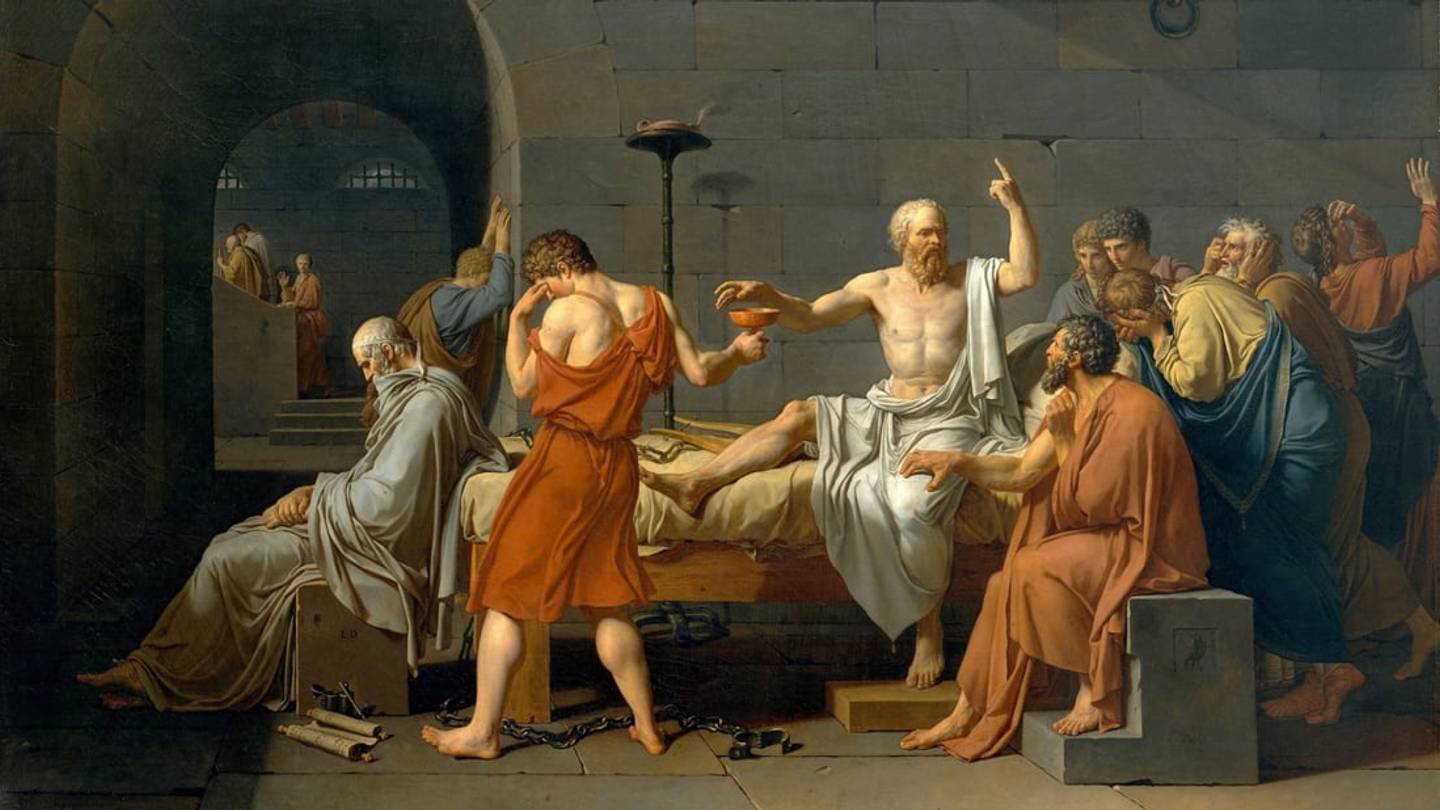
Long before he was regarded as a pioneer of the Neoclassical style, 18th-century French painter Jacques-Louis David was fascinated by history, enamored by ancient art, and determined to use his works to change the world. With The Death of Socrates , he brought politics into painting, shook up the art scene, and won major admirers ahead of the French Revolution.
In 399 BCE, the Athenian courts convicted the philosopher Socrates of impiety, declaring he was corrupting the youth and had failed to worship the city's gods. He was sentenced to execution by hemlock poisoning. His protégé Plato recounted in the Phaedo that Socrates did not run from nor cry over his impending demise. Instead, he treated his execution as his final lesson. Taking the poison before his students, he did so while lecturing about how he believed in the immortality of the soul, and so did not fear death. Nonetheless, his friends and students wept around him.
At the time of his execution, Socrates would have been about 70 years old, and was unlikely to have looked quite so fit. But a beefier body wasn't his only upgrade. Comparing The Death of Socrates to busts of the famed philosopher, it's clear David gave him a makeover with a softer profile and less bulbous nose.
Socrates sits just off center of the painting, reaching for the cup of poison, while giving a pointed speech. At the foot of the bed, turned away from him, is an old man with a beard and white robes. This is David's depiction of Plato, who wasn't actually present at the scene. Notably, he chose to make the Phaedo author look much older than he would have been at the time. Plato was roughly 29 when Socrates died.
David studied the Phaedo and conversed with scholar Father Jean Félicissme Adry , among others. But David did not feel beholden to his research. He made Plato older, Socrates fitter. He excluded some attendees from the scene, yet included both Plato and Apollodorus of Phaleron, a student of Socrates who the philosopher had kicked out for his intense display of grief. Apollodorus is the curly-haired blond who has thrown himself against the pillar inside the arch.
Look past all the weeping students, past the sullen Plato, into the hallway, where a woman in dusty pink robes waves her hand. That's Socrates's wife, seemingly regarded as an afterthought.
"L. David" can be spotted on the gray bench on which a man in a coral robe sits. That is Crito, an agriculturist and companion of Socrates depicted in Plato's works. It's believed this signature placement means David related most to Crito. The writer Victor Moeller has suggested this means the painter saw himself as someone who "clutches at the morals and values that Socrates represents," which is suggested by how Crito clutches at the philosopher's thigh.
The other signature is just his initials, L.D. They can be found on the bench where Plato sits. Art historians believe this is a sort of citation to the source material, nodding to Plato's contribution to this painting via his Phaedo .
A few years ahead of the French Revolution, The Death of Socrates was commissioned by the Trudaine de Montigny brothers , two radical political reformers who were calling for an upheaval of French norms by promoting a free market system. To them, Socrates was a hero who sacrificed himself to his principles rather than accepting banishment and shame. In this painting of stoicism in the face of death, David was creating a clarion call for how the rebels should push toward their goals, not with cowardice and outcry like Socrates's studentsâsave for Plato and Crito!âbut with self-control, honor, and fearlessness.
In his video essay " The Death of Socrates : How To Read A Painting," writer Evan Puschak argues that the painting is meant to be read like an ancient Roman frieze. If perceived through this lens, first the viewer would take in the wailing students, and perhaps wonder why they cry. Then they'd regard Socrates, lecturing and strong. Then, in the direct center of the painting, the cup of poison, hanging heavy with threat and finality. Next is the red-robed student so rattled he can't even look at his teacher in this final moment. Lastly, we'd regard the old man on the bench, Plato, left behind to tell the story that survived his friend and mentor.
Puschak notes that Socrates became famous because of Plato's writings about him and his philosophies. With this in mind, you could regard The Death of Socrates  left to right and see it as essentially being about Plato. In this context, the philosopher is thinking back on that fatal day. Behind him the death of Socrates plays out as memoryâvibrant, beautiful, and bittersweet.
In 1784, David debuted Oath of Horatii , which depicted a Roman legend with vibrant colors of crimson and blue. This palette was panned by critics , who called it "garish." As such, art historians suspect that David chose to subdue his reds in this piece. Notably, the colors grow more vibrant toward the center of the painting, thus drawing our eyes to Socrates and the young man holding the cup of poison.
Outraged by the French monarchy, David became a passionate member of the Jacobin Club, a radical democratic group born during the French Revolution. He used his skills as a painter to benefit their cause whenever possible. As the years went by, David grew bolder, moving away from ancient history as allegory and painting more recent events to engage his audience. In 1793 and 1794, he memorialized French Revolutionaries with The Death of Marat , The Last Moments of Michel Lepeletier , and The Death of Young Bara .
At this time, Rococo was all the rage. This late 18th-century French artistic movement embraced light colors, ornate compositions, curves, whimsy, and luxurious gold tones. In David's painting, the focal point is a man made of angular geometry; those whose spines curve around him are perceived as weak. The colors are more vibrant, the composition detailed but not florid, the subject life and death, not whimsy.
The painting debuted at a Paris salon on August 25, 1787. It's unknown how long its exhibition lasted, but what is known is that Thomas Jefferson was one of its earliest admirers. According to art historian Narim Bender , influential English painter Sir Joshua Reynolds compared it to Michelangelo's Sistine Chapel and Raphael's Stanze rooms. After visiting the salon nine more times to view it, he declared The Death of Socrates "in every sense perfect."
Italian artist Pietro Antonio Martini expressed his admiration over this epic exhibition by creating the breathlessly detailed depiction Exposition au Salon du Louvre en 1787 . The piece captures numerous visitors, walls full of paintings, and The Death of Socrates . You can find it near the center of the painting, in the bottom row. Just below the large portrait of a woman in a gown, it stands out with its gaping archway hovering above a trio of chatting guests.
Though Oath of Horatii was criticized for its color, it's now viewed as the start of the Neoclassical style. But it was the critical reception and popularity of The Death of Socrates that both cemented the style and brought it to the attention of the world. Neoclassicism found inspiration in ancient Greek and Roman art's focus on anatomy and musculature, the stark simplicity of their statues, and the two-dimensional friezes that captured historical events. Essentially, David took these inspirations and gave them new life in relevance with oil paints.
The Metropolitan Museum of Art , which proudly houses The Death of Socrates today, declares it as "arguably the artistâs most perfect statement of the Neoclassical style."
Loading recommendations... Please wait while we load personalized content recommendations