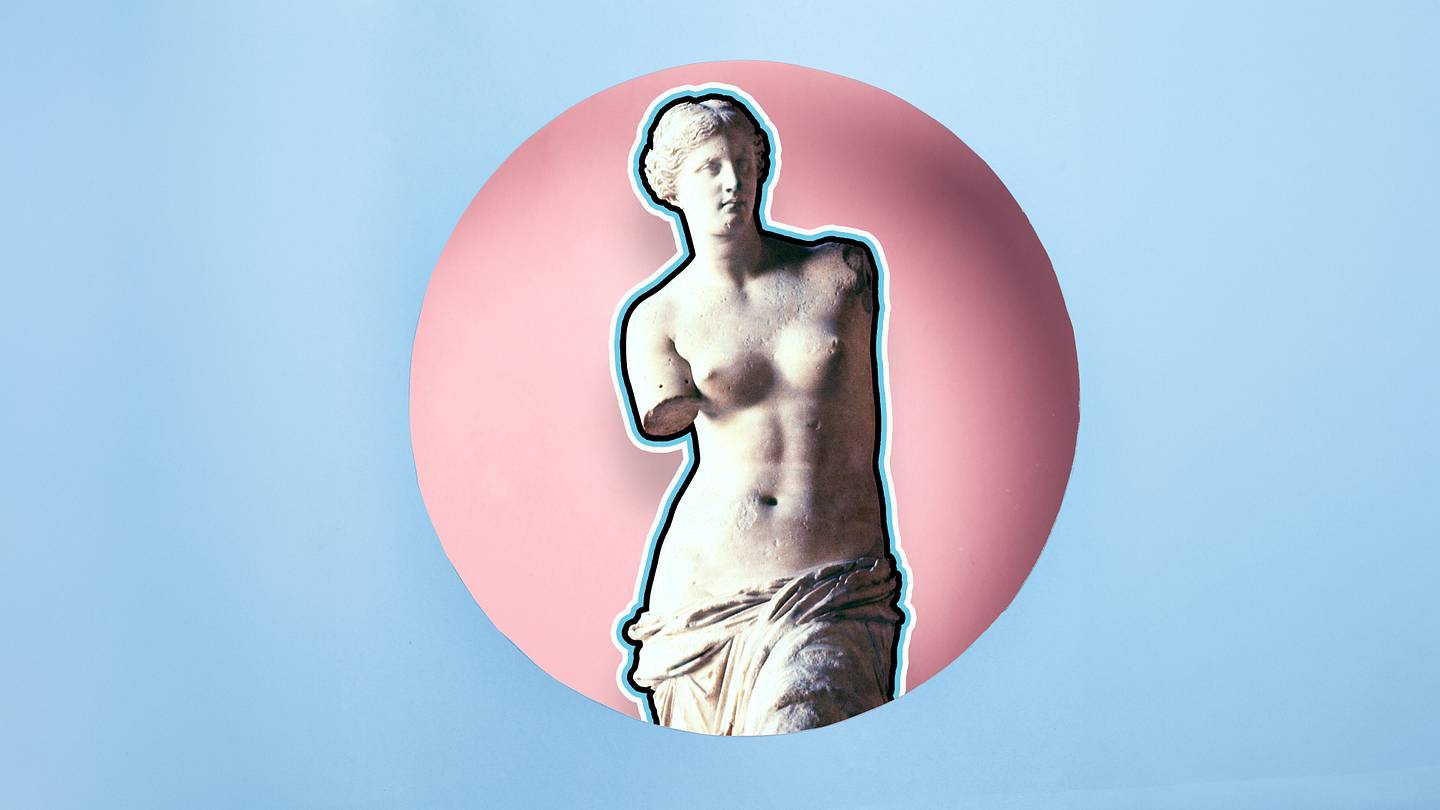
For much of the world, the mystery of the Venus de Milo lies in its missing arms. But thereâs much more to this iconic statue than a couple of absent appendages.
Itâs popularly believed that this Grecian statue depicts the Greek goddess of love and beauty, who was often rendered half-naked. However, the Greeks would have called this deity Aphrodite . Nonetheless, the Roman-inspired name Venus de Milo caught on.
On April 8, 1820, a farmer named Yorgos Kentrotas âwho was plucking stones from a wall to use on his farmâcame across the statue in pieces within the ruins of an ancient city on the island of Milos (formerly known as Melos).
A French naval officer named Olivier Voutier and two sailors were indulging in the then-new pursuit of archaeology among the same ruins in which Kentrotas was looking for rocks. According to Curtis Gregory in his book Disarmed , âVoutier ... noticed that the man had stopped digging for the moment and was staring at something in a niche he had uncovered in the wall. His posture was curious enough that Voutier went to look himself.â
When the officer got closer, he saw that Kentrotas was covering up whatever he had seen with dirt. When Voutier got there, he spied the upper half of a statue. âIts odd shape made it useless as a building block, so the farmer had decided to cover it over,â Curtis wrote. âVoutier gave him a small bribe to dig up the statue instead.â He apparently had to pay Kentrotas a couple more times to unearth all the pieces of the statue.
A sculptor of the Hellenistic period, Alexandros is believed to have carved this masterpiece between 130 and 100 BCE. The inscription on the plinthâthe slab on which the statue restedâthat identified him as Venus de Miloâ s creator disappeared nearly 200 years ago (more on that in a bit).
Some have suggested the sculpture is not Aphrodite/Venus, but Amphitrite , the sea goddess who was particularly adored on Milos. Still others have proposed the statue depicts Victory, or perhaps a sex worker. The statueâs missing arms could have provided context clues: A spear could have meant one thing, a spool of thread another. If she held an appleâas some reports claimâit could mean she was Aphrodite, holding the award given to her by Paris before the Trojan War began. To this day, itâs a matter of passionate debate .
After Kentrotas and Voutier unearthed the spectacular sculpture, they kicked off a chain of events that would eventually lead to the Marquis de Rivière presenting Venus de Milo to Louis XVIII. In turn, the ruler gave the statue to the Louvre , where itâs still on display.
One theory has it that the arms were broken off during a scuffle between French and Turkish troops as the statue was removed from Milos; another theory suggests that as Venus de Milo was being reassembled, the arms were discarded for having a ârougherâ appearance. But âmost scholars today believe the sculptureâs arms already were missing when it was found by Voutier and the farmer,â wrote Elizabeth Nix on History.com.
According to Curtis, Kentrotas found additional fragments as he dug out the statue, including âa marble hand holding an apple, a piece of a badly mutilated arm, and two herms ... quadrangular pillars about three feet high with a carved head at the top.â
Sight unseen, early 19th century art historians decided the newly discovered Venus must have been the work of Greek artist Praxiteles, and publicized the work as such. This attribution would have placed the piece in the Classical period (5th through 4th centuries BCE), which was more respected artistically than the Hellenistic period. To save face and better promote Venus de Milo âeven at the cost of misinforming the publicâthe plinth was removed before it was presented to the king.
During his conquests, Napoleon Bonaparte had plundered one of the finest examples of Greek sculpture, Venus deâ Medici, from Italy. In 1815, the French government returned that beloved sculpture, but in 1820, France embraced the chance to fill the hole its absence left in French culture and national pride, promoting Venus de Milo as being even greater than Venus deâ Medici upon her Louvre debut. The ploy worked, and the piece was met with almost universal praise from artists and critics.
Perhaps the most famous of Venus de Miloâ s detractors, the celebrated Impressionist painter Pierre-Auguste Renoir dismissed this delicate depiction of grace and female beauty as â a big gendarme .â He created his own sculpture of Venus in 1914.
Auguste Rodin, however, was a different story: He wrote an entire essay titled âTo the Venus de Milo â in which he said, âthou, thou art alive, and thy thoughts are the thoughts of a woman, not of some strange, superior being, artificial and imaginary. Thou art made of truth alone, outside of which there is neither strength nor beauty. It is thy sincerity to nature which makes thee all powerful, because nature appeals to all men. Thou art the familiar companion, the woman that each believes he knows, but that no man has ever understood, the wisest not more than the simple. Who understands the trees? Who can comprehend the light?â
By the autumn of 1939, war threatened to descend on Paris, so Venus de Miloâ along with some other priceless pieces, such as Winged Victory of Samothrace and Michelangeloâs Slavesâ were whisked away for safekeeping at various chaÌteaux in the French countryside.
Venus is missing more than just her arms . She was originally draped in jewelry, including an armband, earrings, and a headband. These flourishes are long lost, but in some cases, the holes for fixing them to the piece remain in the marble; in the case of the statueâs earrings, Curtis writes that they were âvaluable enough that robbers broke off her earlobes to get them.â A slight groove in the statueâs neck indicates that it wore a choker.
While itâs easy for todayâs art admirers to think of Greek statues as white, the marble was often painted in the style of polychromy. However, no trace of the original paint scheme remains on Venus de Milo today.
Even with the statueâs slight slouch, Venus de Milo stands at 6 feet, 8 inches tall.
Art historians have noted that Venus de Milo bears a striking resemblance to Aphrodite of Capua , which is a Roman-era copy of a possibly late 4th century BCE bronze Greek original. That would be at least 170 years before Alexandros carved his goddess, leading some to speculate that both statues are actually replicas of an older statue.
The missing arms of Venus de Milo have been so much more than the source of numerous art historian lectures, debates, and essays. Their absence has also been an accidental invitation to the world to imagine how they might be positioned, what they might hold, and whom they would make her. Unexpectedly, the statueâs missing arms are what lend the statue its beauty.
In 2015, The Guardian 's Jonathan Jones explained the pieceâs appeal: âThe Venus de Milo is an accidental surrealist masterpiece. Her lack of arms makes her strange and dreamlike. She is perfect but imperfect, beautiful but brokenâthe body as a ruin. That sense of enigmatic incompleteness has transformed an ancient work of art into a modern one.â
A version of this story ran in 2015; it has been updated for 2023.
Loading recommendations... Please wait while we load personalized content recommendations