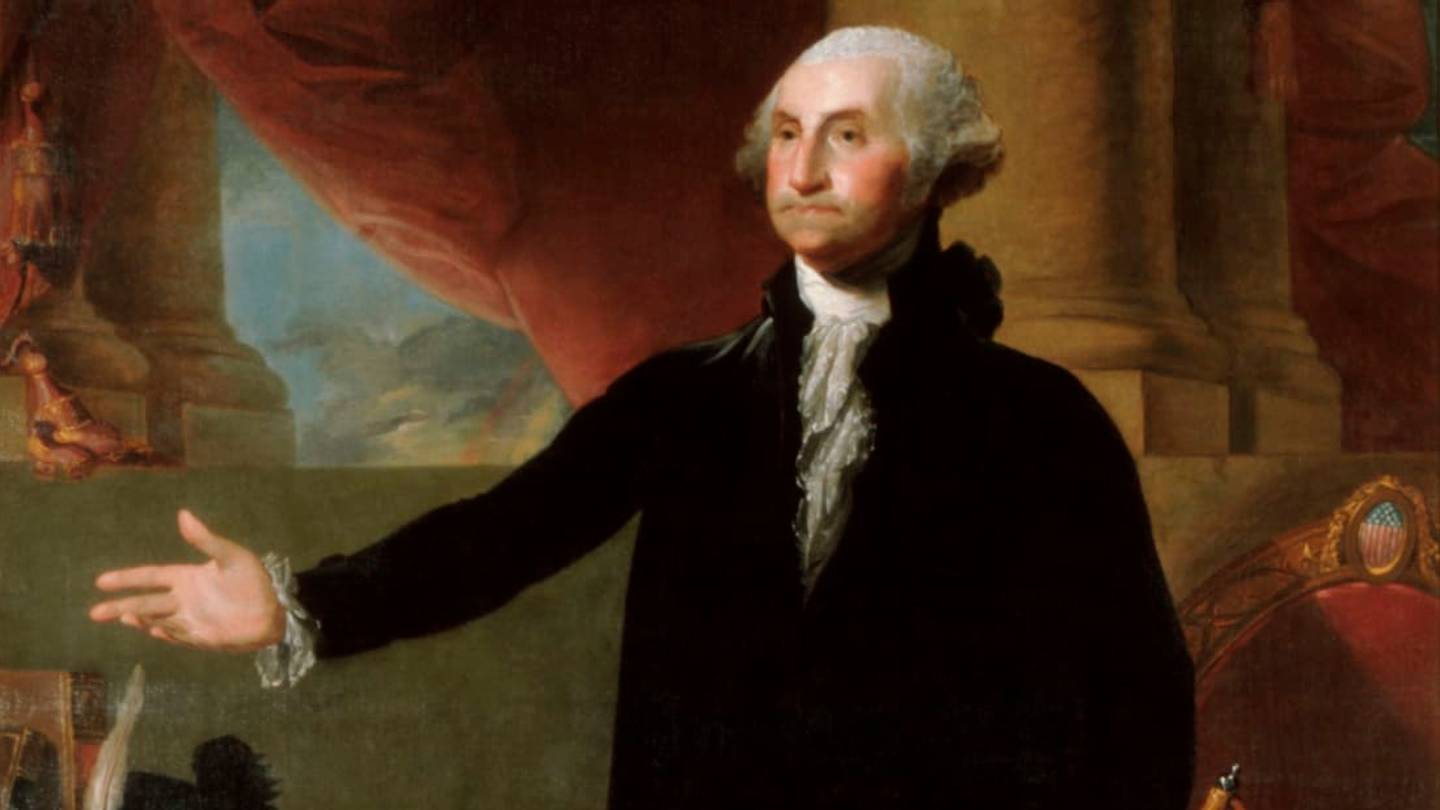
American painter Gilbert Stuart's legacy is defined, in part, by his iconic painting of the first U.S. president, George Washington. Yet there's more to this presidential artwork and its curious creator than meets the eye.
Instead, the Lansdowne Portrait is named for the Marquess of Lansdowne. Born William Petty-FitzMaurice, he was the Prime Minister of the United Kingdom during the end of the American Revolution and the beginnings of the peace negotiations. American senator William Bingham commissioned this portrait in 1795 . It was a present for the Marquess, in thanks for his support of the Jay Treaty and normalizing relations between the two countries. During that time, the newly minted United States was nearing the 20th anniversary of the adoption of the Declaration of Independence, which paved the way for Washington's presidency.
The Lansdowne Portrait isn't even his most popular portrait. That honor would go to the 1796 Athenaeum Portrait . Not only is that unfinished portrait counted as the most iconic image of Washington, but it's also the basis of the president's depiction on America's dollar bill. Churning out copies of his greatest works, Stuart turned his Washington portraits into a cottage industry. He ultimately sold 130 copies of Athenaeum for $100 apiece.
As the American Revolution approached, the Rhode Island-born painter fled to England to escape the conflict. There and in Ireland, he developed a reputation as a portrait artist. Stuart won praise for capturing the character of his subjects, as he did with the 1782 painting of William Grant, The Skater .
Well, that and mounting debt that chased him out of England and then Ireland. Stuart planned to use the education he'd acquired overseas to paint America's political elite in the prestigious manner of European royalty. He wrote to a friend:
Stuart returned to the U.S. in 1793. But meeting Washington was no easy task.
Reaching New York City, Stuart sought a contact that could get him closer to the president, and found Founding Father John Jay. After impressing John Jay by painting his portrait, the American statesman obliged the painter with a letter of introduction that sent Stuart to Philadelphia, which served as the country's capital until 1800 . There, the president and the portraitist would meet again and again, spawning the Lansdowne Portrait , the Athenaeum , and the Vaughan , among other works.
Previous paintings, like John Trumbull's George Washington Before the Battle of Trenton , presented the sitting president as a general contemplating battle. Stuart's full-length portraits portrayed him as " a civilian commander in chief ." Here, he is a man of peace, but nonetheless shown as strong, holding a compelling oratorical pose, while clutching a ceremonial sword.
As the first president, Washington was well aware that his actions set a precedent. This informed not only his politics, but also his attire. At his inauguration in 1789, Washington purposely chose to wear clothing made in America , instead of English garb. His buttons were embossed with eagles, a symbol of this new nation. In this portrait, captured toward the end of his second term, he's shown in a formal black suit that was often his preference to wear in public. It's respectable, but not regal. The intention was to set Washington apart from the royal portrait tradition by rejecting their ornate and expensive robes.
"State" portraitsâpraising paintings of powerful menâoften set their subjects in porticos with columns, drapes, and a bit of open sky. This setting would then be draped in symbols, often of status or accomplishment. Stuart took this concept used for monarchs, bishops, and military leaders and re-imagined it for this new brand of leader.
The top of the Neo-Classical chair from which Washington appears to have risen is topped with an oval that's inlay displays the stars and stripes of the American flag. Within the gold-hued table leg to the President's right, you'll spot a pair of eagles, perched proudly, holding a cache of arrows ever ready for war. Even the books shown on the floorâ General Orders, American Revolution, and Constitution & Laws of the United Statesâ allude to the United States' growing history.
The House of Representatives once boasted a wooden mace that looked like " a bundle of reeds tied together and topped by an eagle ." It was meant as a symbol of America's strength through unity. Unfortunately, the staff was destroyed when the British set fire to Washington, D.C. in 1814.
The inkwell itself is meant to represent Washington's legacy of signing in legislation, like the 1795 Jay Treaty . The little dog on which the well rests is inspired by Greek historian Plutarch's work, symbolizing âthe conservative watchful, philosophical principle of life.â The griffin of the Washington family crest is engraved on the inkwell.
Its meaning reaches back to the biblical tale of Noah's Ark. In the painting's context, the colorful rainbow suggests things are looking up for this new nation that fought so hard for its creation. The dark clouds in the other window are believed to represent the dark times of the Revolutionary War, which had passed.
Stuart believed in physiognomy, the idea that a person's character is reflected in their features. Because of this, he strived to have Washington's strength of character conveyed through his capturingâand he succeeded. A London journalist seeking to describe the piece to a 1797 audience wrote , "The countenance is mild and yet forcible. The eye, of a light grey, is rendered marking by a brow to which physiognomy attaches the sign of power. The forehead is ample, the nose aquiline, the mouth regular and persuasive. The face is distinguishable for muscle rather than flesh, and this may be said of the whole person.â
It annoyed Stuart when his portraits would be unfavorably compared to Jean-Antoine Houdon's sculpture of Washington , where the president's jaw was more relaxed, allowing for a more natural countenance. Stuart once explained the cause for this difference, saying , "When I painted him, [Washington] had just had a set of false teeth inserted, which accounts for the constrained expression so noticeable about the mouth and lower part of the face."
The original painting was shipped off to the Marquess of Lansdowne in 1796, but as he did with Athenaeum , Stuart made copies. One of the versions made its way to the White House (as Stuart's way to distinguish the original from the copies, the White Houseâs copy has United States misspelled as â United Sates â on one of the books on the floor). The original was the property of the Marquess until his death, when it was sold.
After several more exchanges in the 19th century, it became property of the Dalmeny family and toured around England and Scotland. Beginning in 1968, it was displayed on indefinite loan in the Smithsonianâs new National Portrait Gallery until 2000. That year , the paintingâs owner, Harry Dalmeny, announced that he was going to sell the piece at auction, unless the National Portrait Gallery could find $20 million to buy it. Soon after the announcement, the Donald W. Reynolds Foundation gave the Portrait Gallery $30 millionâ$20 million to buy the painting and another $10 million for a place to display it and a national tour.
When the British were descending on the White House during the War of 1812, President James Madison sent word to his wife, the nation's beloved First Lady, to evacuate. But before she did, quick-thinking Dolley made sure their copy of Stuart's work was rescued, so it would not be destroyed by the advancing invaders. She had it broken out of its frame and spirited away from the White House's hallowed halls before she made her escape. The White House was burned down, but the Madisons and their treasured Lansdowne were preserved.
Loading recommendations... Please wait while we load personalized content recommendations