âDonât touch the artâ is a simple rule, enacted by almost every gallery and museum in the world. Yet for some reason, there are a select few who ignore it. Maybe itâs because their curiosity gets the best of them. Or maybe theyâre on a quest for the perfect selfie. Or perhaps itâs not on purpose at all, but the result of an accident. For whatever reason, the museum-goers below left a trail of mangled artwork in their wakes.
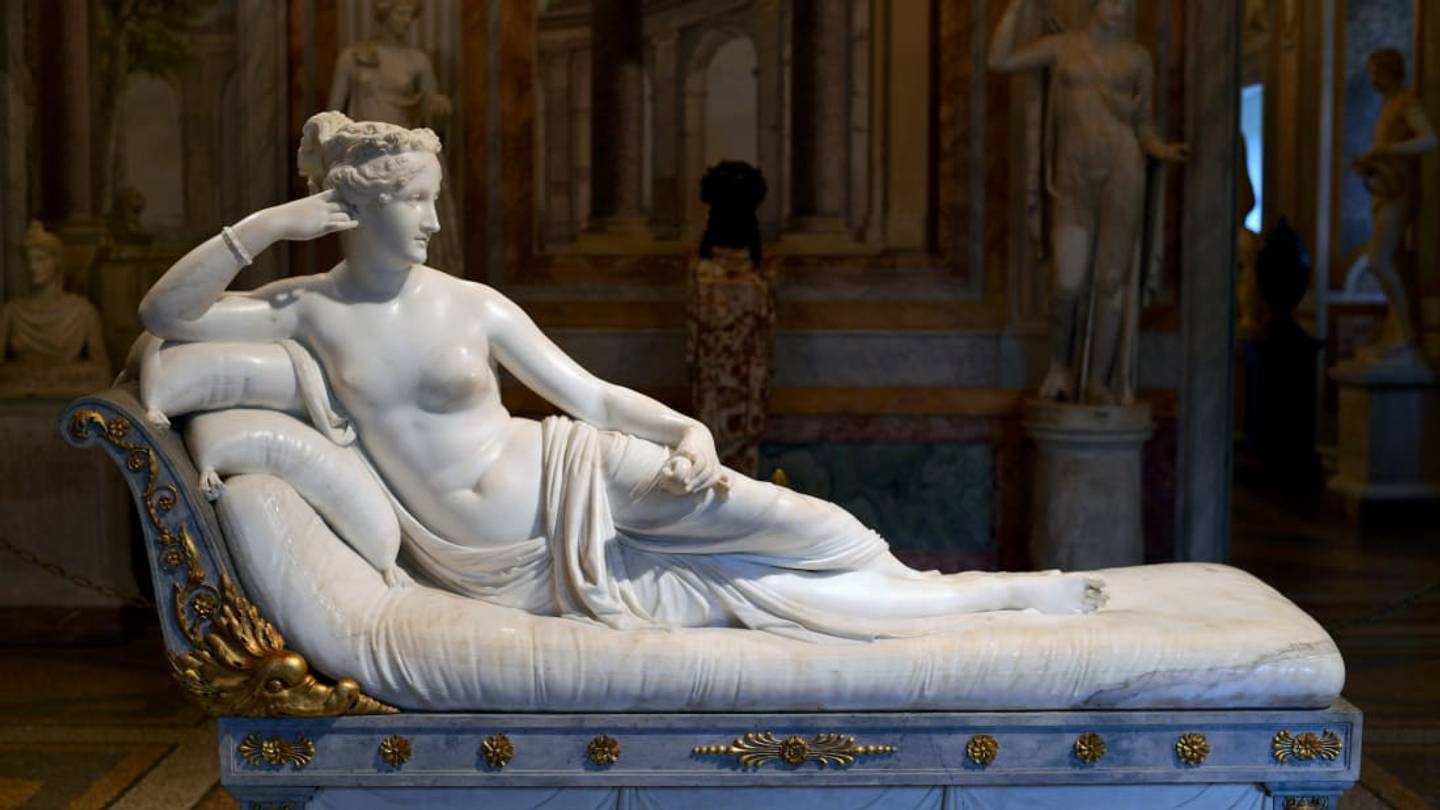
If any lesson should be taken from art gallery mishaps, itâs that you should never use a valuable work of art as a piece of furniture. In July 2020, an unnamed tourist from Austria decided to luxuriate on the plaster cast of Antonio Canovaâs Pauline Bonaparte as Venus Victrix (1804) at Italyâs Antonio Canova Museum to make his selfie look as casual as possible. (Bonaparte was Napoleonâs sister.) In doing so, he crumbled the toes of poor Pauline, who is depicted in the sculpture as reclining on a cushion. Surveillance footage shows the man acknowledging the loss of the extremities before walking away. Police later identified him from a museum reservation. He apologized for the accident and offered to pay for the restoration work.
Itâs probably a good idea to keep an eye on kids if theyâre anywhere near a famous work of art, as Rotterdamâs Museum Boijmans Van Beuningen in April 2025 learned the hard way. Mark Rothkoâs 1960 painting Grey, Orange on Maroon, No. 8 was hanging in a facility adjacent to the main building when a visiting child touched and damaged it during what the museum said was an âunguarded moment.â The museum told CNN that the artwork, though to be worth tens of millions of dollars, âsustained superficial damageâ and that âsmall scratches are visible in the unvarnished paint layer in the lower part of the painting.â The museum does plan to restore the painting and display it again.
In 2016, a 24-year-old visiting Lisbon, Portugal, made a very bad call when he climbed onto a 126-year-old statue installed on the facade of Lisbon, Portugal's Rossio Train Station to snap a selfie. The freestanding statue, which depicted 16th century king Dom Sebastiao, toppled over and shattered on the ground. The tourist, who attempted to flee, was caught by the authorities and eventually forced to appear in front of a judge; Portugal's infrastructure department has no information about when the statue will be fixed.
Hercules might have had the strength of the Gods, but unfortunately, that toughness didn't translate to sculptures of him. In 2016, two tourists visiting the Loggia dei Militi Palace in Cremona, Italy, damaged the 300-year-old Statua dei due Ercole ( Statue of Two Hercules ) when they climbed on it to take a selfie. The tourists were reportedly hanging off the crown of one of the marble figuresâwhich held the town's emblem between themâwhen it gave way, falling to the ground. The tourists were charged with vandalism, and the government called in experts to assess the damage.
The most famous (read: hilarious) art ârestorationâ in history might be 80-year-old Cecilia Gimenezâs attempt to fix a deteriorating fresco painting at a church in Borja, Spain. Her new and improved art made international headlines  and inspired endless internet memes in 2012. Saturday Night Live even worked the news into their Weekend Update segment a couple of times, with Kate McKinnon playing Gimenez.
The painting, a depiction of Jesus Christ by artist ElÃas GarcÃa MartÃnez in the 1930s, was flaking due to moisture; Gimenez, a parishioner at the church, worked off a 10-year-old photo of the fresco while doing her restoration. When her work was revealed, Ecce Homo was redubbed âPotato Jesus.â Gimenez told a Spanish TV station that she had approval to work on the fresco (which authorities deny), and had done so during the day. âThe priest knew it,â she said. âIâve never tried to do anything hidden.â
Though the church had originally planned to work with art restorers to fix the fresco, by 2014 they had changed their tune. Gimenezâs artwork became a major tourist attraction, bringing 150,000 visitors from around the world and revitalizing Borja. The church charged $1.25 a head to see the artwork, which was preserved behind plexiglass, just like another very famous, memeworthy work of art: the Mona Lisa . A center dedicated to the interpretation of the new Ecce Homo opened in 2016.
Rule number one for entering any space with priceless art: tie your shoelaces. In February 2006, a man named Nick Flynn took the wrong staircase inside the Fitzwilliam Museum in Cambridge, Englandâand when he tried to change course, he accidentally stepped on his own untied shoelace and fell. With no handrails to grab, the only thing to break his fall were three Qing Dynasty vases from the 1600s and 1700s, which were sitting on a windowsill. Flynn was unhurt, but the vases, worth more than $100,000, were not so lucky: They shattered into 400 pieces.
âAlthough [I knew] the vase would break I didnât imagine it would be loose and crash into the other two,â he said. âIâm sure I only hit the first one and that must have flown across the windowsill and hit the next one, which then hit the other, like a set of dominos.â Flynn, who was reportedly banned from the museum, called the incident âjust one of those unbelievably unlucky things that can sometimes happen.â
This story has something of a happy ending, though: By August 2006, Penny Bendall, a ceramic restorer, had glued one of the vasesâwhich had broken into 113 piecesâback together for an exhibition on art restoration. âPutting the vase back together may have looked impossible to most people but actually it wasnât a difficult jobâfairly straightforward,â she told the Daily Mail .
Should you be given a pass for breaking something if it was technically already broken? In 2013, a Missouri man visiting Museo dellâOpera del Duomo in Florence, Italy, wanted to see how the pinky finger of a 600-year-old statue of the Virgin Mary by Giovanni dâAmbrogio measured up next to his own. You know what happened next: The man got a little too close and damaged the statue's digit. Thankfully, the finger that he broke was made of plaster and not original to the sculpture, and art restorers grabbed it quickly before it could fall and be further damaged. The man apologized, and restorers at the museum made plans to repair the finger again. Hopefully the second fix was more permanent.
The good news is this Milan statue, which lost its left leg to an unknown selfie enthusiast in 2014, was a replica of another statue that dates back to 220 BCE. The bad news is that the replica was still very valuable and pretty old, dating back to the 1800s. Security cameras in that area of the Academy of Fine Arts of Brera weren't working when the incident occurred, but according to the Daily Mail , witnesses saw a student tourist climb onto the statue and sit on its knee to take a photo. What the student didnât realize was that the statue, made of terra cotta and plaster, had been assembled in pieces, and the leg was already partially detached; museum director Franco Marrocco told the Corriere della Sera that the museum was already planning to restore the statue before the accident.
A 6-foot-tall Picasso painting is pretty hard to miss when itâs hung on a museum wall, just as the visitor who fell into one back in January 2010 discovered. A woman was attending a class at New York Cityâs Metropolitan Museum of Art when she lost her footing and tumbled into The Actor , leaving a 6-inch tear as well as a dent in the lower right corner of the 1904 artwork. âWe saw the big, coarse threads that looked sort of like a nasty jute rug,â Gary Tinterow, chairman of the museumâs department of 19th Century, Modern and Contemporary art, said in an interview with The New York Times . âThe question was how to get Humpty Dumpty back together again.â
That process took three months. Lucy Belloli, a conservator at the Met, told The New York Times that the process involved photographing the canvas, securing flakes of paint with adhesive, and using strips of paper with rabbit-skin glue as bandages, as well as a six-week period of realigning the painting using small sand bags. (â[T]he torn portion of the canvas had to be gently coaxed back to its flat state, otherwise it would have a tendency to return to the distortion left by the accident,â the Times explained.) Some retouching was also necessary. The painting was returned to the wall in April 2010 with a layer of Plexiglass to protect it; most visitors would not have been able to tell the painting was ever damaged.
Read More Stories About Art:
A version of this story ran in 2016; it has been updated for 2025.