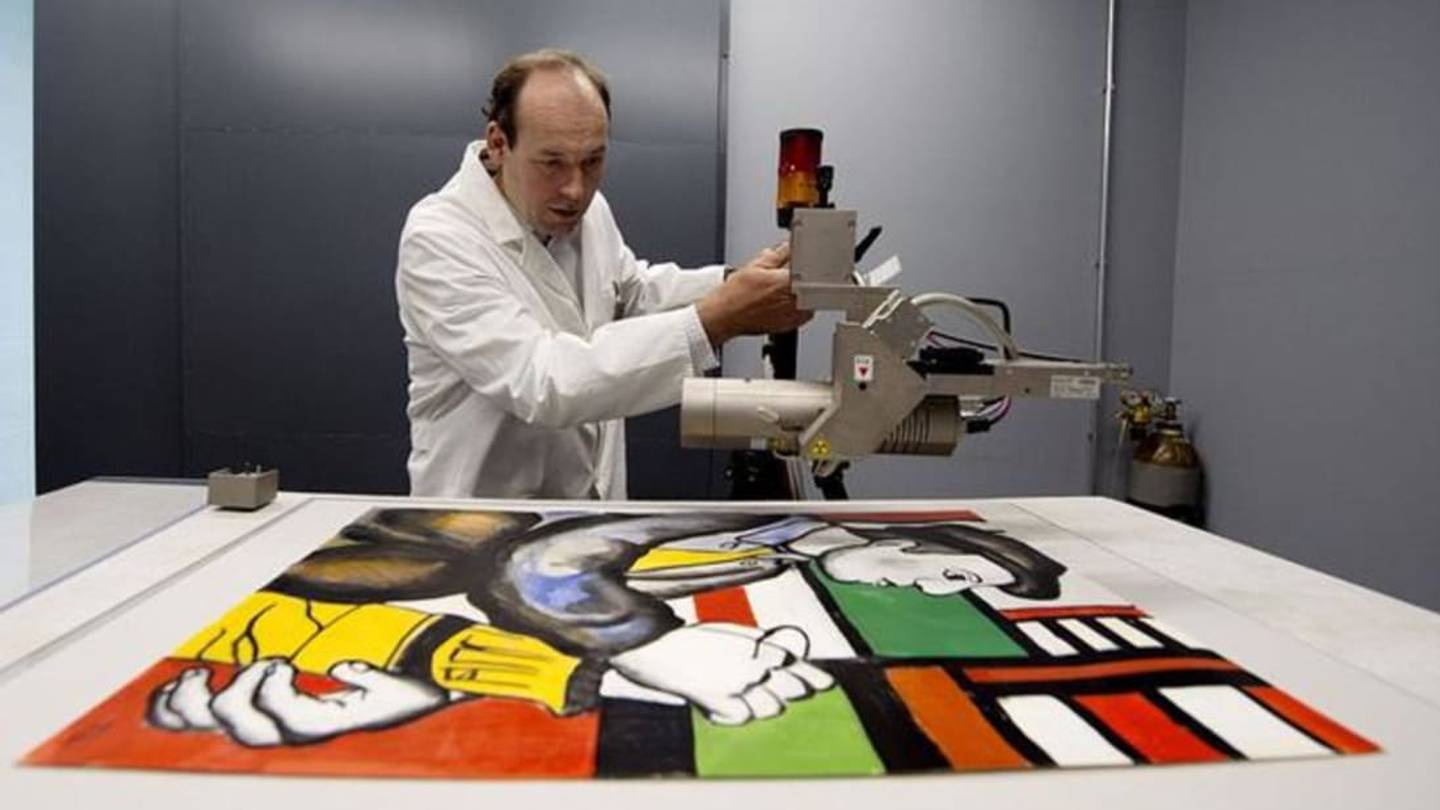
Approximately $64 billion is spent on art every year. Itâs estimated that anywhere from 2 to 50 percent of those pieces out there are counterfeits. Here's how experts spot the fakes.
Craquelureâthe web of fine cracks on old paintingsâis unique to every work of art. For centuries, forgers faked the phenomenon by splintering their paintings with solvents, pencil sketches, formaldehyde, and frozen beeswax. (One time, the forger Han van Meegeren aged a fake Vermeer by baking it in a pizza oven .) Today, many museums keep a thorough record of what a paintingâs cracks look like, and scientists use Reflectance Transformation Imaging to create a âtopographic mapâ of the original's cracked surface [ PDF ].
There were approximately 2000 nuclear bomb tests between 1945 and the Nuclear Test Ban treaty in 1963. Those explosions soaked our planet in radioactive isotopesâparticularly cesium-137, carbon-14, and strontium-90âand contaminated the worldâs soil, including the flax and linseed oil used in modern paint. The result? Most paintings created after 1945 contain these isotopes. With the help of a mass spectrometer , scientists can examine a painting to see if it has too many of these radioactive atoms. The technique proved that one of Peggy Guggenheimâs favorite paintings, an abstract piece attributed to Fernand Léger and supposedly painted in 1913, was actually made years after Legerâs 1955 death.
Painters such as Rembrandt and Holbein loved painting on wooden panels. Like all things wooden, those panels contain tree rings, and experts can examine those ringsâa method called dendrochronology [ PDF ]âto double-check the workâs authenticity. (How? Over periods of nice weather, trees grow thick and healthy rings. When weather is rough, rings thin out. Experts can compare and match the pattern of weak/healthy rings to known tree samples to determine the wood's age and origin.)
Painters usually draw sketches on the canvas before getting to work. Experts can see these covered-up scribbles with infrared reflectography , a technique that fires wavelengths of radiation into the artwork to reveal what's hiding under coats of paint. In 1954, art historians discovered a second copy of Francesco Franciaâs The Virgin and the Child with an Angel . Decades of controversy soon followed, with the general consensus being that the copy in Londonâs National Gallery was a 19th century forgery and the version now in the Carnegie Museum of Art was the real one. In 2009, infrared reflectograms helped pinpoint the fake: The forger had sketched the National Gallery's painting with graphite, a material that wasnât available during Franciaâs lifetime.
Even traditional x-rays can unearth a paintingâs hidden underbelly. For years, curators at the Fogg Art Museum believed their Portrait of a Woman was made by the great Francisco de Goya. But in 1954, an x-ray revealed that a different portrait was hiding beneath the surface! More analysis showed that the buried painting contained zinc white paintâa pigment that didnât exist when Goya was alive. Busted.
In 1923, the forger Han van Meegeren successfully passed his fake The Laughing Cavalier off as a work by the 17th century Dutch portraitist Frans Hals. Experts later realized they had been duped when, using x-ray diffraction, they discovered the painting was dabbed with synthetic ultramarine paint, a pigment invented 162 years after Hals died [ PDF ]. Today, art historians use Raman spectroscopy to detect these out-of-date pigments. (To oversimplify the process, the technique involves firing lasers at a pigment. As light scatters off the paint, the machine picks up each pigment's unique chemical fingerprint.)
In 1989, the FBI arrested Robert Trotter for forging the works of 19th century American still life painter John Haberle . The Feds nailed Trotter thanks to good old fashioned UV light [ PDF ]. That's because a shower of UV light makes the varnish on old paintings shine. Newer paintings, however, donât fluoresce as much, and they often emit an uncanny uniform glow. Trotter had coated his fakes with a copal varnish, which, under UV light, created a sheen that looked good to an amateur, but to a professional was too consistent for a 100-year-old painting.
Before we had fancy machines to catch fakes, curators used the Morelli method . Giovanni Morelli was a 19th century Italian art critic who had a knack for authenticating paintings with his naked eye. He knew that artists followed formulas when painting tiny details such as ears, eyes, or fingernails, and he believed if an art critic memorized an artistâs habits for painting these body parts, he or she could determine who held the brush. (Morelli was a doctor by training and believed identifying art through trifling details was parallel to diagnosing a disease.) Incidentally, Morelli knew Arthur Conan Doyleâs uncle, and itâs possible that his ability to pinpoint tiny telltale clues inspired Doyleâs Sherlock Holmes .
For 17 years, Shaun Greenhalgh forged everything from fake Gauguin sculptures to 3300-year-old Egyptian statues in his backyard shed, aging his âancientâ artworks with tea and clay . He fooled countless art lovers and museums until 2006, when Scotland Yard came knocking. His big mistake? Experts at the British museum discovered three of his cuneiform scripts were littered with spelling mistakes . (To Greenhalghâs credit, the Victoria and Albert Museum was so impressed with his forgeries they included his fake works in an exhibition in 2010.)
Did you know that Michelangelo started his career as an art forger? In 1496, the 20-year-old forged the sculpture of a centuries-old sleeping Cupid, buried it in acidic dirt to make it look old, and sold it as an âantiquity.â He pulled off the charade so well that when the buyer realized it was a fake, he wasnât even that mad: Michelangelo kept his money and news of the fraud catapulted him to fame.
Reporting by Sam McPheeters, Lucas Reilly, and Jennifer M. Wood.
Loading recommendations... Please wait while we load personalized content recommendations