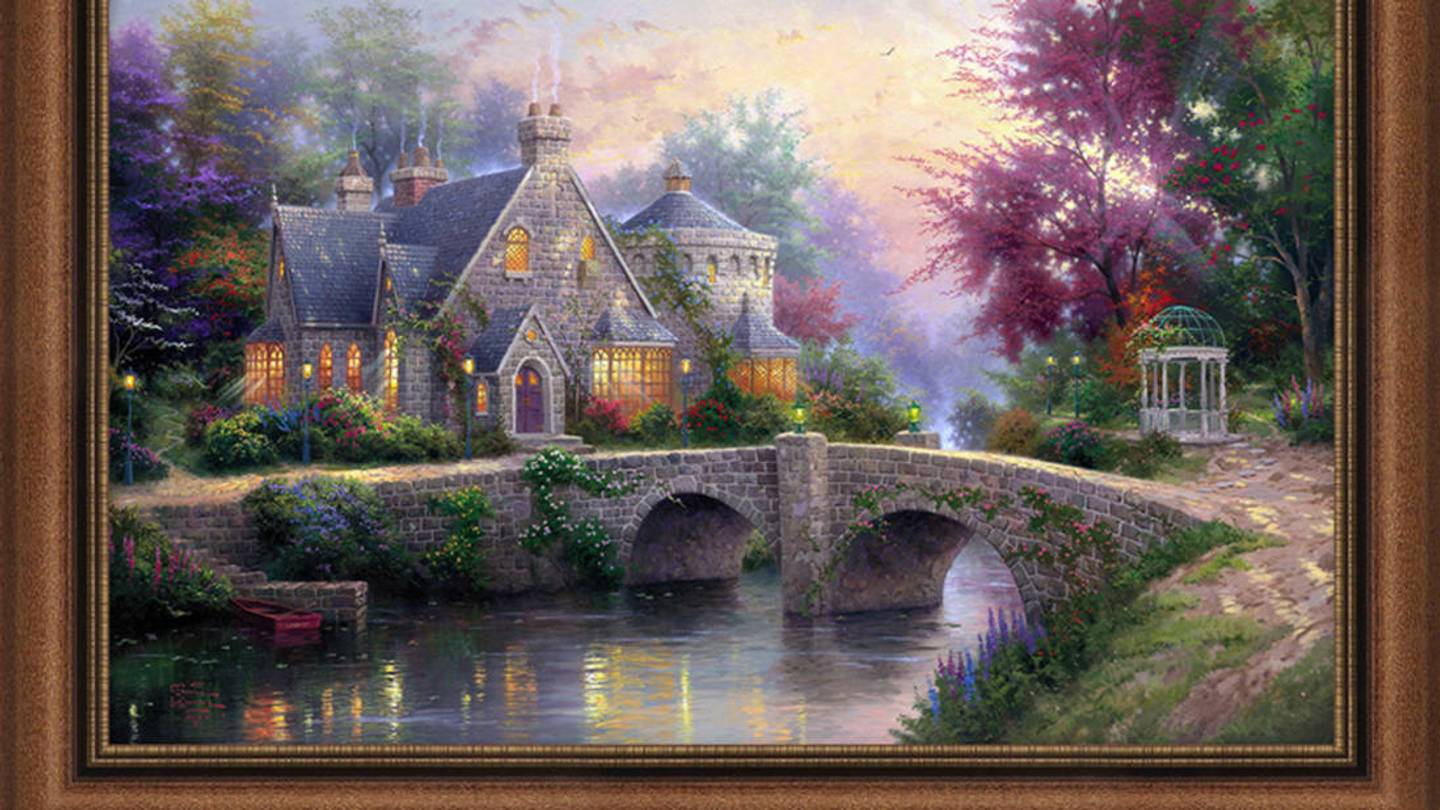
Known for his peaceful landscapes and serene scenes of churches and cottages illuminated by beams of light, at the time of his death in 2012, Thomas Kinkade was reported to be the most popular commercial artist in America. Learn more about the Painter of Light with the following facts.
When he was very young, Thomas Kinkade decided that he wanted to be an artistâand after that, he really never put down his paintbrush. His mother, Mary Ann, remembered that his second grade teacher commented on his artistic ability and predicted that Thomas would be a successful artist one day. His brother, Patrick, tells stories about Thomas preferring to spend his childhood inside drawingâno matter how much he bugged him to play outside.
When a family friend commented that she liked something he had drawn, Kinkade offered the piece to her for a small fee . He used the money, as well as what he earned on his paper route, to buy art supplies and make small renovations, such as adding a loft area to his childhood bedroom to turn it into a proper studio.
When Kinkade was 12 years old, Wessels ended up building his studio about 100 feet from where the Kinkades lived in what Kinkade described as âone of the great moments of destiny in my life.â A fictionalized version of their relationship is featured in the film Thomas Kinkade's Christmas Cottage , with the young painter (played by Jared Padalecki) being advised by his mentor (Peter OâToole) that âThe light lasts forever. Paint the light!"
Kinkade was well-known to be a devoted Christian, and he often depicted churches and included Bible verses with his paintings. Kinkade became a born again Christian in 1980 and credited God with much of the inspiration for his work.
Kinkade gave himself the nickname not just in reference to the element commonly found in his paintings, but also as a reflection of his artistic philosophy. âI'm a warrior for light,â he said in an interview with the Mercury News in 2002. âWith whatever talent and resources I have, I'm trying to bring light to penetrate the darkness many people feel.â
It is estimated that a Kinkade painting hangs in one out of every 20 homes in the U.S. During its most successful days, his company, Media Arts Group, generated $130 million in sales annually and his paintings were available at 350 franchise locations across the country.
Under allegations of malpractice, Media Arts Group filed for Chapter 11 bankruptcy in June 2010 . Around the same time, a lawsuit was brought against him by several gallery owners who believed they had been persuaded to open galleries in locations that Kinkade knew wouldnât be able to support the business. The suit resulted in a $3 million ruling in favor of his former employees.
Becoming a father led Kinkade to paint Evening at Merrittâs Cottage, Chandlerâs Cottage, Winsor Manor , and Everettâs Cottage . The painter is known to have hidden other symbols that reference his family in his work, such as adding in secret Ns as a tribute to his wifeâs name, Nanette, and including the numbers â5282â in reference to their wedding date, May 2, 1982
Called the Village , the area featured cottage-style houses based on those featured in Kinkadeâs work that lined streets with names such as Summer Gate and Rose Arbor Way. The neighborhood promised âCalm, not chaos. Peace, not pressure.â Two other communities were planned in Couer d'Alene, Idaho and Columbia, Missouri until the calm and peace were unable to stand up against the chaos of the housing market of the early 2000s.
The artist was known to ride his Harley-Davidson around the small town where he lived, Los Gatos, and befriend the local homeless population. He was a reader, but also occasionally liked to shoot and blow things up on his ranch. Each Christmas was not complete without an appearance by Kinkade dressed as Santa Claus himself.
Laura Hamilton, Flickr // CC BY-NC-ND 2.0
The last years of the artistâs life were less calm and peaceful than the scenes depicted in his paintings. A drunk driving incident in 2010 resulted in Kinkadeâs private bodyguard also turning into his personal driver. For the last two years of his life, Kinkade and his wife were legally separated. He died at 54 in the house he shared with his girlfriend with large amounts of alcohol and Valium in his system and green paint on his fingernails. His death led to a highly publicized battle over his estate between his ex-wife and girlfriend that ended in December 2012 with an undisclosed arrangement and the parties announcing "Putting Mr. Kinkade's message of love, spirituality, and optimism at the forefront, the parties are pleased that they have honored Mr. Kinkade by resolving their differences amicably."
Loading recommendations... Please wait while we load personalized content recommendations