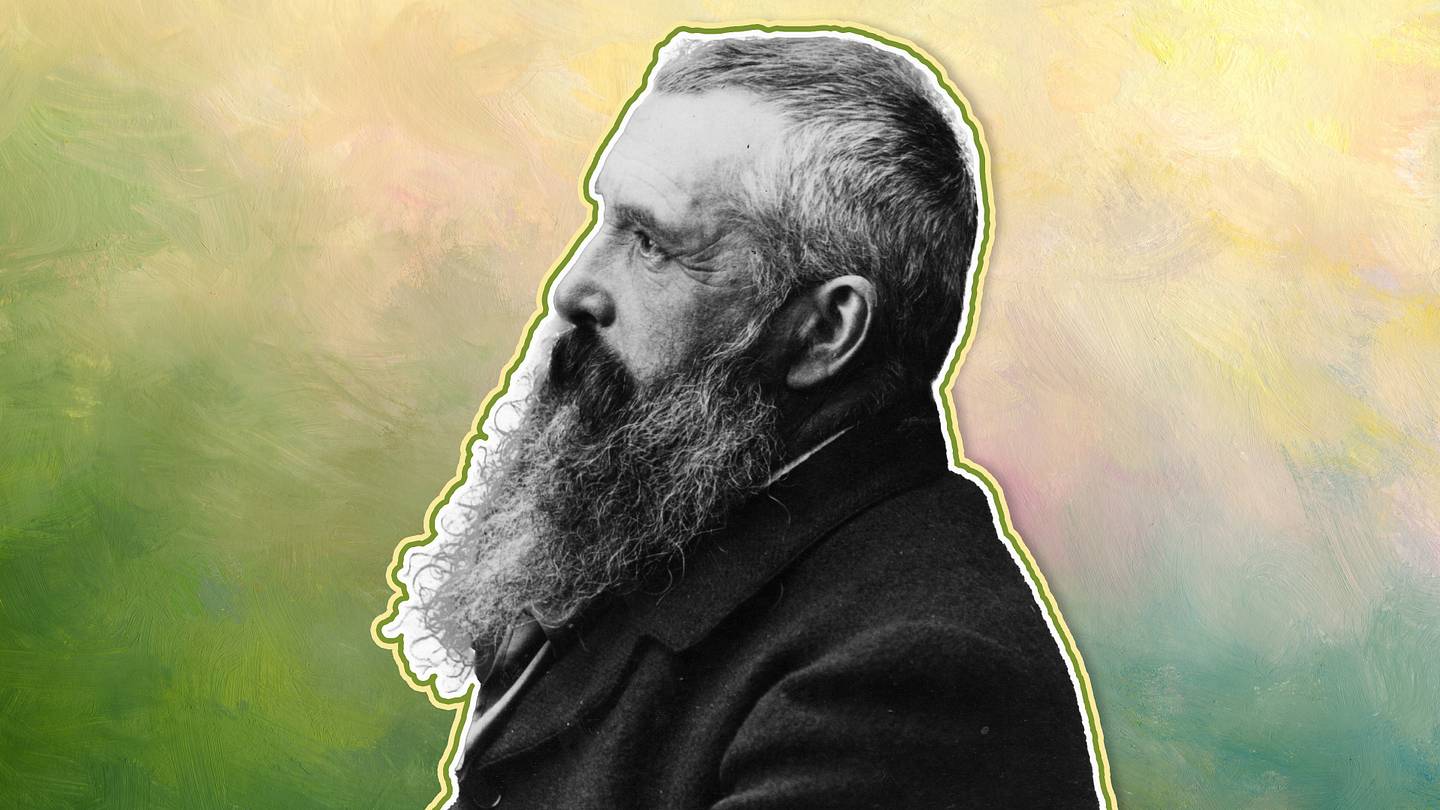
Oscar-Claude Monet is beloved for his series of oil paintings depicting water lilies, serene gardens, and Japanese footbridges. The French painter manipulated light and shadow to portray landscapes in a groundbreaking way, upending the traditional art scene in the late 19th century. Here are 12 things you might not know about the father of French Impressionism.
November 14, 1840, Paris, France
December 5, 1926, Giverny, France
âHaystacksâ series, âWater Liliesâ series, âImpression, Sunriseâ
Born in Paris in 1840, Monet began drawing as a young boy, sketching his teachers and neighbors. He attended a school of the arts and, as a young teenager, sold his charcoal caricatures of local figures. He also learned about oil painting and en plein air (outdoors) painting, which later became a hallmark of his style. Monetâs mother encouraged his artistic talent, but his father, who owned a grocery store, wanted him to focus on the grocery business. After his mother died in 1857, Monet left home to live with his aunt and, against his fatherâs wishes, study art.
In 1861, Monet was drafted into the army; he was forced to join the First Regiment of African Light Cavalry and left Paris for Algeria, a territory that was then controlled by France. Monetâs father offered to pay for his sonâs discharge if he would promise to give up painting, but Monet refused to abandon art. After serving one year of his seven-year military commitment, Monet got sick with typhoid fever. His aunt paid to get him released from the army, and she enrolled him in art school in Paris.
In his late twenties, Monet was frustrated with the Académie, Franceâs art establishment. He hated creating formulaic artwork, copying the art that hung in the Louvre , and painting scenes from ancient Greek and Roman myths. Although he tried to get his paintings into the Académieâs art exhibits, his art was almost always rejected. Depressed and struggling to support himself and his family financially, Monet jumped off a bridge in 1868. He survived his fall into the Seine and began spending time with other artists who also felt frustrated by the Académieâs restrictions.
In 1873, Monet was spending his summer in a rented home in Argenteuil, a suburb of Paris. His friend Pierre-Auguste Renoir visited Monet to spend time together and paint outdoors. The two men connected over their mutual dislike of the traditional style of the Académie. During his visit, Renoir painted Monet painting in his garden, creating a painting within a painting. The work, straightforwardly called Monet Painting in His Garden at Argenteuil , depicts Monet standing outside as he paints flowers.
Monet created a community with other frustrated artists, a group that included Renoir, Camille Pissarro, Edgar Degas, and Paul Cézanne. The group, which called itself The Anonymous Society of Painters, Sculptors, Printmakers, etc., organized an exhibition in 1874. The exhibition included groundbreaking artwork featuring bright, vivid colors and loose, seemingly spontaneous brushwork. After a critic compared one of Monetâs paintingsâ Impression, Sunrise âto an unfinished sketch (or âimpressionâ), the term Impressionists caught on to describe the artists who displayed these radically different, new paintings.
Monet frequently painted his first wife, Camille Doncieux, who worked as a model and had been in a relationship with the artist since the mid-1860s (they married in 1870). The couple had two sons, but Camille died, perhaps of uterine cancer, in 1879.
Alice Hoschedé, the wife of a businessman and art collector, had been living with the Monets after her husband went bankrupt, and Monet may have started an affair with her while Camille was still alive. After Camilleâs death, Hoschedé jealously destroyed all of her letters and photographs. Despite this, Hoschedé (along with her six children) lived with Monet and his two kids, and the couple married in 1892 after Hoschedéâs husband died. (One of Hoschedéâs daughters later married one of Monetâs sons, so the step-siblings became husband and wife.)
From 1883 until his death in 1926, Monet lived in Giverny, a village in northern France. Over the years, he hired gardeners to plant everything from poppies to apple trees in his garden, turning it into a beautiful, tranquil place for him to paint.
Finally wealthy from sales of his paintings, Monet invested serious money into his garden. He put a Japanese footbridge across his pond, which he famously painted, and he imported water lilies from Egypt and South America. Although the local city council told him to remove the foreign plants so they wouldnât poison the water, Monet didnât listen. For the last 25 years of his life, he painted the water lilies in a series of paintings that showcased the plants in varying light and textures.
As Monetâs garden expanded, he hired six full-time employees to tend to it. One gardenerâs job was to paddle a boat onto the pond each morning, washing and dusting each lily pad. Once the lilies were clean, Monet began painting them, trying to capture what he saw as the light reflected off the water.
Around 1908, when he was in his late sixties, Monet began having trouble with his vision. He was diagnosed with cataracts in 1912. He later described his inability to see the full color spectrum to a reporter six years later, saying, âReds appeared muddy to me, pinks insipid, and the intermediate or lower tones escaped me.â When he became legally blind in 1922, he continued painting by memorizing the locations of different colors of paint on his palette.
Monet delayed getting risky cataract surgery until 1923, and critics mocked him for his blurry paintings, suggesting that his Impressionist style was due to his failing vision rather than his artistic brilliance. After two cataract surgeries, Monet wore tinted glasses to correct his distorted color perception and may have been able to see ultraviolet light.
In the summer of 1926, Monet was diagnosed with lung cancer. Afterward, his best friend, former Prime Minister Georges Clemenceau , wrote to the artist, âWhat more could one ask for? Youâve had the best life that a man could dream of. Thereâs an art to leaving as well as entering.â Monet died on December 5, 1926, at home in Giverny, with Clemenceau âat his side and amid his wonderful collection of paintings, mostly by friends and pupils,â according to The New York Times.
In 2015, an art dealer in London discovered an unknown Monet pastel hidden behind another Monet drawing he had bought at a 2014 auction in Paris. The pastel depicts the lighthouse and jetty in Le Havre, the port in France where Monet lived as a child. Art scholars authenticated the pastel as an true Monet artwork and dated it to 1868, around the time he jumped into the Seine.
Beginning in 1980, Monetâs former home in Giverny was opened to tourists to see his gardens, woodcut prints, and mementos. Each year, hundreds of thousands of people visit Giverny to walk through the artistâs famous garden and refurbished home. Besides looking at a variety of flowers and trees, visitors can also see Monetâs bedroom, studio, and blue sitting-room.
Loading recommendations... Please wait while we load personalized content recommendations