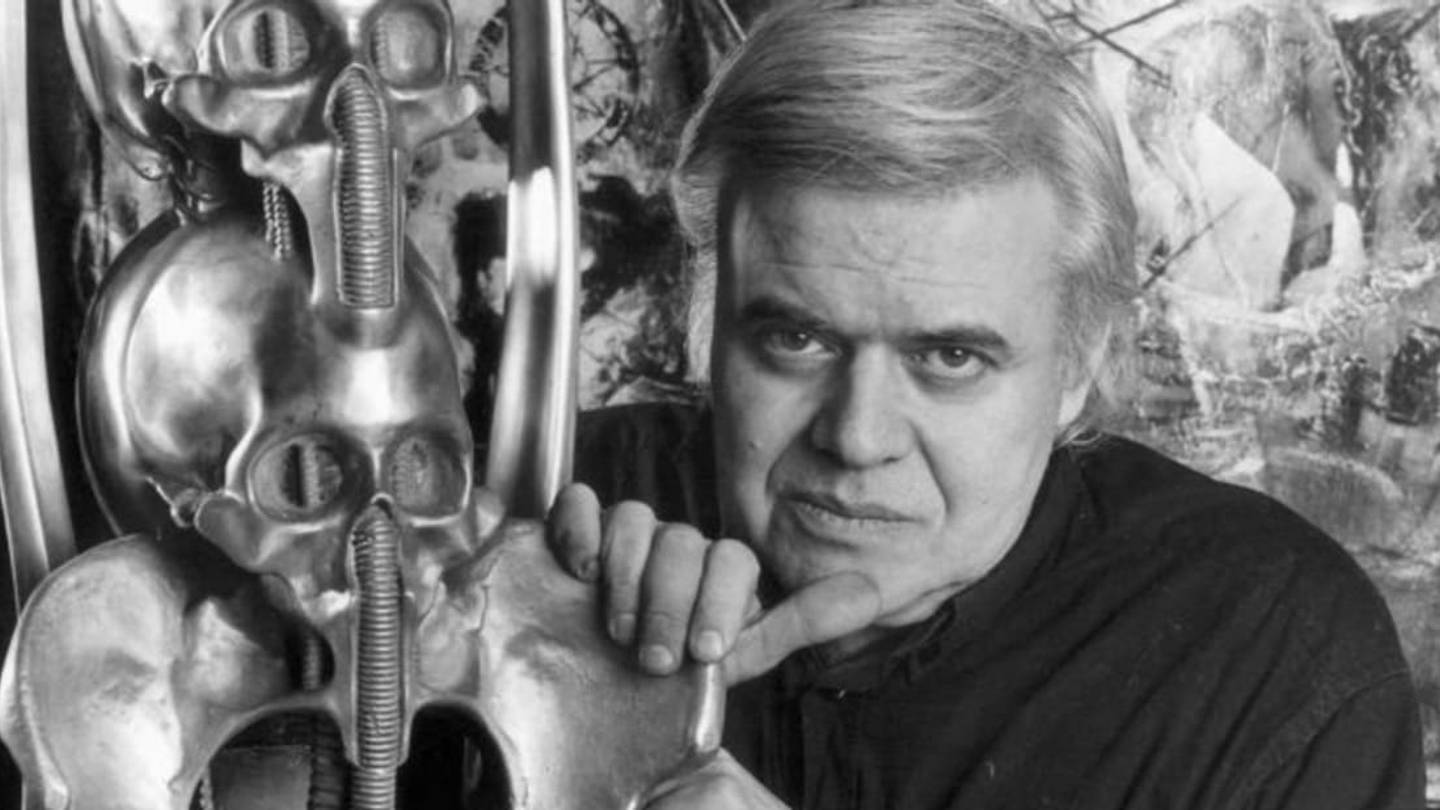
When Swiss surrealist artist Hans Rudolf Giger died at the age of 74 in 2014, he left behind an impressive body of work. Best known for designing the lanky, drooling Xenomorph for 1979âs Alien , much of his life was devoted to studies in biomechanical visions. Here are a few things you might not have known about the man behind the horror.
Growing up in Chur, Switzerland, young Giger was urged to enter the family business and become a pharmacist. He preferred art, entering the School of Applied Arts in Zurich and creating works based on his adolescent love of Egyptian iconography like mummies and sarcophaguses. During some of his first gallery shows that displayed his preference for quasi-sexual imagery, neighbors were so appalled that they spit on the galleryâs windows when they walked by.
Nearly 10 years prior to beginning work on Alien , Giger was invited to design costumes and sets for a small Swiss film titled Swiss Made [ PDF ]. Released in 1969, the film is about a humanoid extraterrestrial who visits Earth with his alien dog companion. âI used a real dog,â Giger said, âand I made the clothes in polyester.â Although crude, the design of the alien (above) hints at the banana-shaped cranium heâd later make famous.
Ridley Scott had no idea how he was going to proceed with the art direction for Alien , a script he agreed to direct about a space crew that inadvertently picks up a dangerous, acid-blooded passenger. When he visited the Fox lot for a meeting, he spotted Gigerâs book, Necronomicon , which collected many of his darkly fantastic paintings. âI took one look at it, and Iâve never been so sure of anything in my life,â Scott said . Giger designed the creature in its four stages: the egg, a face-hugger, a chest-burster, and a full-grown adult with assistance from model maker Roger Dicken. Both artists were on set to provide touch-ups; Giger hand-sculpted the âspace jockeyâ out of clay.
Discussing his craftsmanship on Alien with Starlog in 1979 [ PDF ], Giger shared that the eggs from which the aliens hatch were made of some very practical materials. In addition to plastic, the artist used store-bought, neon-green toy Slime that was popular in the 1970s as well as âsome real [animal] flesh inside.â For the stretching tendons seen when the adult alien opens its maw to devour a victim, Giger said he used âshredded latex contraceptives.â
For reasons that were not immediately clear to Giger, the artist was not asked back by Fox or director James Cameron for 1986âs Aliens âthis despite the fact that Giger won an Academy Award for his work on the original. Closer to the filmâs release, he found out why via a letter written by Cameron himself. The director explained that Gigerâs âbizarre, psycho-sexual landscapeâ is what attracted the director to the sequel, but that he âfelt I had to put my own unique stamp on the project ⦠I felt the risk of being overwhelmed by [Giger].â Cameron went on to ask Gigerâs forgiveness for the slight.
Giger was invited to return to the franchise with 1992âs David Fincher-directed Alien 3 . While contributing to the new design work, Giger clashed with the effects team and found the experience unsatisfactoryâeven more so when he screened the film and noticed Fox had both ignored his contractual specification that he be credited for work on the sequel (instead of just âoriginal design byâ) and left his name out of the closing credits. The mistakes were corrected for the film's home video release.
Although he didnât work on the Alien franchiseâs fourth installment, Giger certainly had a legitimate claim that any design work owed an incredible debt to his original designs. Fox, however, seemed to disagree, omitting his name from the credits entirely. An angry Giger sent off a letter to Fox. âThe creatures in Alien: Resurrection are even closer to my original Alien designs than the ones which appear in Aliens and Alien 3 ,â he wrote . âWhy does Fox not give me the credit I rightfully earned? ... All I can wish them is an Alien breeding inside their chests.â
Rather than be invited to work on Aliens , Fox installed Giger on another sequel project: 1986âs Poltergeist II: The Other Side , a follow-up to Tobe Hooperâs 1982 film about a family burdened by malevolent spirits. Giger was disappointed in how his Great Beast design appeared in the film and expressed that he wouldâve preferred to work on Aliens âin production around the same timeâinstead. âPerhaps the Poltergeist people wanted to keep me away from Aliens for fear of losing meâ he told Cinefantastique [ PDF ] in 1988. âI was horrified by Poltergeist II .â Â
In 1994, Giger was invited to submit a design for a revamped Batmobile for Batman Forever , the second sequel to Tim Burtonâs 1989 original. While a pairing of Burton and Giger would have been interesting, the filmmaker had left the series by this time, replaced by Joel Schumacher. Gigerâs lobster-claw-shaped vehicle was a radical departure for the franchise; it never made it past the sketch stage.
Gigerâs work was celebrated by a number of musicians, many of whom asked him to design their album cover art. For Debbie Harryâs 1981 record, KooKoo , Giger used a recent acupuncture session as inspiration, depicting Harryâs face being threaded by four needles. Harry had asked Giger during a gallery event. He accepted, but later confessed he had never heard her music. âThis was due to the fact I was more interested in jazz,â he later wrote . The image was banned from advertisements in England.
When Giger settled into a modestly-budgeted castle in Gruyères, Switzerland that could provide a home for all of his work, not everything was in place. According to a 2009 Vice.com interview, Giger found that some paintings had been stolen from the property; others went missing during transportation to gallery shows. âI said Iâll pay 10,000 francs if someone knows anything about them,â he said . âIt upsets me so much ⦠itâs sh*t.â
Fans looking for a truly immersive Giger experience may want to visit Switzerland, where two bars designed by the artist are still in operation . The Giger Bars in Chur and Gruyères are extensions of the artistâs work in biomechanics, with columns of vertebrae and posts that have been polished so that they feel like something (almost) organic. The latter location is also adjacent to a Giger-approved museum of his works. Before his passing in 2014, Giger was in talks to bring a bar to the United States.
Gigerâs aesthetic was on display in relatively low-resolution in Dark Seed , a 1992 DOS and Amiga computer point-and-click game: the artist contributed concept and background art. A sequel, Dark Seed II , followed; neither one caught on with gamers. âThat was done without my real involvement,â he later told an interviewer [ PDF ]. âThey just used my name.â
International Carnivorous Plant Society
Following Gigerâs death in 2014, a plant breeder named Matthew Kaelin named a carnivorous species âNepenthes H.R. Gigerâ because of its spikes and peristome teeth. While the plant normally dines on insects, it has been known to digest small animals that happen to fall into its mouth. Resembling something from a hostile alien world, it's a fitting tribute to the artist.
Loading recommendations... Please wait while we load personalized content recommendations