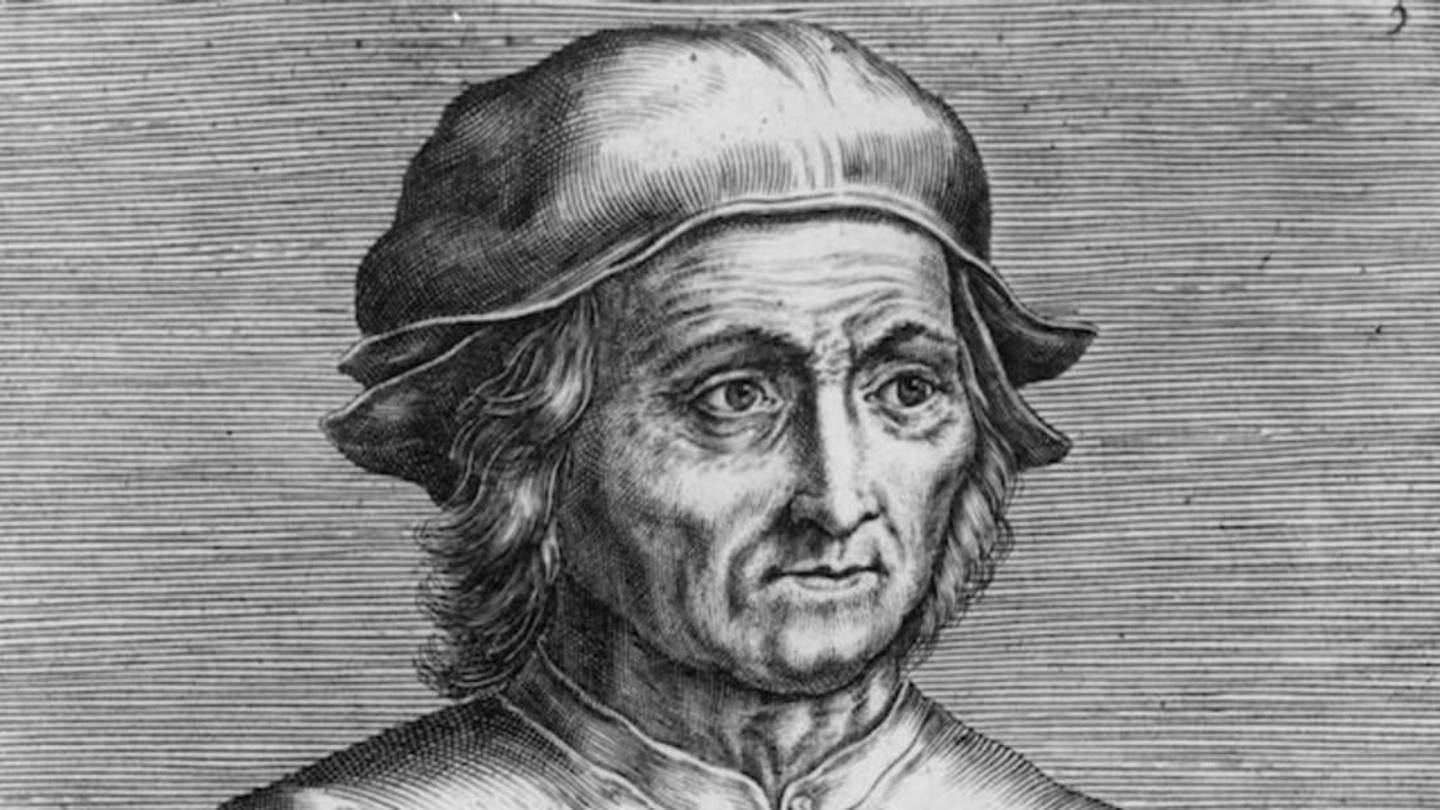
Hieronymous Boschâs paintings are all about the details. The celebrated Early Netherlandish painter is known for his Biblically-themed landscapes, which he peppered with fantasticalâand often macabreâmicro-portraits of humans, animals, monsters, and hybrid creatures. Many of these works are thought to illustrate humanityâs foibles, or serve as a cautionary reminder of sinnersâ eternal fates.
Bosch was presumably born in 1450, and was in his mid- to late 60s when he died in 1516. In honor of the quincentenary of Boschâs funeral mass, which was held on August 9, 1516, here are eight facts about the artistâs life, work, and legacy.
Few artists are as reveredâor as mysteriousâas Hieronymous Bosch. At the height of his career, he was famous throughout Europe, and art lovers in the Netherlands, Spain, Austria, and Italy enjoyed (and often imitated) his work. Still, historians know surprisingly little about the painterâs life.
Bosch left behind no diaries, letters, or documents. Further complicating things, art historians say there are only around 25 known paintings and some 20 drawings worldwide attributed to the artist. Also, Bosch never dated his works , so we donât know exactly when he painted them, or how old he was at their time of completion.
Hereâs what we do know about Bosch: He was born in the Dutch municipality of 's-Hertogenbosch, likely between 1450 and 1455. (Like many aspects of Boschâs life, his exact birth date is unknown.) Records show that he spent much of his life in his hometown, and that his father, grandfather, great-grandfather, and most of his uncles were also painters. Boschâs father, Antonius van Aken, was an artistic adviser to the Illustrious Brotherhood of Our Blessed Lady, a prestigious Christian confraternity that revered the Virgin Mary. Bosch, himself, joined the fraternity in the late 1480s.
The artist was also a husband: Around 1480, he married Aleyt Goijaert van den Mervenne (sometimes written as Aleyt Goyaerts van den Meerveen, among other spellings). She was from a wealthy merchant family in the nearby town of Oirschot, where they moved soon after.
The Brotherhood of Our Blessed Lady recorded Boschâs death in 1516, and his funeral mass was held at the church of Saint John on August 9 of the same year. Experts donât know how Bosch died, or his precise date of death.
In short, Bosch was a respected, influential, and wealthy member of his Dutch communityâa life that belies his morbidly creative mind.
Boschâs life is ambiguous, and so is his name. Over the centuries, the artistâs first name has been recorded as Heironymous, Jheronimus, Jeroen, Jerom, and Jerome. And in 1604, Dutch art historian Karel van Manderâthe artistâs first biographerâused the name Ieronimus. Around the same time period, 16th-century art critic José de Sigüenza wrote Boschâs first name as Jerónimo.
As for the painterâs last name, it isnât even really Bosch: His hometown, 's-Hertogenbosch, was colloquially known by locals as Den Bosch, and Bosch chose to adopt this moniker as his surname. Historians have recorded Boschâs real last name as Anthonissen, Anthoniszoon, van Aken, or van Aeken.
Most contemporary sources say that Boschâs birth name was, in fact, Jheronimus van Akenâso why so many monikers? Art historian Nils Büttner offers some clarity in his 2016 biography, Hieronymus Bosch: Visions and Nightmares. According to Büttner , Bosch used the name Hieronymus van Aken while signing official legal documents. (The Illustrious Brotherhood of Our Blessed Ladyâs records also refer to him by this name.) Publicly, Bosch went by the name Jheronimus Bosch. Meanwhile, Boschâs family and peers simply called him Joen. Today, most academics simply refer to the artist as Hieronymus Bosch.
3. BOSCH'S MOST FAMOUS WORK IS
THE GARDEN OF EARTHLY DELIGHTS
Hieronymus Bosch (circa 1450â1516) [Public domain], via Wikimedia Commons
Bosch may have died 500 years ago, but contemporary musicians, designers, choreographers, artists, and authors continue to draw inspiration from his worksâmainly from his most famous painting, The Garden of Earthly Delights .
English rock band XTC recorded a track called âGarden of Earthly Delightsâ for their 1989 album Oranges & Lemons. In 2015, Raf Simonsâwho served as Christian Diorâs creative director from 2012 until late 2015 âbased an entire fashion collection on the painting. Choreographer and director Martha Clarke distilled the work into a dance/theater production . For its Spring/Summer 2014 season, Dr. Martens created Bosch-inspired heaven and hell-printed boots, shoes, and bags. Crime writer Michael Connelly named his popular Detective Hieronymus "Harry" Bosch character after the painter . Thereâs even a Bosch-themed coloring book .
Though The Garden of Earthly Delights (1510-1515)âwhich portrays the entire human experience, from earthly life to heaven or hell, in three attached canvasesâis Bosch's undisputed masterpiece, he created other fantastical, lesser-known works , like The Last Judgment  and The Haywain Triptych . Both paintings trace humanityâs path from creation to a sinful earthly existence, all the way to fiery damnation.
Many of Boschâs works are thought to have been created for religious patrons. However, influential secular figures might have also enjoyed and purchased his elaborate paintings. For example, The Garden of Earthly Delights was displayed in Hendrik  III of Nassau's  Brussels palace by 1517âmeaning either the ruler or another wealthy patron likely commissioned it.
Not all of Boschâs paintings survived the centuries, and some that were once attributed to him have been debunked as imitations. But thanks in part to wealthy early collectors, like Philip II of Spainâwho amassed multiple Bosch works during the late 16th centuryâmany of them can today be seen in museums like Madrid's Museo Nacional del Prado .
Boschâs paintings belong to some of the worldâs most famous museums: the Louvre  in Paris , the Metropolitan Museum of Art  in New York, and the National Gallery of Art  in Washington, D.C ., to name a few. But until recently, one of the painterâs forgotten works sat in storage for decades at the Nelson-Atkins Museum of Art in Kansas City, Missouri.
The Nelson-Atkins Museum had acquired the paintingâwhich was likely once part of a triptychâin the 1930s. Called The Temptation of St. Anthony , it depicts the titular saint filling a jug with water as he supports himself with a staff. Tiny, surreal figures hover in the foreground: a floating sausage, a fox-monster hybrid, and a toad wriggling out of the water.
The work was likely produced between 1500 and 1510. Experts believed it was created by one of Boschâs art pupils, who studied at a workshop he ran in 's-Hertogenbosch. But in early 2016, experts who participated in an international research project called the Bosch Research and Conservation Project (BRCP) announced that Bosch himself had painted The Temptation of St. Anthony . The researchers spent years examining this painting, along with other Bosch-attributed works held by museums around the world. They concluded in a statement that âBoschâs hand is still clearly recognizable in the original brushwork.â
Needless to say, the âlostâ work is no longer in storage: Earlier this year, Boschâs hometown, 's-Hertogenbosch, held a major retrospective at the Noordbrabants Museum. The event was called âJheronimus BoschâVisions of a Genius,â and was timed to coincide with the 500-year anniversary of Boschâs death. It featured 17 of the artistâs surviving paintings, including The Temptation of St. Anthony . It also showcased 19 of his drawings, one of them a newly discovered work called The Infernal Landscape . (Sadly, The Garden of Earthly Delights was deemed too fragile to be transported from its current home at Madrid's Prado.)
BRCP also discovered that two Bosch-attributed works from the Museo Nacional del Prado, The Cure of Folly  and another work called The Temptation of St. Anthony , were likely painted by his pupils. These works were pulled from "Visions of a Genius" shortly before it opened on February 13, 2016.
6. BOSCH MIGHT HAVE INCLUDED A SELF-PORTRAIT IN
THE GARDEN OF EARTHLY DELIGHTS.
There are no reliable surviving portraits of Bosch, so we donât know exactly what he looked like. However, one art historian, Hans Belting, believed he incorporated his own figure into The Garden of Earthly Delights. Belting theorized that the cracked eggshell-man in middle of the third panel is Bosch, smiling ironically at the viewer.
In 2014, a Tumblr blogger named Amelia was studying The Garden of Earthly Delights when she noticed a peculiar detail : a series of musical notes tattooed on the posterior of one of Boschâs tortured sinners. She zoomed in on the notes, transcribed them into modern notation, and recorded a piano version of the â600-years-old butt song from Hell,â as she referred to it in a blog post. Someone also wrote accompanying lyrics (Sample line: âWe sing from our asses while burning in purgatoryâ). Amelia called the song "The Music Written on This Dude's Butt.â
You can listen to the song online âbut, as Amelia herself points out, keep in mind that there are probably errors in the transcription, and the original tune likely sounded different during Boschâs era. Â
You can celebrate the painterâs legacy by attending the annual Bosch Parade , a floating river extravaganza thatâs typically held each June in 's-Hertogenbosch. The regionâs creative types pool together to build elaborate, Bosch-themed floats, which they navigate down the Dommel River as thousands of onlookers enjoy the spectacle from land.Â
Additional Source: Hieronymus Bosch: Visions and Nightmares , Nils Büttner Â
Loading recommendations... Please wait while we load personalized content recommendations