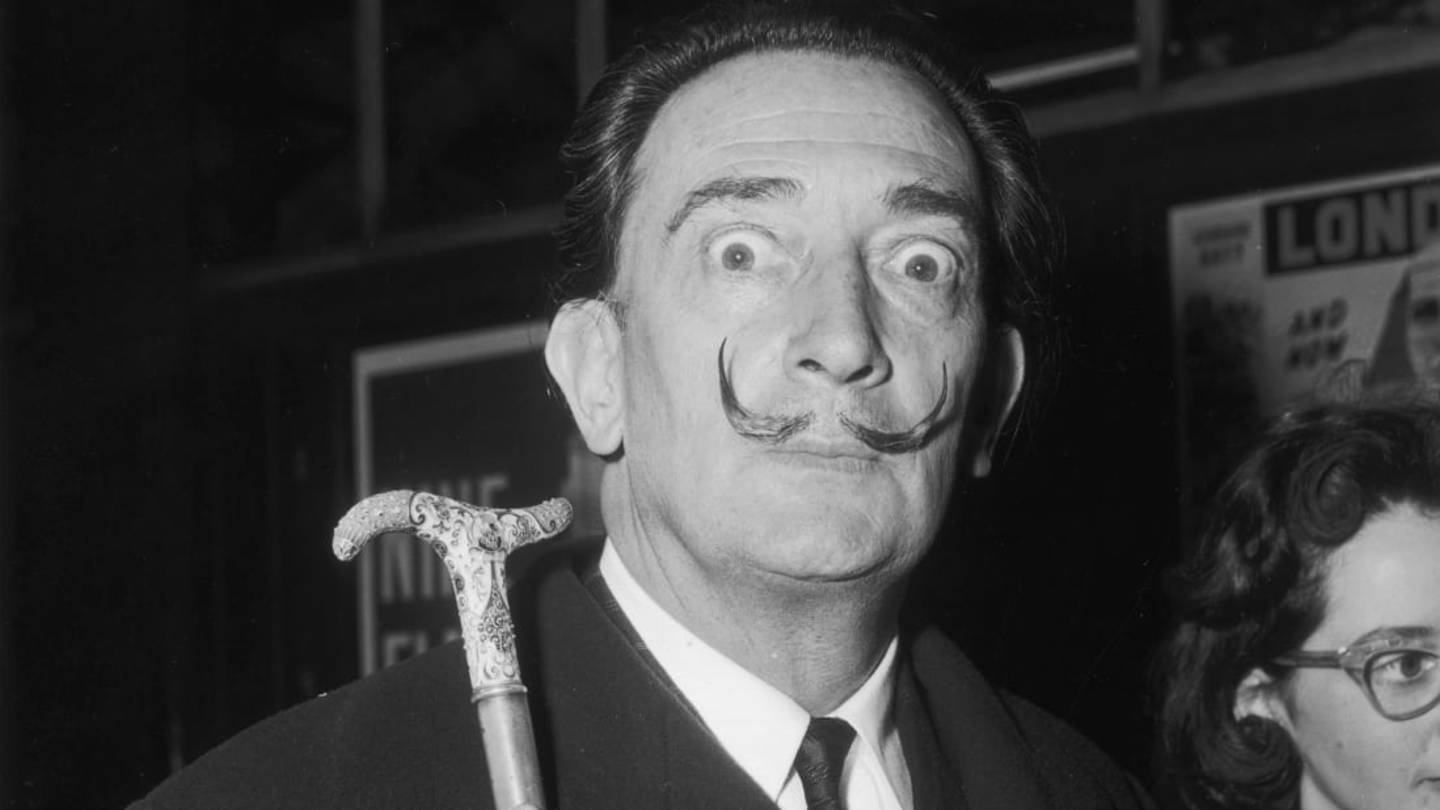
Salvador Dalà was one of the most famous painters of the 20th century. The Surrealistâs self-promotional antics and bizarre artwork made him an international celebrity early in his career, and there are still traces of him littered throughout pop culture. References to the melting clocks in his most famous painting, The Persistence of Memory , have cropped up on everything from The Simpsons to news coverage of the 2015 New England Patriots's Deflategate scandal. His distinctive personal style is now so iconic that he has become a Halloween costumeâone instantly recognizable by mustache alone .
The artistâs long career was full of unexpected twists, and even if you've seen his work, you probably donât know how far-reaching his influence remains today, more than a century after he was born on May 11, 1904.
Dalà painted one of his earliest known works, Landscape of Figueres , in 1910, when was about 6 years old. The oil-on-postcard work depicts a scene in his Catalonia hometown, and now hangs in the Salvador Dalà Museum in St. Petersburg, Florida. He also found success relatively early; he created his most iconic work, The Persistence of Memory , when he was just 27.
Even from a young age, Dalà bristled at the confines of traditional schooling. He was bright but easily distracted, and more interested in doodling than studying. He began his education at age 4 at a local public school in his hometown of Figueres, but only two years later, his father transferred him to a French-speaking private school, âdue to that first option having failed,â as the Dalà Foundation tactfully explains it . At his secondary school, he embraced his love of public attention by throwing himself down stairs in front of his classmates and teachers, as he wrote in his autobiography The Secret Life of Salvador Dalà .
When he graduated, his father insisted that he go to the School of Fine Arts in Madrid, on the grounds that if he had to be a painter, he should at least be qualified to teach. He would be expelled from the school not once, but twice. His first expulsion in 1923 was over his role in student protests involving painter Daniel Vázquez DÃaz, who students felt had been unfairly denied a professorship in the painting department. However, Dalà returned to school the next year, only to face expulsion again in 1926.
In his autobiography, Dalà explained that his second expulsion was the result of him refusing to submit to an oral exam, telling them, âI am infinitely more intelligent than these three professors, and I therefore refuse to be examined by them. I know this subject much too well.â This marked the final straw for his academic career.
Dalà pioneered what he called the âParanoiac-Criticalâ method, designed to help him access his subconscious. He described it as a âspontaneous method of irrational knowledge, based on the critical-interpretative association of the phenomena of delirium.â One of the ways he would access this delirious state without drugs or alcohol was to stare at a fixed object and try to see something different within itâmuch like you might see a shape in the clouds, as the National Gallery of Victoria in Australia explains it [ PDF ]. Or, he would try to keep himself between sleep and wakefulness, napping with a spoon in his hand and a mixing bowl in his lap. When he fell asleep, the spoon would fall into the bowl, and he would wake up. He would continue to do this in order to keep himself in a semi-conscious, dreamlike state, according to Dalà scholar Bernard Ewell.
The Surrealist movement was heavily influenced by Sigmund Freud , whose work was just beginning to be translated into French for the first time when the movement emerged in Paris in 1924. Dalà began reading Freud as a young man at art school in Madrid, and the psychoanalystâs ideas about dreams and the subconscious had a profound impact on his work . âThe book presented itself to me as one of the capital discoveries of my life,â he wrote about reading Freud's The Interpretation of Dreams .
The feeling wasnât exactly mutual at first. Freud considered the Surrealists " complete fools â and had little interest in avant garde art. But Dalà was determined to meet Freud. âMy three voyages to Vienna were exactly like three drops of water which lacked the reflections to make them glitter,â the artist wrote in his autobiography. âOn each of these voyages I did exactly the same things: in the morning I went to see the Vermeer in the Czernin Collection, and in the afternoon I did not go to visit Freud because I invariably learned he was out of town for reasons of health.â (Emphasis in the original.) Finally, Dalà set up an appointment to meet with the 82-year-old Freud in London in the summer of 1938. Dalà recounts that âwe spoke little, but we devoured each other with our eyes.â This may have been less romantic than Dalà frames it; Freud had mouth cancer , and an artificial palate made it difficult for him to speak.
Nevertheless, Dalà showed Freud his painting Metamorphosis of Narcissus , the first painting he made entirely using his paranoiac critical method, as well as an article he wrote on paranoia. The psychoanalyst later wrote to Stefan Zweig, who arranged the meeting, that Dalà was an âundoubtedly perfect technical masterâ who forced him to reconsider his opinion of Surrealists.
While Dalà is considered a Surrealist, his fellow Surrealistsâmany of them communistsâtried to expel him from their movement early in his career over his fascist sympathies. In 1934, the âfather of Surrealism,â writer André Breton , called members of the movement to his apartment in Paris. His order against the painter read: âDalà having been found guilty on several occasions of counterrevolutionary actions involving the glorification of Hitlerian fascism, the undersigned propose that he be excluded from surrealism as a fascist element and combated by all available means.â
Breton and his supporters were offended by DalÃâs depiction of Lenin in his 1933 work The Enigma of William Tell , as well as by the fascination he expressed for Hitler, who he later said âturned him on.â Furthermore, he had painted a swastika on the armband of the nurse in his painting The Weaning of Furniture-Nutrition , a detail his fellow Surrealists forced him to paint over .
The incident didnât mark the end of DalÃâs dalliances with fascism. He later became a supporter of Spanish dictator Francisco Franco, meeting with the general twice at his palace in Madrid, including to personally deliver a portrait of Francoâs niece.
When the English critic and novelist reviewed DalÃâs autobiography in 1944, he did not hold back in his assessment of this painterâs character. Dalà admits to a number of amoral acts in the book without any show of remorse, including kicking his toddler sister in the head and pushing a boy off a 15-foot-tall bridge as a child. (The book is described by the Dalà Foundation as âan account full of truths, half-truths, and âfalsehoods,ââ so these events may never have happened.) Allowing that the painter was an incredibly skilled artist, Orwell was still horrified, and wasnât afraid to call him out.
âOne ought to be able to hold in oneâs head simultaneously the two facts that Dalà is a good draughtsman and a disgusting human being,â Orwell wrote in the essay. The writer, who traveled to Spain to fight with the Republicans during the Spanish Civil War, was also repulsed by the painterâs politics (or lack thereof). âWhen the European War approaches he has one preoccupation only: how to find a place which has good cookery and from which he can make a quick bolt if danger comes too near,â he mocked.
In the 1940s, Alfred Hitchcock commissioned Dalà to help him create a dream sequence for Spellbound , his 1945 thriller starring Ingrid Bergman and Gregory Peck. âI wanted Dalà because of the architectural sharpness of his work,â Hitchcock explained in one of the extensive interviews he gave to fellow filmmaker François Truffaut in 1962. Hitchcock hoped that Dalà could bring some of the vivid imagery of his work to the dream sequence the movie called for, but the director got a bit more Surrealism than he bargained for. As Hitchcock told Truffaut, âDalà had some strange ideas; he wanted a statue to crack like a shell falling apart, with ants crawling all over it, and underneath, there would be Ingrid Bergman, covered by the ants! It just wasnât possible.â
In the wake of his work with Hitchcock, Walt Disney approached Dalà in 1945 about joining Disney Studio to work on an animated film called Destino , featuring a score by Mexican composer Armando Dominguez. Dalà had drawn up 22 oil paintings and stacks of drawings, and he and legendary Disney designer John Hench created storyboards for the film. But only eight months after they started, the project was shelved for financial reasons, with only 15 seconds of demo reel completed. (Disney and Dalà remained friends despite the hiccup.) In 1999, Roy E. Disney, Waltâs nephew, decided to restart the production. Animators at Walt Disney Studios Paris painstakingly translated DalÃâs original storyboards to create a film faithful to his vision. The 6-minute short was released in 2003 .
In 1955, Dalà arrived at the Sorbonne in Paris for a lecture in a Rolls-Royce filled to the brim with what TIME magazine called âa quaint profusion of fresh cauliflowerââaround 1100 pounds worth, packed to the roof. He proceeded to explain to an audience of 2000 people that âEverything ends up in the cauliflower!â The painter told journalist Mike Wallace in a nearly nonsensical interview in 1958 that the point of the stunt was that he had discovered âthe logarithmic curve of cauliflower.â
Dalà met his future wife, Elena Ivanovna Diakonova, who went by Gala, in 1929, while she was married to Surrealist poet Paul Eluard. (Theirs was something of an open marriage, and they both regularly had affairs .) Dalà met Eluard in Paris and invited him and several other artists to visit him at his home in Cadaqués over the summer. Eluard brought Gala and their daughter Cecile there, and Gala and Dalà fell in love and became inseparable. Gala eventually divorced Eluard, and she and Dalà married in a civil ceremony in 1934, with the approval of Eluard, who remained on good terms with Gala.
Gala became DalÃâs muse, portrait model, and business manager. He even signed his paintings with both of their names, explaining in The Secret Life of Salvador Dalà that âIt is mostly with your blood, Gala, that I paint my pictures.â (Emphasis in the original.)
Dalà bought Gala a centuries-old Catalan castle in the small town of Púbol in 1969, creating a retreat for her that he would only visit if he got her written permission. "Everything celebrates the cult of Gala, even the round room, with its perfect echo that crowns the building as a whole and which is like a dome of this Galactic cathedral,â he wrote of the home in his book The Unspeakable Confessions . When Gala died in 1982, the distraught painter broke the Spanish law prohibiting the moving of corpses without official permission, putting her in the backseat of his car to drive her from their home in Port Lligat to Púbol, where she had wanted to be buried. Dalà moved there after her death to be close to her. Itâs now the Gala-Dalà Castle House Museum .
Dalà was a guest on several game shows during his lifetime. In 1957, he made an appearance on the show Whatâs My Line , serving as the unnamed guest whose career a panel of blindfolded guests had to identify. Despite host John Dalyâs best efforts to rein in the artist, he proved to be a difficult nut to crack, since he tried to answer âyesâ to every question, including âDo you have anything to do with sports, or any form of athletic endeavor?â He was ultimately identified by a final question about whether or not he had a ârather well-knownâ mustache.
DalÃâs gravity-defying facial hair became a topic of conversation when the artist appeared on a 1954 episode of The Nameâs the Same . Host Robert Q. Lewis called the mustache "quite beautifulâ early in the show, and when panelist Gene Rayburn brought it up laterââAre you kidding with the thing?â he asked, gesturing as if twirling a mustacheâDalà answered exactly how you might expect him to. âThis is the most serious part of my personality,â he said. He then went on to explain that his facial hair had some literary influence . âItâs a very simple Hungarian mustache. Mr. Marcel Proust used the same kind of pomade for his mustache.â As for the physics of the thing, it was all in the pomade, he said. He declined to discuss exactly how he got his facial hair to grow to such insane lengths.
In 1954, Dalà published a book with photographer Philippe Halsman entirely devoted to his mustache, featuring 28 images of the iconic facial hair. Halsman and Dalà met in 1941 and collaborated for decades, creating what are still some of the most recognizable portraits of the artist, including Dalà Atomicus , featuring the artist suspended in midair along with several cats, an easel, a bucket of water, and a chair. Each page of Daliâs Mustache: A Photographic Interview presents a short question from Halsman, with answers from Dalà printed on the next page, below the photograph. The results are, as one would expect, often absurd. âDali, what makes you tick?â one page asks, for instance. âMy hairspring, of course,â Dalà answers. The photographs showed Dalà with a mustache twisted into an infinity symbol, dressed as the Mona Lisa , and using his facial hair as a paintbrush, to name a few examples.
In July 2017, DalÃâs body was exhumed as part of a paternity suit brought by a woman who claimed to be his daughter. The exhumation proved the woman wrong, but it did yield one unexpected discovery: His mustache lives on. According to the forensic experts who saw the body, his trademark waxed 'stache has remained intact since his 1989 death. âThe mustache preserved its classic 10-past-10 position," LluÃs Peñuelas of the Gala-Salvador Dalà Foundation told the Spanish paper El PaÃs (as translated by NPR ). The doctor who embalmed Dalà in 1989 called it âa miracle.â
In 1965, Dalà was scheduled to make a visit to the prison at Rikers Island to give an art lesson to inmates. But on the day the lesson was supposed to take place, sickness confined him to his New York hotel room, and he canceled. Instead, he made the prisoners a painting, a Surrealist take on the crucifixion of Jesus. The painting, unknown to the outside world, hung near a cafeteria trash can in the prison until the 1980s, when it was put away, then rehung near the prisonâs entrance where the inmates couldnât access it. That spot proved more dangerous than the ketchup-splattered wall by the trash cansâin 2003, a group of prison officers stole it , replacing it with a cheap imitation. The officers were prosecuted, but the painting was never recovered. One of the thieves pointed fingers at his conspirator, an assistant deputy warden named Benny Nuzzo, saying that Nuzzo panicked and destroyed the painting after they committed the crime.
DalÃâs art doesnât only appear in galleries and museums. He also did plenty of commercial work. (Fellow Surrealist André Breton nicknamed him âAvida Dollars,â or âeager for dollars.â) He created ads for De Beers Diamonds , S.C. Johnson & Company, Gap, and Datsun station wagons. (The Gap ad featured the tagline âSalvador Dalà wore khakis.â) Between 1938 and 1971, he created four covers for Vogue , and in 1945, one for Town & Country . In one example of his relentless self-promotion, he was even a celebrity spokesperson , shilling for brands like Alka-Seltzer and the French chocolate company Lanvin . Some of his commercial art endures todayâyou can still see his work in the Chupa Chups lollipop logo.
Dalà occasionally moonlighted as a fashion designer, bringing some of his signature motifs to womenswear. He collaborated with Italian fashion designer Elsa Schiaparelli to create clothing inspired by his paintings, like a dress with drawer-like pockets inspired by The Anthropomorphic Cabinet , a shoe hat inspired by a photo Dalà took of Gala, and a lobster-print dress worn by Wallis Simpson in a Vogue photoshoot in 1937. (Dalà regularly put lobsters in his paintings, often using them to represent his fear of castration.)
He also designed a line of swimsuits for a clothing manufacturer in Wisconsin named Jack A. Winter. The creepy bathing suits (on video here ) included a top that looked like a sandwich board and featured a giant pair of eyes, and a bikini that inexplicably came with an inflatable baseball catcher. The suits didnât make it to market, but Dalà reportedly took the inflatables back to his home to use in his pool.
In 1936, Dalà had himself fitted for a deep diving suit in advance of the International Exhibition of Surrealism, a major London art show where his work would be displayed along with other renowned modern artists like Pablo Picasso, Man Ray, Joan Miró, Rene Magritte, and Marcel Duchamp. Dalà planned to give a lecture in the diving suit while holding a billiard cue and two wolfhounds on leashes.
No one could hear his lecture, called âSome Authentic Paranoiac Phantoms,â through the airtight suitâwhich a mechanic had bolted him into before the talkâand a few minutes in, he began to suffocate. He tried to gesture that he needed help removing the helmet, but the audience took it as part of his performance and laughed. As biographer Meryle Secrest recounts in her book Salvador Dali: The Surrealist Jester , âThe more he gesticulated the more they laughed and it took some time, during which Dali thought he would faint dead away, before, as [Surrealist poet] David Gascoyne explained, âwe realized he was in some distress,ââ and Gascoyne rescued him from the bolted helmet with a wrench [ PDF ]. (As with much of the artistâs life, there's a bit of debate over the exact details of the incidentâDalà himself said Gala and the poet Edward James saved him with a hammer, neglecting to mention Gascoyne at all.)
The incident certainly fit with the outlandish public image Dalà had cultivated. âI believe the Dalinian mythology which was already so crystallized upon my return to New York owed a great deal to the violent eccentricity of this lecture in a diving suit,â the artist later wrote in The Secret Life of Salvador Dali . The event was fictionalized in Michael Chabonâs book The Amazing Adventures of Kavalier and Clay , in which one of the characters rescues the artist from a similar predicament at a New York City cocktail party.
Being an exhibition full of Surrealists, DalÃâs stunt was hardly the oddest behavior on display that day. Painter Sheila Legge arrived at the showâs opening carrying a pork chop that quickly went bad in the June heat, and poet Dylan Thomas went around offering visitors teacups of boiled string.
Dalà and Gala were known for throwing elaborate, bizarre dinner parties. At one, a fundraiser in Monterey, California in 1941, guests like Bob Hope and Alfred Hitchcock were asked to dress up as their own dreams. (Gala wore a unicornâs head.) Dalà borrowed monkeys from the San Francisco zoo for the evening, and guests were served fish in satin shoes, followed by live frogs. The event was so lavish that, rather than raising money for refugee artists, as it was designed to, it actually lost money.
In 1973, Dalà released his own cookbook, Les Diners de Gala , a how-to guide to Surrealist cooking that featured some of DalÃâs favorite motifs, like snails, lobsters, and eggs. In keeping with the often sexual themes of his paintings, he also included recipes for an âaphrodisiacâ course. The book was illustrated with photos of Dalà himself in front of banquets of food, his drawings, and some of his paintings, like his work Couple with Their Heads Full of Clouds (1936). The rare cookbook was re-released by TASCHEN in 2016. His 1977 book about wine, The Wines of Gala , was re-released by the same publisher the next year.
Published in 1944, Hidden Faces follows a group of aristocrats living in France before and during World War II. Dalà announced it with signature flair, saying that the ânew times of intellectual responsibilityâ had prompted him to write âa long and boring âtrue novel.â The New York Times reviewed it under the headline âIt's Boring, but Is It Art?â (A paywalled version is here .) âHis sofa in the shape of lips showed more âintellectual responsibilityâ than this,â reviewer Mark Schorer wrote in his scathing column.
Upon its re-release in 1974, other readers were more impressed. A Publishers Weekly review trumpeted that it âdeals brilliantly with love and lovers, war and death, passions and perversions,â while the Observer 's John Melly wrote that it is âso full of visual invention, so witty, so charged with an almost Dickensian energy that it's difficult not to accept its author's own arrogant valuation of himself as a genius.â
Instantly recognizable by his trademark mustache, Dalà inspired a mustachioed Sesame Street puppet known as Salvador Dada. The Muppets have worked in a number of Dalà spoofs over the years, including in a 2015 special called The Cookie Thief , in which a few of the Muppets see a painting called The Persistence of Cookies at the Museum of Modern Cookie.
In the 1960s, the mayor of Figueres, SpainâDalÃâs hometownâ asked the artist to donate a piece to the cityâs art museum, Museu de l'Empordà . Instead, he declared he would donate an entire museum. He began refurbishing the Figueres Municipal Theatre, which was almost entirely destroyed during the Spanish Civil War, and turned it into the Salvador Dalà Theatre-Museum. The museum, with its DalÃ-designed facade decorated with sculptures of giant eggs and bread rolls, officially opened in 1974, but Dalà continued to expand it up until his death.
He also lived there during the last years of his life. After his castle in Púbol was damaged by an electrical fire, he moved into an annex of the museum, the Galatea Tower (named after Gala) in 1984, largely withdrawing from public life until his death in 1989. After he died, he was buried under the theater stage.
In February 2018, Sothebyâs put up for auction two largely unknown Salvador Dalà paintings, rediscovered within the personal collection of an Argentinean family. The artist had originally painted them for Countess de Cuevas de Vera, an aristocrat who split her time between Franceâwhere she hob-nobbed with artists like Dalà and Picassoâand Buenos Aires. They were painted in 1931 and 1932 and were passed down through the countessâs family. âThese are the kind of painting that I do my job for,â Thomas Bompard of Sothebyâs told The Guardian before the works went up for auction, saying he felt âabsolutely privileged to be the one to bring these gems to the market for the first time.â The two paintings sold for a combined $8 million.
Loading recommendations... Please wait while we load personalized content recommendations