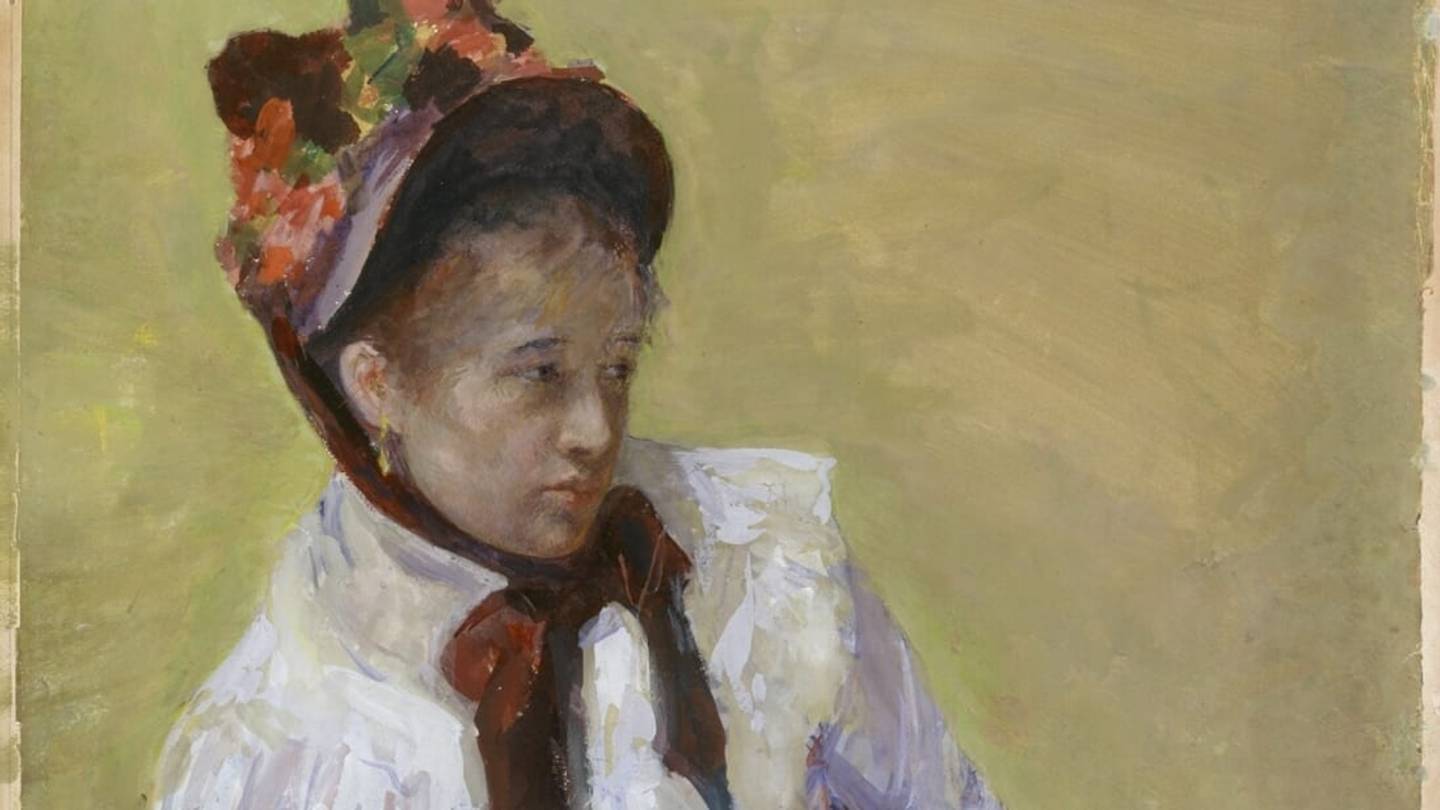
Mary Cassatt spent much of her career painting tender depictions of mothers and their childrenâbut behind these scenes of gentle domesticity was a headstrong woman with a radical sense of independence. An American expat in Paris, Cassatt joined ranks with the early Impressionists and became a successful painter and printmaker, undeterred by the social and professional limitations placed on women in her day. Letâs take a closer look at the life of this pioneering artist .
Mary Stevenson Cassatt was born in 1844 in Allegheny City, Pennsylvania, now part of Pittsburgh. Her father was a prosperous stockbroker and her mother hailed from an affluent banking family. When she was 15, Cassatt enrolled in the Pennsylvania Academy of Fine Arts, one of the countryâs leading art schools. Despite the patronizing attitudes of male teachers and students, Cassatt became determined to forge a career in the artsâan unusual ambition in an era when genteel women were not expected to work outside the home.
Cassatt was resolved to continue her studies in Paris, the center of the art world at that time [ PDF ]. Her father, Robert Cassatt, responded to his daughterâs ambitions with cutting disapproval. âI would almost rather see you dead,â she recalled him telling her. He eventually relented, and Cassatt and her mother sailed to Paris in 1865. But later, when Cassatt was still working to build her reputation as an artist, her father would not give her money for art supplies.
Because the Ãcole des Beaux Arts , the top art school in Paris, wasn't open to women, Cassatt studied privately under a number of prominent instructors. She also secured a permit to copy paintings at the Louvreâan important educational and social practice for aspiring female artists, who were not permitted to congregate at cafés with their male counterparts. Cassattâs diligence paid off; in 1868, her painting A Mandolin Player was accepted to the Paris Salon , the cityâs preeminent, state-sponsored art exhibition. Whatâs more, her submission was hung âon the line,â or at eye level, rather than at the top or bottom of the wallâa sign that the work was particularly impressive to the Salonâs jury.
When the Franco-Prussian War broke out in the summer of 1870, Cassatt sailed back to Pennsylvania and moved in with her family. In spite of the promising start to her career abroad, Cassatt found herself in a slump. Her family took up a summer residence in the country, where Cassatt was frustrated by the lack of professional models to paint and great artworks to study. Two paintings that she had placed in a New York gallery didn't sell , so she took them to Chicago in the hopes of finding a more willing market there. Unfortunately, her visit coincided with the Great Chicago Fire of 1871, which burned through thousands of buildings in the cityâincluding the jewelry store where Cassattâs paintings had been put on display. She was unharmed, but her artworks were destroyed.
Cassatt longed to return to Europe. âMy fingers ⦠itch,â she wrote , âand my eyes water to see a fine picture again.â When Cassatt received a commission to paint two copies of works by the Renaissance master Correggio, which were located in Parma, Italy, she was finally able to sail abroad. After a period of work, study, and travel in Europe, she settled in Paris in 1874.
Though her paintings were repeatedly accepted by the Salon, Cassatt grew exasperated by the Parisian art establishment, finding its tastes too conservative. One of her two submissions to the 1875 Salon was rejected, only to be accepted the next year when she darkened the background to make it more conventional. In 1877, both of her entries were rejected by the Salonâs jury , marking the first time in seven years that her works had not been included in the esteemed exhibition. Cassatt didn't hide her discontent. "She is entirely too slashing,â one of her friends complained , â[and] snubs all modern art.â
Cassatt encountered a more like-minded cohort of artists when Edgar Degas invited her to join the Impressionists in 1877. The members of the group had also experienced rejection by the Salon and had been exhibiting their works independentlyâa radical move at the time. Cassatt got to work preparing for the fourth Impressionist exhibition of 1879, which ultimately featured 11 of her paintings . Bright colors and pronounced brushstrokes set Impressionist works in marked opposition to the polished paintings favored by the Salon, and the group was, initially, widely mocked . But Cassatt, who was the only American artist officially associated with the Impressionists in Paris, felt liberated by the new style. âI took leave of conventional art,â she recalled . âI began to live.â
Cassatt discovered Degasâs now-famous pastels in 1875, while passing by a gallery window. âI used to go and flatten my nose against that window and absorb all I could of his art," she later said . "It changed my life." Degas was similarly enthralled by Cassattâs work when he came across one of her paintings at the Paris Salon of 1874. âIt is true,â he reportedly exclaimed . âThere is someone who feels as I do.â He was 10 years older than Cassatt and had a profound influence on her work. But their relationship wasn't merely one of a teacher and a student; they were collaborators, working side by side , visiting exhibitions together and exchanging ideas. Cassatt inspired Degas to experiment with metallic paint and he depicted her walking through the Louvre in an intimate series of artworks.
Cassatt and Degas drifted apart as their styles evolved and diverged. The Dreyfus Affair , a political scandal that saw a Jewish army captain wrongfully convicted of treason, also drew a wedge between them; Cassatt believed in Dreyfusâs innocence, while Degas vehemently did not . But Cassatt nevertheless grieved when Degas died in 1917. âHe was my oldest friend here,â she wrote , âand the last great artist of the 19th century.â
Though Cassatt never married or had a family of her ownâshe believed that doing so would be an impediment to her career âshe was well known for her tender, yet unsentimental portraits of mothers and their children . Cassatt was inspired in part by Renaissance depictions of the Madonna and Child , but her works have an unposed and intimate quality, capturing small moments of domestic life: a mother bathing her child , a baby cupping his motherâs chin, a woman breastfeeding . Cassattâs frequent return to scenes of domesticity was in part a matter of access. She was not free to join her male colleagues in roaming Parisian cafés and clubs, so she painted the spheres that women occupiedâand where they were in control . âBy depicting such humble environments,â writes art history scholar Bridget Quinn, âshe elevated scenes of womenâs work, pastimes, friendships, and occupations as worthy of high art.â
In 1890, Cassatt visited a major exhibition of Japanese woodblock prints in Paris. Rendered in the Ukiyo-e style, the prints depicted sumptuous pleasure scenes: geishas, Kabuki actors, sumo wrestlers, beautiful landscapes. Cassatt was enthralled. âI dream of doing it myself and canât think of anything else,â she wrote . Instead of woodblocks, she worked with metal printing plates to emulate Ukiyo-e âs bold lines, flat colors and intricate patterns. Her subjects were once again bourgeois French women, but she borrowed directly from the Japanese works. Cassattâs The Coiffure , for instance, echoes a print by Kitagawa Utamaro depicting a woman examining her hair in the mirror. Ten Ukiyo-e -inspired prints were included in Cassattâs first solo show in 1891, and the series is still hailed as some of her best work.
In 1892, Cassatt was commissioned [ PDF ] to paint a sprawling canvas mural for the â Womanâs Building â at the World's Columbian Exposition , which was due to take place the following year in Chicago. The building would showcase womenâs achievements, and Cassatt was tasked with creating a mural that explored the idea of the âModern Woman.â She had never worked on such a large scaleâthe mural was to span 12 feet by 58 feetâbut thought it would be â great fun â to try something new. Cassatt created a three-paneled, richly allegorical piece depicting womenâs ambition, knowledge, and creativity. The center and largest panel, titled âYoung Women Plucking the Fruits of Knowledge and Science,â referenced the Biblical story of Adam and Eveâbut in Cassattâs painting there are no men, only women passing the fruits of their knowledge to one another.
At the end of the fair, the Womanâs Building was demolished and Cassattâs mural was put into storage. Although she reproduced similar themes in later artworks, the mural itself disappeared without a trace.
In 1910, when she was 66 years old, Cassatt traveled to Egypt with her brother Gardner and his family. She was awestruck by Egyptian relicsââ[I]t is surely the greatest Art the past has left us,â she declared âbut also left shaken, unsure how to measure her own works against these ancient triumphs. She claimed that she felt âcrushed by the strength of this Art.â Another blow came when Gardner, who had fallen ill during the trip, died. Cassatt was devastated and her own health began to unravel; she was ultimately diagnosed with diabetes. Physically and emotionally depleted, she could barely bring herself to work for the next two years [ PDF ].
Cassatt acted as an advisor to a number of art collectors and advocated for the donation of art to American museums. Her most important client was her friend Louisine Havemeyer . They met as young women in Paris in the early 1870s; Cassatt encouraged Havemeyer (then known by her maiden name Elder) to purchase a Degas pastel , marking the start of a decades-long friendship rooted in a mutual love of art. With Cassatt as their guide, Havemeyer and her husband, the â sugar baron â H.O. Havemeyer, amassed a stunning collection of works, particularly rich in its representation of 19th-century French artists like Monet , Manet, Degas, and Cézanne. By donating their acquisitions to American museumsânotably the Metropolitan Museum of Art in New York, which holds most of the collectionâthe Havemeyers helped cultivate the publicâs taste for Impressionism. Louisine Havemeyer readily credited Cassattâs influence, calling her the â fairy godmother â of the collection.
Cassatt was a staunch supporter of womenâs right to vote. âIf the world is to be saved, it will be the women who save it,â she told Havemeyer, a fellow suffragist. In 1915, Havemeyer organized an exhibition to raise funds for the suffrage movement. By this time, cataracts had rendered Cassatt nearly blind and she could no longer work, but she gave 18 previously completed pieces to the show. Though anti-suffrage factions of high society boycotted the exhibition , enough money was raised for Havemeyer to establish a fund for the suffragist cause. Cassatt was thrilled. âI am so very glad about the exhibition,â she wrote to her friend. âThe time has finally come to show that women can do something.â
Loading recommendations... Please wait while we load personalized content recommendations