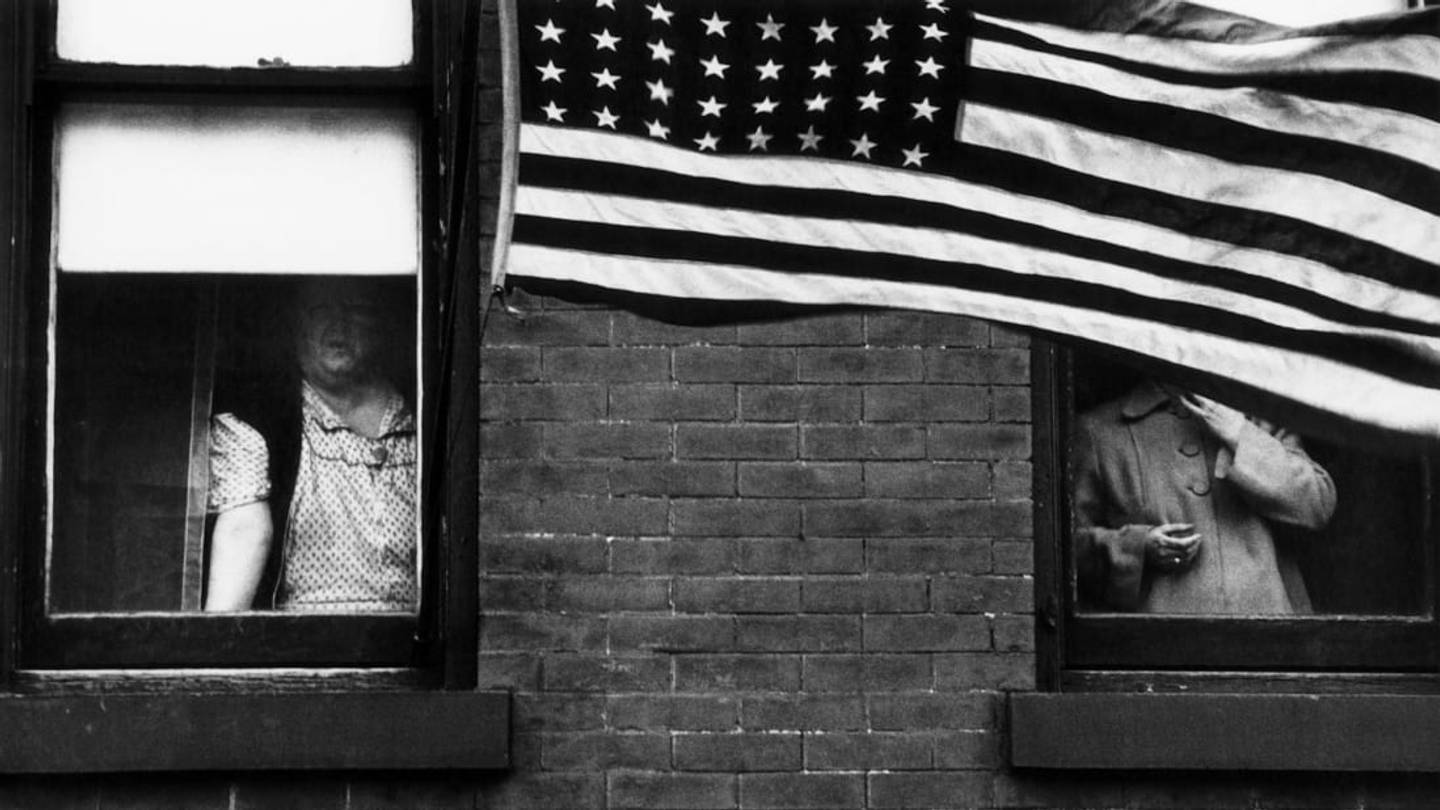
On a hot September day in 1957, Jack Kerouac sat on a New York City sidewalk holding America in his hands. At least, thatâs how it felt. In reality, he held a book of photographs taken by a Swiss photographer named Robert Frank. Like Kerouac, who had recently released On the Road, Frank had just completed a historic road trip across America. He had driven from New York City to Detroit to New Orleans to Los Angeles, photographing practically every big city and one-horse town along the way. He planned to publish the photos in a book and wanted Kerouac to write an introduction. So the two met outside of a party, plopped down on the sidewalk, and flipped through the pictures.
There were cowboys and cars, jukeboxes and tattered flags, cemeteries and shoe shiners, politicians and proselytizers. And, in one photo, a shining stretch of straight highway in New Mexico, darting like an arrow toward the horizon. Kerouac was sold. To him, the pictures did more than capture America: The black-and-white film had âcaught the actual pink juice of human kind.â He agreed to write some text to accompany it. âWhat a poem this is,â heâd tell Frank. âYou got eyes.â
It hadnât been easy. Frank had driven more than 10,000 miles to capture those photos. Along the way, he used 767 rolls of film, filled uncountable tanks of â¨gas, and endured two stints in jail. He knew the photographs were good. But he didnât necessarily think they would change photographyâor how people see the country.
The pictures in Robert Frankâs The Americans are so ordinary that you just might miss what makes them extraordinary. They show people eating, sitting, driving, waitingâand thatâs about it. Rarely do the subjects look at the camera. When they do, they seem annoyed. Many of the photos are blurry, grainy, and smudged by shadows. But the devil is in those details: Together, the pictures comprise a skeptical portrait, an outsiderâs view of a country that was, at the time, all too sure of itself.
Born in Switzerland in 1924, Robert Frank grew â¨up in a bubble about to burst. Before his 15th â¨birthday, he saw the stock market crash, the Spanish Civil War erupt, Jews like his father lose their citizenship, and Nazis invade Poland. Frankâs family worried that Switzerland was next. But it wasnât: Paradoxically, Frankâs biggest complaint as a teenager was that the country was as small, quiet, and dull as ever. He desperately wanted out.
When Frank was 17, a path appeared. A professional photo retoucher named Hermann Segesser lived above his family, and â¨one day, the teenager visited him. âI want to learn what you do,â Frank said. Segesser took Frank under his wing, teaching him how to work a camera, develop negatives, make prints, and retouch photos. For the next five years, the shutterbug informally studied photography with Segesser and other Swiss lensmen, building a portfolio of â40 Fotosâ that he hoped would be his ticket out of Switzerland.
In February 1947, Frank took his collection and sailed to New York City. He didnât plan to stay in New York long, says Sarah Greenough in her book Looking In. But he fell in love with the cityâs energy. âNever before have I experienced so much in one week as here,â he wrote to his parents. âI feel as if Iâm in a film.â
Life felt even more like a movie when he landed a gig as a staff photographer at Harperâs Bazaar. At 22, Frank had already realized his dreamâhe was being paid to take photos. But taking pictures of purses and girdles for the magazineâs fashion section quickly grew tedious. Frank became frustrated by how much control the editors had over his photos, and disillusionment set in. After just one month, he quit.
From there, he wandered. For six years, Frank traveled the world, stopping in Peru, Panama, Paris, London, and Wales. He got married. And he continued to hone his style, taking pictures of whatever he liked. Most of his photos were light, gentle, and romantic, and he dreamed of selling them to big magazines like LIFE, Jonathan Day writes in his book Robert Frankâs The Americans: The Art of Documentary Photography. But his work was consistently rejected. Heâd almost given up on making a career of his art when, in 1953, he returned to America to give it one final shot. âThis is the last time I go back to New York and try to reach the top through my personal work,â he said.
This time, the scene he found in New York was different. Frank had a Swiss friend, a designer named Herbert Matter, who hobnobbed with abstract painters like Hans Hofmann, Franz Kline, and Jackson Pollock. Frank was enamored with their world. His Greenwich Village apartment, overlooking Willem de Kooningâs yard, was in a bohemian wonderland. He met Beat poets like Allen Ginsberg and Gregory Corso, and he soon met Walker Evans, who was famous for photographing the Great Depression.
Frank was taking pictures through it all, absorbing everything he could from his new community. From the abstract painters, he learned to embrace ambiguity and chance, to âfollow your intuitionâno matter how crazy or far-off or how laughed at it would be,â he told William S. Johnson. The Beats encouraged him to treat photography as a jazz solo: spontaneous, raw, present. Most important, the photographers taught him to hate mainstream photography.
In the 1950s, photographs were crisp, sharp, and clean. A photo was perfect only if it followed the traditional rules of composition. Pictures were routinely upbeat, especially in popular magazines trumpeting the American way of life. That aesthetic reached its apogee in 1955, when the Museum of Modern Artâs photography curator, Edward Steichen, introduced an exhibit called âThe Family of Man.â A display of 503 photographs from more than 60 countries, it depicted people as being the same everywhere. Dubbed the âgreatest photographic exhibition of all time,â it was wildly genteel, treating war and poverty as minor blemishes on the human raceâs report card.
But Frank, who had been in Europe during World War II and had visited the poorest parts of South America, knew better. âI was aware that I was living in a different worldâthat the world wasnât as good as thatâthat it was a myth that the sky was blue and that all photographs were beautiful,â Frank told Johnson in 1989.
So he bought a used car and proved it.
Powered by a tank of gas and a grant from the Guggenheim Foundation, Frank puttered west in June 1955. His network of famous friends had helped him win the grant, and money in his wallet meant he could do whatever he wanted. With nowhere in particular to go, he drove. He slept in cheap hotels and started each morning, wherever he was, by taking his Leica 35mm and photographing the closest bar or Woolworths. With Allen Ginsbergâs mantra about spontaneity in mindââfirst thought, best thoughtââhe snapped two or three photos in each spot and moved on. Then heâd visit the post office, the bus and train stations, the cemetery, and other five-and-dimes. He went wherever strangers congregated and tried to blend in. He rarely talked to anyone he photographed.
Shortly into his trip, Frank noticed a trend: The land of opportunity looked like a land of drudgery. Everybody seemed bored and tired. Frank sure felt it. As Greenough recounts, by the time a worn-out Frank reached Detroit, he wrote to his wife, Mary, that he just wanted to âlie down anywhere where it is nice and not think about photographs.â Then his car broke down, and he couldnât help but use the extra time to photograph an African American concert, where he was arrested for having two license plates.
It wasnât the last time Frank ran into trouble, especially as he pressed further south. On the Arkansas border, he was accosted for no particular reason by a sheriff who pulled out a stopwatch and gave him five minutes to leave the state. In Port Gibson, Mississippi, a group of teenagers harassed Frank, calling him a communist. In McGehee, Arkansas, state police pulled his car over on U.S. 65. When the officers peered into the car window, seeing suitcases and camerasâand hearing Frankâs foreign accentâthey suspected he was a spy. They demanded that Frank hand over his film, briefly jailing him when he refused. Before his release, Frank had to sign his name under the heading criminal. It made him furious, and his empathy for others who were being treated unfairly grew. âAmerica is an interesting country,â he wrote to his parents. âBut there is a lot here I do not like and I would never accept. I am trying to show this in my photos.â
Originally, Frank had no agenda but to photograph everyday Americans doing everyday things. But the more he traveled the south, the more his viewfinder stumbled across people the American Dream had seemingly forgotten. More and more, he captured an America that everyone knew existed but preferred not to acknowledge; he looked for the overlooked and captured the weariness in their eyes.
It didnât matter whether Frank caught people standing around a jukebox or a coffin, his camera froze the same look on everybodyâs face. People looked in, looked out, looked at their feet, looked everywhere but at each other. In Miami Beach, an impatient elevator girlâtrapped pressing buttons for strangers all dayâstared into space. In Detroit, working-class men ate at a lunch counter, ignoring their neighbors and blankly looking ahead. In New Orleans, a segregated trolley rambled by; a plaintive black man in the back stared sadly, deeply, into Frankâs lens.
Frank was catching a direct contrast to the smiling humanity of Steichenâs âThe Family of Manâ exhibit. But it didnât anger himâhe was moved. âI had a feeling of compassion for the people on the street,â he told Dennis Wheeler in 1977. He saw beauty in highlighting the truth, even if it was mundane, sad, or small. There was something distinctly American, celebratory even, about giving the voiceless a voice. To Americans, these sights were too ordinary to notice. But Frankâs foreign eyes saw how they affected and controlled everyday life. Automobiles, especially. To Frank, few things defined American life more. They were places to sleep, eat, enjoy a movie, joy ride, travel, wait, make love, and, for some, die. Most of all, cars were a way Americans could isolate themselves. Frank included.
After nine months, he had driven over 10,000 miles across more than 30 states. In all, he had taken 27,000 photographs. When he returned to New York in 1956, he whittled those images down to 1,000 large prints. He tacked and stapled the photos around his apartment like wallpaper. After four months, he chose just 83 of them for his book, The Americans.
According to Jack Kerouac, Frank had âsucked a sad poem right out of America onto film.â But the critics were not so kind. When the volume was first published in Paris, it hardly made a ripple, but the U.S. edition, published in 1959 with Kerouacâs introduction, riled them up. The bottom line, critics said, was that The Americans was anti-American. Minor White described it as a âUtterly misleading! A degradation of a nation!â Bruce Downes scorned Frank as a âjoyless man who hates the country of his adoptionâ and a âliar, perversely basking in ⦠misery.â John Durniak called it a âWart-covered picture of America. If this is America we should burn it down and start again.â
The Americans, after all, was the opposite of what readers saw in the Saturday Evening Post or an episode of Leave It to Beaver. There were no white picket fences, no pies cooling on windowsills. Not a single page would inspire a heartwarming Norman Rockwell painting. It was totally different from the simple, wholesome, patriotic photo essays everybody was used to. Idyllic as the critics believed things were, America was wrestling with dark issuesâMcCarthyism, segregation, poverty, and the Cold War chief among them. America was as lonely as it was big, and Frank had captured glimpses of all of it.
If that was a tough message to swallow, critics must have choked on Frankâs style. The Americans contained everything good photography was supposed to avoid. Arthur Goldsmith of Popular Photography lambasted it as âflawed by meaningless blur, grain, muddy exposure, drunken horizons, and general sloppiness.â But Frank, inspired by the abstract painters he admired, had been ambiguous by design, Day writes. A murky nation deserved murky photos. The composition was as unstable as the American Dream. More practically, the blur, shadows, and strange angles framed details that traditional techniques led viewers to ignore. In one photo, a starlet walks down a red carpet, her face entirely blurred. Our eye drifts to the haggard fans standing behind the velvet ropes, one chewing nervously on her fingernails. Frankâs technique spotlighted details we tend to overlook. And in this case, he saw the people in the margins as the stars.
Despite the critical uproar, the book was largely ignored. Only 1,100 copies were sold, earning Frank $817.12. Soon, he deserted photography and took up filmmaking (most famously documenting the Rolling Stonesâ doped-up exploits in 1972). But it wouldnât be long before The Americans appeared hauntingly prescient. By the late 1960s, politicians and activists were addressing everything Frank had captured: discrimination, mind-numbing work environments, inequality. Street photographers, from Garry Winogrand to Lee Friedlander, were drawing inspiration from its crushing honesty. In an interview with NPR in 2009, legendary street photographer Joel Meyerowitz said, âIt was the vision that emanated from the book that led not only me but my whole generation of photographers out into the American landscape.â Today, The Americans is regularly hailed as the most influential photography book of the 20th century. Exhibitions across the globe have featured Frankâs photos, and, just recently, a 1961 print of that segregated New Orleans trolley sold for $663,750.
More significantly, the book is no longer perceived as anti-American. Having grown up on a continent soaked in wartime propaganda, Frank loved the freedom the United States afforded him as an artistânowhere else did he have as much liberty to experiment so wildly and to photograph so truthfully. âOpinion often consists of a kind of criticism,â he said in 1958. âBut criticism can come out of love.â Uncovering the ugly side of America was Frankâs way of forcing the land he adored to face its problems and improve. Photographing ordinary life was a way to level the playing field, to celebrate not just the little things, but the everyman. What could be more American?
This story originally appeared in the January/February 2015 issue of Mental Floss magazine.
Loading recommendations... Please wait while we load personalized content recommendations