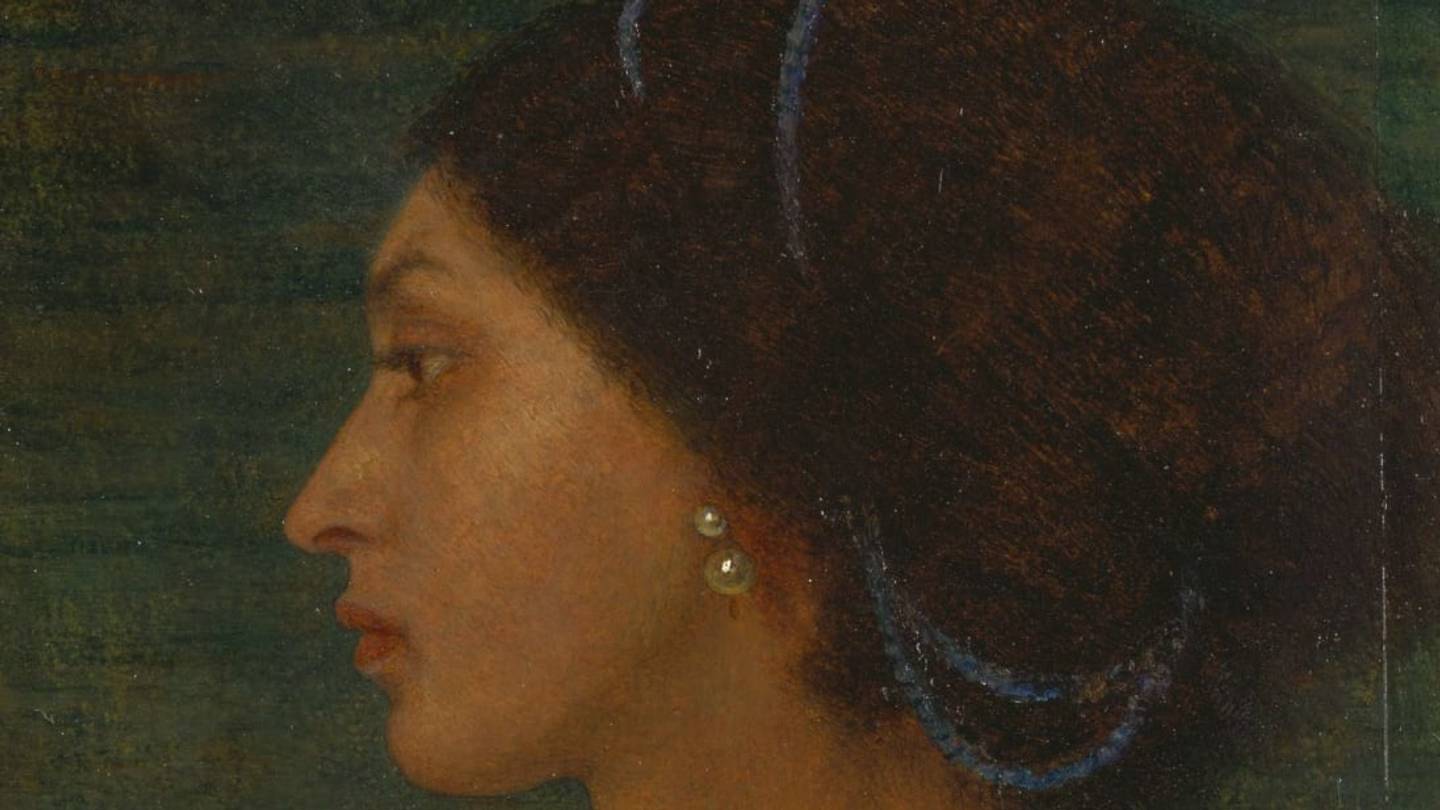
When people mention 19th-century Pre-Raphaelite art, it often conjures a very specific imageâone of glowingly pale women, often gathering wildflowers . Fanny Eaton, the Jamaican-born British art model, was the exception to that rule, but her place in its history has been largely overlooked.
Illustrator and writer Sarah Ushurhe noticed this and sought to change it. She created an animated short about Eaton, which was commissioned by BBC, and even corrected a misidentified sketch at the Victoria and Albert Museum. âThe presence and role of Black people in British history is never highlighted as much from an art history perspective,â Ushurhe told Mental Floss in an email. âI'm delighted that this hidden history about her career is being uncoveredâit allows Black and mixed heritage people to see themselves in non-subservient positions in Victorian art.â Here are eight facts about Eaton, the oft-forgotten Victorian muse.
Fanny Matilda Antwistle was born on June 23, 1835, in St. Andrew, Jamaica. Her mother was Matilda Foster, a formerly enslaved person. Eatonâs father is unknown, but a written description of her as âmulatto,â a derogatory term then associated with mules, indicated that she was mixed race. Some sources propose that âAntwistleâ referred to James Entwistle, a white British soldier, as Eatonâs potential father. Eaton and her mother moved to England sometime during the 1840s.
Although itâs unclear where Simeon Solomon would have met Eaton, he sketched her in 1859. Just a year later, she posed as the titular character in The Mother of Moses , Solomonâs painting that debuted at the Royal Academy in 1860.
When it came to racial representation in 19th-century British art, Black models were often used to highlight the whiteness or status of other models, or as exoticized, unnamed characters . Itâs important to note this social climate, as Eatonâs portraits often portray her as Biblical figures or well-dressed and dignified despite her working class social status.
âAlthough described by some as âwild,â her beautiful, curly natural hair worn in a middle part style has become a trademark of most of the pieces sheâs featured in,â Ushurhe said. Eatonâs curls have a meaningful impact today. âThose with a similar natural hair texture to Fanny, like myself, who may not feel comfortable with their natural hair texture can see themselves celebrated through Fanny in art,â Ushurhe said. âItâs especially notable for the Victorian era, when the Black and mixed heritage presence was usually hidden away.â
The Pre-Raphaelite artists were originally known as the Pre-Raphaelite Brotherhood , and as such, the women artists who contributed to this artistic style were often viewed in relation to their male artist relatives. One of those artists was Rebecca Solomon, sister of Simeon Solomon, who painted Eaton as an Indian maid in A Young Teacher (1861). Joanna Boyce Wells, another notable female artist, painted one of the most strikingly elegant studies of Eaton. Wells had also planned to create a portrait of Eaton as a sibyl, but died at age 30 before this could happen.
Fanny Eaton began living with James Eaton, a horse-cab driver, when she was 22. The couple had 10 children. Fanny became their sole caretaker after James died in his forties. Brian Eaton, Fannyâs great-grandson, has suggested they may not have actually wed, since no marriage document was ever found.
Eaton seems to have stopped modeling near her mid-thirties, with six children in tow at that point. After James died, she took on a variety of jobs , including working as a seamstress, a lodger, and house cook.
Pre-Raphaelite historian and Fanny Eaton scholar Jan Marsh speculated on her blog that The Slave , a somewhat muddy-looking 1886 painting by William Blake Richmond, might have featured Fanny Eaton as the model. Since Eaton seems to have quit modeling decades prior to the completion of this painting, whether or not itâs her remains a mystery.
Loading recommendations... Please wait while we load personalized content recommendations