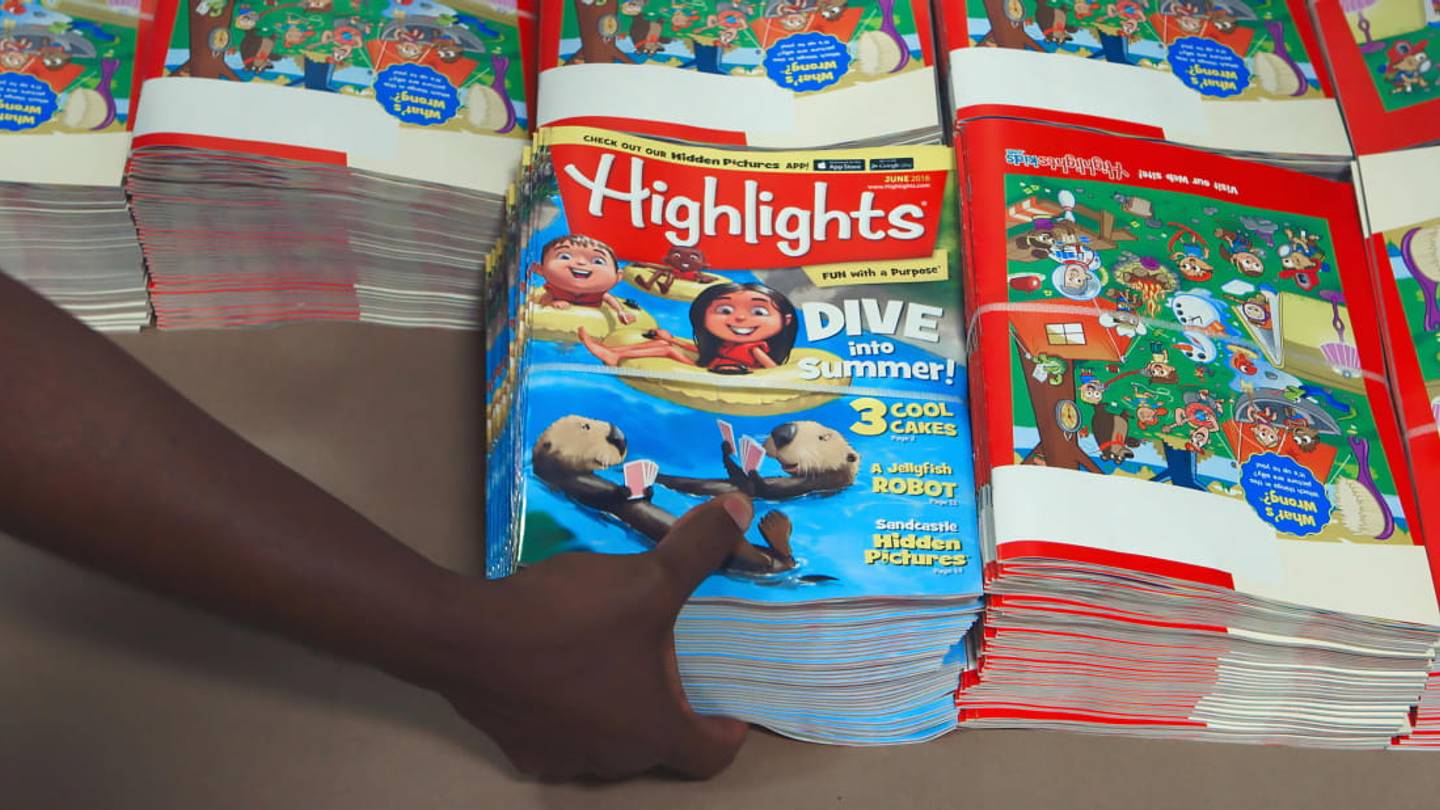
The inside-look-at-a-venerable-publication is a burgeoning documentary subgenre thanks to hits like The September Issue (2009) and Page One: Inside the New York Times (2011). Even still, thereâs a certain cognitive dissonance in hearing that thereâs a new film documenting the long-running kids' magazine Highlights for Children . After all, how much drama could there be in a colorful, inoffensive mag best known for its hidden picture puzzles, lesson-based comics like Goofus and Gallant and The Timbertoes , and its permanent residency in dentists' offices across America? A great deal, it turns out.
Director Tony Shaffâs 44 Pages â currently playing at New York Cityâs IFC Center, streaming on select networks, and playing on demandâis a 90-minute fly-on-the-wall account of the Highlights staff putting together their June 2016 issue, which marked the magazineâs 70th anniversary. Itâs pretty standard stuff: how stories get picked, finding illustrators, staring down deadlines. Full disclosure: I have worked in editorial roles at Scholastic News , Sports Illustrated Kids , and Time for Kids . There are certainly huge differences between those publications and Highlights , but the way the documentary conveys the experience of working for an outlet like this oneâand the responsibilities that come with itâis accurate and honest and an important addition to the inside-media documentary canon.
But where the film soars is in its exploration of the magazineâs history and perpetual resonance. Founded in 1946 by husband-and-wife team Dr. Garry Cleveland and Caroline Myers, Highlights and its âFun with a Purposeâ tagline were created to give children a magazine full of encouragement and guidance.
Originally intended for kids ages two to 12, it currently serves those ages six to 12 and grapples with the issues young people face every dayânot only traditional ones, such as best friend conflicts, but new challenges like digital overload. The magazine is a constant, steadying influence in the lives of children, and it holds an outsized place in their lives. The scenes in the film of kids meeting editors or touring Highlights âs offices in Honesdale, Pennsylvaniaâand of adults engaging with the magazine years after they first read itâare touching and reaffirming.
The film is also chockablock with insight, trivia, and, at times, tragedy about what madeâand makes âHighlights a force in the lives of kids, and culture generally, around the world. Here are 10 of our favorites.
Itâs a pop culture joke at this point how ubiquitous Highlights is in doctor and dentist offices. (Everyone from The Simpsons to Parks & Recreation has riffed on it.) But without the medical community, there would absolutely not be a Highlights today. About four years into the magazine's launch, the Myers were out of money. Their son, Garry Jr.âthen a 28-year-old aeronautical engineerâtook a six-month leave from his job to help his parents wind the business down.
âInstead, when he got there and he started looking into it, he decided that he could make it go,â Garry Jr.'s daughter Pat Mikelson , who is now Highlights âs historian and archivist, said in the documentary. âMy dad rolled out this program to put Highlights into doctors' and dentists' offices and that really is what made Highlights take off and sustain us so we could earn enough money that we could definitely grow and continue.â
Ten years after Garry Jr. saved Highlights , the company had reached 500,000 subscribers and he was thinking of expanding its reach. On December 16, 1960, Myers, his wife Mary, and vice president Cyril Ewart boarded a plane in Columbus, Ohio, bound for New York for a meeting about getting the magazine on newsstands. âThey went into New York in a snowstorm,â Mikelson recalled. âAnd there was a mid-air collision between two planes. One of the planes landed on a street in Brooklyn ... Everyone on those airplanes lost their lives.â
The crash between the United Airlines DC-8 and a TWA Super Constellation is one of the most notorious and tragic aviation disasters in American history. Mikelson and her four siblings went to live with an uncle in Texas while her grandparentsâwho by this time were in their 70sâstepped in to help guide the magazine. â Highlights survived," Mikelson said. "My grandparents just decided they were going to go forward. As a family, it was very difficult, and it was for many years. But we all made it through.â
Today, the company is still a family business: CEO Kent S. Johnson is the great-grandson of Garry C. and Carolyn Myers.
Highlights has a long tradition of helping kids point their moral compass in the direction of goodness (see: Goofus and Gallant ). And in the early days, that mission included publishing passages from the Bible. But the goal was never to push one ideology: Bible stories ran alongside pieces on other world religions, such as Islam, Judaism, and Buddhism. âI was actually very shocked,"Â art director Patrick Greenish Jr. admitted. "For some odd reason, I always thought Highlights was a Christian brand. And they're not. Having good morals doesn't mean you have to be Christian. It's just knowing right from wrong. It's essentially what it boils down to.â
If a magazine is as old as Highlights , chances are good that some pretty big names will have passed through its pages. To wit: Highlights has published poems from Lewis Carroll , Carl Sandburg, Ogden Nash , Emily Dickinson , Langston Hughes , and Rita Dove. At one point in 44 Pages , we see a layout with a story bylined Robert Louis Stevenson. And later, editor-in-chief Christine French Cully shares with editor Judy Burke a gem she unearthed from the archives: a letter from Highlights editor Walter B. Barre, dated February 6, 1968, buying a piece from Walter Cronkite titled "Political Conventions." "We are happy to purchase all rights including copyright to this manuscript for the sum of $200,â Barre wrote. (Itâs unclear whether the piece ever ran.)
One of the realities of working for a children's publication is that you inevitably steer clear of some topics, or at least give them more thought than you would at a general audience publication. One potential minefield is holidays: You donât want to alienate anyone or make them feel like their celebration is less important than another. So it makes sense when Highlights senior editor Joëlle Dujardin explained that the magazine does not publish fiction pieces about Santa Claus. Stories about witches are another no-go zone, which also tracks; there are a lot of people who donât want their kids exposed to the supernatural, but thatâs not why Highlights avoids them.
âWe don't cover [witches] to respect the Wiccan community's feelings about witches and the portrayal of them as being dark and scary, whereas a lot of Wiccan people are not,â Dujardin says. âNo witches, no Santa, no child trafficking.â (That last one seems obvious, but in the documentary we see Dujardin reading a kid-submitted a story about children being kidnapped.)
Goofus and Gallant is one of the perennial features of Highlights , a comic strip featuring two boys who represent very clear sides of a challenge. âHere's the bad choice, here's the good choice,â assistant editor Annie Beer Rodriguez explained. Added Mikelson: âGoofus is the bad and Gallant is the good, always.â
The characters first appeared in 1940 in Childrenâs Activities , the magazine Garry C. Myers worked on before creating Highlights with his wife. But their didactic adventures originally had a more fantastic bent: They first appeared as little elves, before becoming more recognizably human in 1950.
Illustrator Neil Numbermanâa self-professed Brooklyn hipster artistâhas contributed numerous pieces to Highlights , including Hidden Pictures, mazes, word searches, and crossword puzzles. As a result, he has gained some unique insights into what worksâand what really, really doesnâtâwhen it comes to those venerable Hidden Picture puzzles.
â Highlights took us out to a retreat, and it was literally a Hidden Pictures class,â Numberman said. âYou can have more difficult ones and easier ones in an illustration. They actually prefer that so that the kid will find something easily and then start to get engaged with the piece. They want the hidden objects to stay away from the crotch. That's the funniest feedback. Sometimes I'll have a rooster and he'll have a tail and I'll say that could be a glove. But since the glove is coming out of the butt, you can't do that.â
âWe get about 3,000 Dear Highlights letters a year,â Reader Mail coordinator Patty Courtright said. âWe reply to every letter that we receive from a child. I believe that we're the only magazine who writes to a child every time one writes.â That dedication has made Highlights a vital outlet for children.
âWe know that they're writing to us with a real issue that is very serious to them,â editorial assistant Allison Kane said. And sometimes, the issues are capital-S serious. âIf it's a real touchy situation,â like running away, abuse, or divorce, âwe put a red sticker on those and try to respond to those as soon as possible,â Courtright explained. âA little girl said she was being abused by her babysitter and she was told not to tell anybody and this child confided in us. She didn't know what to do. That was a case where we got the authorities involved and the mother was so thankful because she had no clue, of course, that this was going on.â The experience really shook Courtright, but âthen I realized, thank god the child felt that she could write to us.â
"Dear Highlights" isnât the only section of the magazine with the potential to impact kidsâ lives in major ways. "Ask Arizona"âan advice column penned by the fictional character Arizona, who answers imaginary letters based on real kid submissionsâis a relatively new creation. Author Lissa Rovetch has written more than 140 of them, and they can address big topics like transgender issues and scary environmental problems. âI know that it makes a difference for kids all over the world,â Rovetch explained. âSeveral years ago, a girl was kidnapped. For many years, she lived in somebody's backyard and he raped her and she had his two little girls. She was allowed very, very few things from the outside world, and one of the things was Highlights magazine. So the idea, for me, that my stories about how to be a kind, real, feeling, decent human being in the world and it's OK to be scared, it's OK to be nervous, it's OK to be angry, these little girls got that was incredibly moving to me."
If you read Highlights as a kid, you probably submitted a poem or story or letter or drawing, hoping to one day see your name or work in your favorite magazine. (Submissions are still rolling in: Dujardin says they get 300 fiction pieces a month.) Even if you got a reply from an editor, odds are you didnât get published in Highlights . But hereâs some long-game validation: Highlights saved everythingâ everything âand, about a decade ago, donated its archive , spanning the years 1946 to 2007, to Ohio State University.
âWe received about 300 different pallets from the Highlights company,â Deidra Herring, Ohio State's education librarian and associate professor, said. âEvery single letter that a child ever wrote, we have acquired.â They also got any kid-submitted art and company philosophy documents. The archive is a boon to researchers, especially of childhood development, which is a pretty good second life for all that adolescent creative energy and angst.
Loading recommendations... Please wait while we load personalized content recommendations