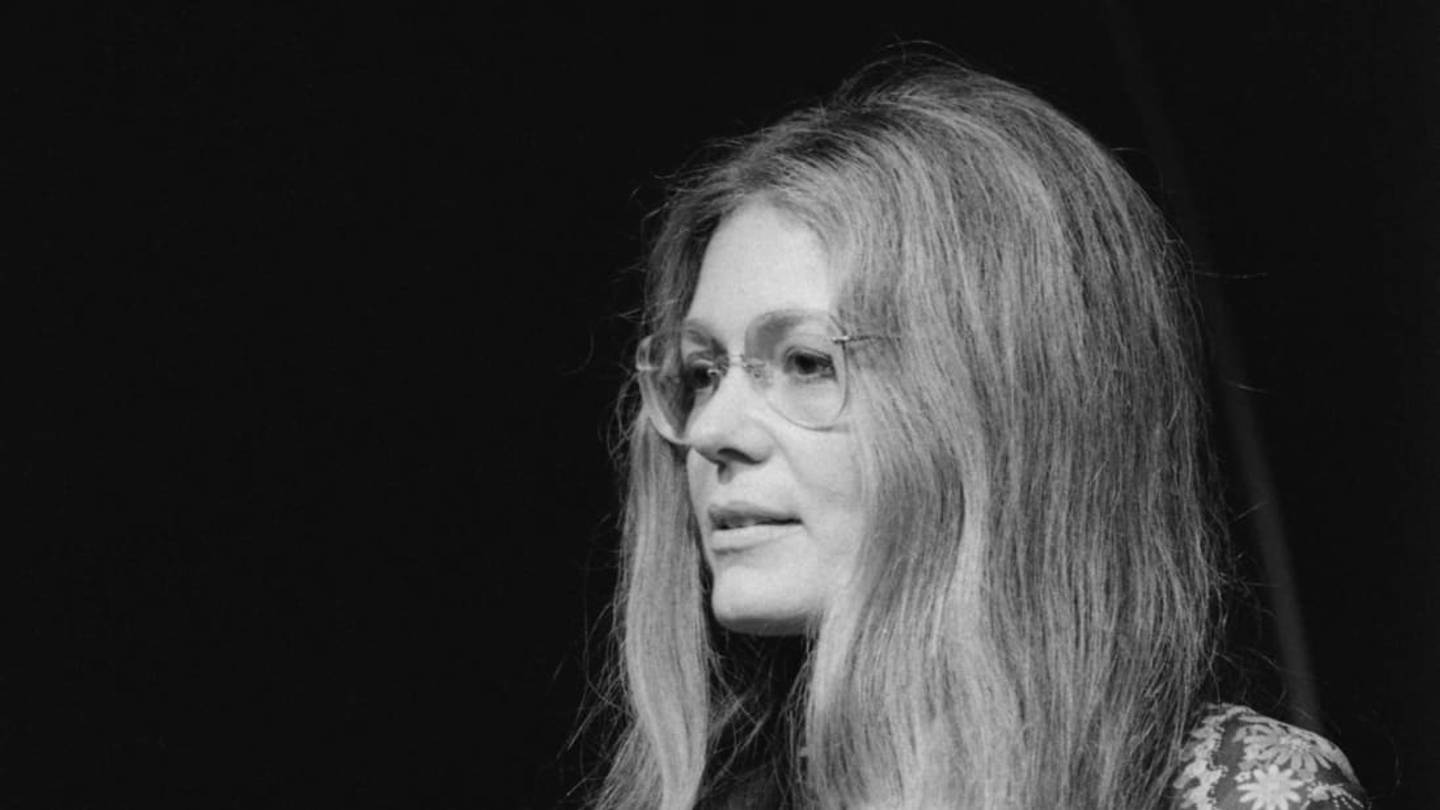
After more than half a century advocating for womenâs rights and other civil liberties, the late Gloria Steinem became one of the most famous feminists of all time. While you might know her best as the face of the womenâs liberation movement or the founder of Ms. magazine, the Ohio-born activist had quite a few other accomplishments to her name. From going undercover as a Playboy Bunny to being Christian Baleâs stepmother, here are 15 incredible pieces of Steinemâs past.
Gloria Marie Steinem, born March 25, 1934, in Toledo, Ohio, didnât see the inside of a classroom very consistently until middle school. She and her parents spent the summers in Clarklake, Michigan, where touring bands came to perform at her fatherâs dance pavilion. Each year when the weather got colder, the Steinems would pack their belongings into a trailer and head south to Florida or California, dealing antiques along the way to fund their journey until the following summer. After Steinemâs parents divorced when she was 10 years old, she moved back to Toledo with her mother and eventually enrolled in school full-time.
Though Steinemâs unofficial home-schooling skipped over certain key subjectsââI'm not sure I've ever learned to do basic math, to be frank,â she confessed on NPRâs Fresh Air âshe remembers learning to read from âketchup bottles and labels and billboards along the highway,â as well as the many books her parents kept around. Louisa May Alcott âs Little Women made an especially significant impression on her as a kid, she told The Guardian , âbecause it was the first time I realized women could be a whole human world.â
Before Steinem was born, her mother, Ruth, had been a newspaper reporter and editor, sometimes even using a male pseudonym so that her work would be published. The nomadic, penniless lifestyle that her husband had chosen for the family didnât suit Ruth, and she struggled with her decision to divorce him. Afterwards, she suffered from depression and developed a dependence on tranquilizers, and a young Gloria became her de facto caretakerâa responsibility that left her disinclined to start a family of her own. âIâd already been the very small parent of a very big child,â she later told People . âI didnât want to end up taking care of someone else.â
After graduating from Smith College in 1956, Steinem was awarded the Chester Bowles Fellowship and spent two years in India, partaking in non-violent protests, contributing to Indian publications, and learning about Gandhian activism. The experience opened her eyes to the issues created by such a stark divide between a societyâs richest and poorest members, and she returned to the U.S. with a newfound passion for civil rights.
While freelancing for high-profile outlets like Esquire and Vogue in the early 1960s, Steinem took on an unforgettable assignment: an exposé for Show magazine on the life of a waitress, or âBunny,â at the Playboy Club in Midtown Manhattan.
To write it, the 28-year-old journalist came up with a fictional identityâa 24-year-old named Marie Catherine Ochs [ PDF ]âand worked undercover as a Bunny for an entire month. Her two-part story, titled âA Bunnyâs Taleâ and published in spring 1963, revealed the abysmally low pay and rampant sexual harassment that Hugh Hefnerâs Bunnies endured at the club. âTo this day when people donât like me they introduce me as a former Bunny, as a put-down,â she told The New York Times in 2016. âOn the other hand, I did improve the working conditions for those women.â
Steinem took a short break from print journalism in 1964 to become a regular contributor for That Was the Week That Was , NBCâs short-lived version of the BBC sketch comedy program of the same name. The 30-minute live episodes, hosted by David Frost, comprised satirical sketches about each weekâs political news and featured celebrities like Henry Fonda, Gene Hackman, and Alan Alda. It was, in Steinemâs words , âthe parent of Saturday Night Live .â
As a leader of the Independent Research Service, an organization founded in 1958 to promote political involvement among young Americans abroad, Steinem accompanied a delegation of students to two World Youth Festivals: one in Vienna in 1959, and another in Helsinki in 1962. Then, in 1967, she told the press that the organization had been funded largely by the CIA.
Because the World Youth Festivals were widely known as an outlet for the Soviet Union to disseminate communist propaganda on an international stage during the Cold War, some people interpreted the CIAâs involvement in sending Americans to the events as a political maneuverâa way for the U.S. government to gather intel and also combat the spread of radical Soviet ideology by presenting a nice, democratic alternative. Steinem insisted that the CIAâs financial support had no strings attached, and she was never asked to report back about the festivals, but that didnât stop people from labeling her a CIA agent or operative after the fact.
In 1968, Steinem helped launch New York magazine, where she wrote a political column and the occasional long-form story. For the December 1971 issue of the magazine, she spearheaded the development of an insert titled Ms. , which featured women-centric articles on subjects like abortion, âde-sexingâ the English language, and the housewifeâs experience. What began as a one-time insert quickly snowballed into its own magazine, and the first issue of Ms. , with Steinem at the helm, hit newsstands in July 1972. She continued to work as an editor for the publication for 15 years, and later worked as a consulting editor.
Steinem self-identified first and foremost as a writer, but she also happened to be the founder or co-founder of countless organizations in a variety of other spheres. To name just a few, there was the National Womenâs Political Caucus , which supports women running for political office; the Womenâs Media Center , launched with Jane Fonda and Robin Morgan in 2005 to provide resources and opportunities for women working in media; and Direct Impact Africa , which provides small communities across Africa with the resources and education needed to achieve economic self-sufficiency.
In the early days of New York , the founders were on the hunt for wordsmiths to create crossword puzzles for their fledgling publication. So Steinem asked Broadway composer Stephen Sondheim, whom she happened to know had a special passion for British-style crosswords. Though Sondheim hardly needed the workâhis credits at that point already included West Side Story (1957), Gypsy (1959), A Funny Thing Happened on the Way to the Forum (1962), and moreâhe accepted, and devised a puzzle for every third issue of the magazine for its first year.
When asked who would play her in a biopic in 2017, Steinem didnât limit her imagination to living actors. She chose Natalie Wood to portray her as a child, and suggested Audrey Hepburn and Cicely Tyson to tackle various stages of her adulthood. She also threw out Marisa Tomei and Meryl Streep, adding, âOf course, Streep could play anything, human or animal.â
A biopic was released in 2020, and although it doesnât include any of Steinemâs dream cast, it does feature plenty of A-listers: Julia Taymorâs The Glorias stars Julianne Moore, Alicia Vikander, Lulu Wilson, and Ryan Keira Armstrong as Steinem at different ages.
In 1966, Steinem started renting an apartment between Park and Lexington Avenues on Manhattanâs Upper East Side. She finally bought the apartment in the 1990s, and purchased another one soon after. In 2017, she bought the third of five apartments in the brownstone building, with plans to use it as a meeting place for traveling feminists. After more than 50 years in the city, the native Midwesterner proved every bit a true New Yorker as those who were born thereâshe never even learned to drive. âI couldnât live anywhere else,â she told The New York Times .
Throughout Steinemâs storied, varied career, the through line had always been her commitment to womenâs issues . She worked tirelessly to legalize abortion, secure congressional votes in favor of the Equal Rights Amendment , create outlets for women in politics and media, and so much more. But she didnât necessarily think of herself as the feminist icon that so many see her as.
âYou know, I get up every morning and try to remember to do what Iâm supposed to do and get my dry cleaning, and so I donât see myself that way,â she said in an interview with Feminist.com. âI just do the best I can, and try to make some balance between what needs doing and what I can uniquely do.â
Steinem was never been shy about rejecting the idea of settling down and starting a family, so her decision to get married in 2000, at age 66, came as quite a surprise to many people. Not only did she become the wife of British businessman and animal rights activist David Bale, but she also became a stepmother to his son, Oscar-winning actor (and former Batman) Christian Bale .
Steinemâs marriage was tragically cut short when David Bale passed away from brain cancer in 2003. âHe had the greatest heart of anyone Iâve ever known,â she said in a statement.
Steinemâs relentless work ethic didnât slow at all with age. She continued to give talks, champion new organizations, and publish works well into her eighties (her most recent book , The Truth Will Set You Free, But First It Will Piss You Off! , was released in October 2019). âThe idea of retiring is as foreign to me as the idea of hunting,â she told Ms. magazine in 2018.
This story was originally run in 2020 and has been updated for 2026.
Loading recommendations... Please wait while we load personalized content recommendations