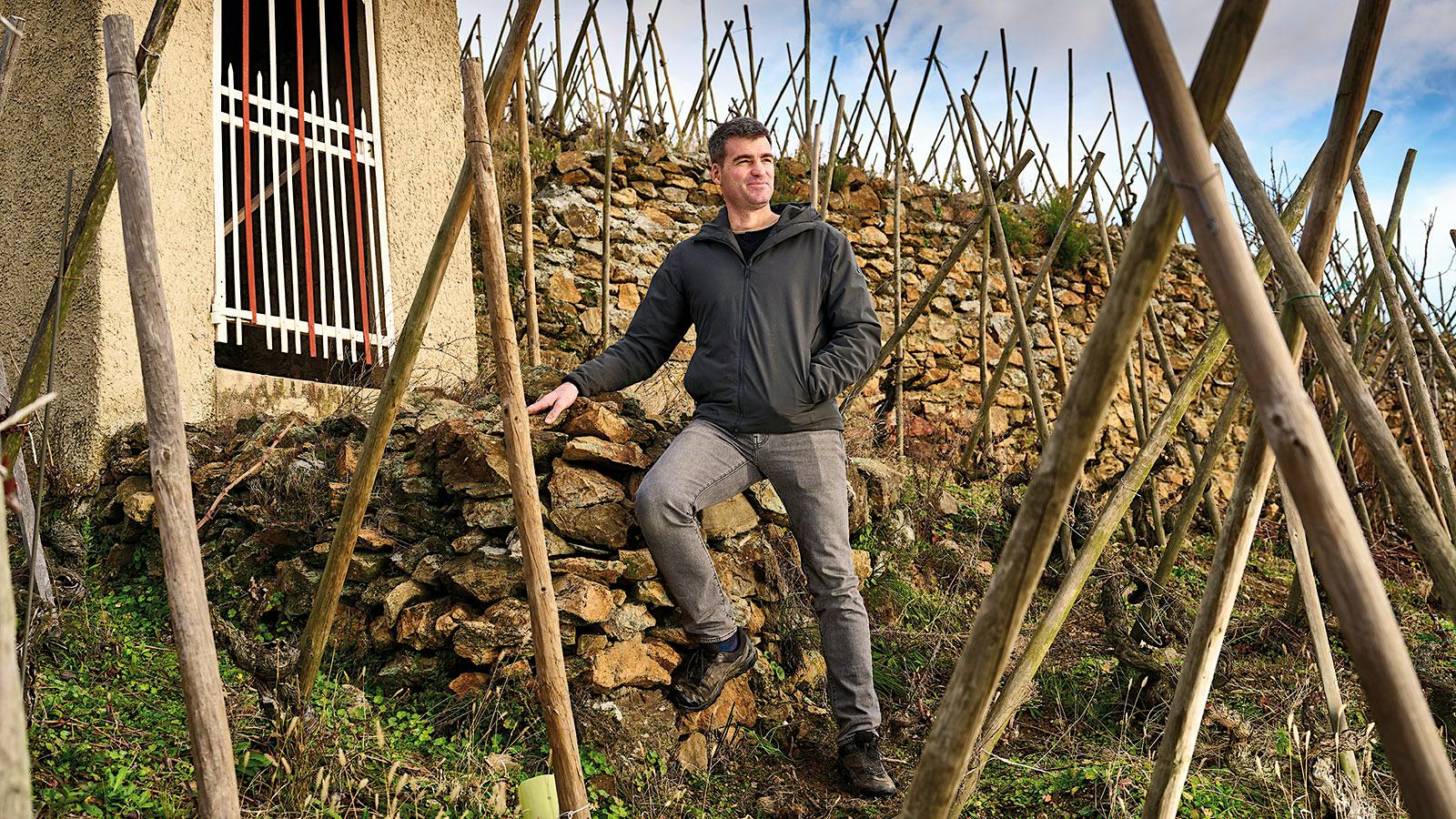
Pierre Rostaing quietly draws samples of his 2025 wines from barrels in his modest, dimly lit cellar in Ampuis, the town in the heart of Côte-Rôtie. The vintage —which marked his 10th leading his family’s benchmark estate—was not an easy one.
“It was frustrating because the 2025 growing season started out so well … .” He trails off wistfully, thinking back to the scorching, dry summer that resulted in a painfully small harvest throughout Northern Rhône. “But what we have is good quality,” he says modestly.
Sure enough, tasting the young wines in barrel with Rostaing, I was struck by their ink-black intensity and concentration. Chewy, fragrant streams of violets, black fruit and iron are supported by finessed tannins and acidity. The wines showcase the Rostaing style—pure, racy and fresh—combined with the power of the vintage.
Many Northern Rhône vintners were quick to proclaim 2025’s greatness—a display of Syrah doing what Syrah does best in these steep, terraced hillsides. But Rostaing, in his classic soft-spoken, understated fashion, is tentative with his enthusiasm. “I hope it could be like 2015, but the wines will have more tannins,” he says, referring to one of the greatest Rhône vintages in recent memory.
Pierre’s restraint is mirrored in the domaine’s winemaking philosophy, which has remained unchanged since his father, René Rostaing, founded the estate in 1971. They are guardians of the traditional, old-school style— whole-cluster fermentation , long macerations, very little new oak—and their savory, soulful wines are among the most captivating expressions of Syrah in the world. Along with Domaine Jamet , located just farther up the Côte-Rôtie hillside, Rostaing is a touchstone for lovers of “classic” Northern Rhône.
Recent vintages reveal increased precision, a dialed-in focus that Rostaing has been pushing toward since he took the reins a decade ago. The stylistic shift is perhaps influenced by his Burgundian training; he worked in Meursault with Dominique Lafon , in addition to stints in Washington and California. Nuances of terroir —between his single-vineyard Côte Blonde (perfumed, finessed) and La Landonne (dark, powerful) cuvées, for example—seem more pronounced. The estate’s flagship bottling, Ampodium, a blend of top terroirs across Côte-Rôtie, feels slightly more finely etched.
It’s difficult to pin Rostaing down on exactly what he has changed, or how he differs from his father. “Perhaps I am more of a scientist,” he suggests. The true magic, he explains, resides in the family’s vineyards, which are without question some of the finest sites in Côte-Rôtie.
When Pierre took over in 2015, he inherited a treasure trove of 20-plus acres of prime, old-vine sites across 14 lieux-dits (including in Condrieu). Rostaing Sr. got his start tending a few small family plots and training under his uncle, Marius Gentaz, a legend in Côte-Rôtie. Vineyard land was cheap in the early 1970s, and Rostaing began snapping up choice parcels in the iconic Côte Blonde and La Landonne lieux-dits . A few years later, he inherited additional old-vine plots from his father-in-law, Albert Dervieux—who, René likes to point out, was the first vigneron in Côte-Rôtie’s modern era to make a living solely from vinegrowing.
Aside from a dialed-up meticulousness in the vineyard and a more site-focused approach, the younger Rostaing makes wines more or less how his ancestors did. His father was never tempted to chase the more modern style—higher extraction, big ripeness, heavy oak—that swept through the Rhône (a trend that René described as “ la maladie Californie ”). Pierre shares the family’s reverence for tradition, the preference for finesse over power.
The throughline across the Rostaing lineup is textural purity—silky tannins that are firm yet never rough. Rostaing points to the rotary fermenters his father adopted in the late 1990s, horizontal fermentation tanks that make a single, slow rotation per day that replicate the more delicate, lower-extraction macerations of the past. “They are not a common tool here—we use them throughout maceration because they are much gentler than pigeage .”
Even in cooler years, Rostating is fully committed to whole-cluster fermentation. He believes that the inclusion of stems is essential to achieving the distinctive Côte-Rôtie perfume. He employs a long élevage in a combination of demi-muids and Burgundy barrels—18 to 24 months, depending on the wine—and no more than 10% new oak in each vintage, so the wines are refreshingly transparent.
That longer élevage means that the currently available Rostaing wines are the 2023s. I’m a fan of the vintage, which I recently reviewed in Wine Spectator ’s New York office. (For more on the vintage, read my tasting report, “ The Rhône’s Sweet Spot .”) As usual, the Rostaings are among the top-scoring Northern Rhône wines I’ve reviewed in the past year , and the 2023s offer the vintage hallmark of juicy, out-of-the-gate accessibility with the savory appeal and mineral freshness of the house style. ( See my reviews here .)
Tasting the 2023s in the cellar with Rostaing, though, it’s clear that he is less keen on the vintage. “It was not a normal year for Côte-Rôtie—and there was so much mildew. The 2023 profile is generous, but with aromatics that are a bit more large, a bit more open—it is not typical.” That is to say: not as terroir -reflective as he prefers. “This is more the case for Ampodium than the single-vineyard cuvées, where the terroir managed more to stay over the vintage effect.”
Rostaing’s flagship red, Ampodium (the ancient Roman name for the Côte-Rôtie hillside), is a blend of more than 20 estate-owned parcels from some of the best lieux-dits in Côte-Rôtie ( premier cru –level sites like Côte Bodin, Leyat, Coteau de Tupin and La Viaillère). It offers the complexity and balance that comes from blending across diverse terroirs —intensely floral notes from lighter soils combined with smoked meat, savory olive and structure from darker soils—in a wine that you can find and afford to drink a little more frequently. (It’s around $100.) When I see Ampodium on a wine list, it’s almost impossible to order anything else.
His single-site bottlings offer a step up in power and longevity from two very different terroirs . The lifted, elegant Côte Blonde cuvée comes from whiter, sandy limestone soils and features a small addition of Viognier. The structured, more powerful La Landonne comes from the iron-rich soils of the Côte Brune side of the slope. (Look also for Rostaing’s outstanding Viognier, the Condrieu La Bonnette, a concentrated, expressive white that feels more chiseled in recent vintages.)
He has further developed two single-site cuvées as tributes to his forebears. The Côte Brune hails from a prime plot once tended by great-uncle Marius Gentaz, and the La Viallière cuvée comes from a very old parcel on the Côte Brune side inherited from his grandfather, Albert Dervieux. Both are produced only in top years.
Vintages can surprise, and Rostaing believes that it’s often the less heralded years that deliver the truest Côte-Rôtie character. “I personally don’t like to rank the vintages,” Rostaing says. “Yesterday I had a bottle of Côte Blonde 2021, and there is no way to put it in a second-class range.” A challenging year, 2021 was widely considered inferior to the run of warmer vintages that surround it. The problem is that we drink them too young, he believes. “They need at least ten years to open.”
We taste a few of his 2024s, still in barrel—another punishingly difficult, cold year with unrelenting rain and mildew. The reds lean into the region’s lifted violet, white pepper, savory bacon signature, and could be great as they mature—nuanced late-bloomers that just need time.
To prove his point, Rostaing pulls a bottle of La Landonne 2013 from the cellar. The year was a late-ripening vintage that was not widely praised. “Maturity came so late in 2013 and we had low quantity, but taste it now—it shows concentration. It’s a very serious vintage.” Indeed, it’s stunning and complex, as if you can taste the feral, granite-and-iron soils of the place. It’s the reason we love Côte-Rôtie.
As we emerge from Rostaing’s dimly lit cellar into the early evening light, the last of the sun is casting shadows on the dramatic, near-vertical amphitheater of the famous Côte Blonde and Côte Brune hillsides that stretch up from the Rhône River. In its steepest sections, Côte-Rôtie’s south- and southeast-facing slopes approach roughly 60 degrees of incline, with vines clinging on for dear life. It’s a backdrop that feels ancient because it is, with Roman-era terraced stone walls that have been continuously reinforced over the centuries. If these mythic hillsides could be captured in a bottle, how would they taste? It feels like Rostaing’s wines are about as close as one can get.
You can get the latest Winery Intels, Tasting Highlights, wine news, producer profiles and more delivered straight to your inbox! Sign up to receive the Sips & Tips email newsletter.