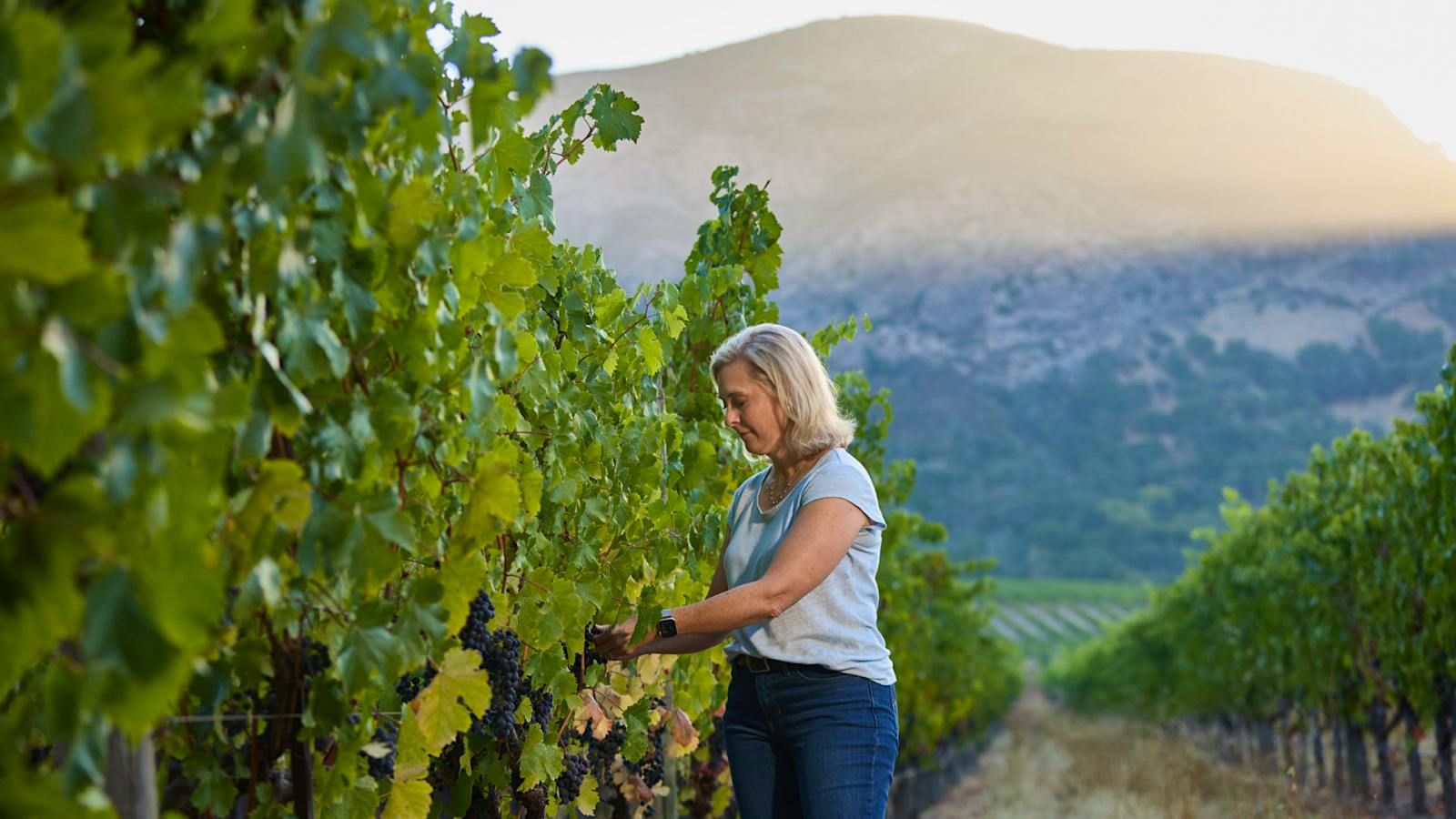
After my first visit with Alison Rodriguez, who took over the winemaking at Silverado Vineyards in 2022, I had a sense that change was afoot at this historic estate. (You can reference the winery’s background via my Winery Intel from that 2024 visit .)
Rodriguez started her winemaking career in Germany in the late 1990s and was there through 2005, when she returned to Napa. Her CV includes stops at Acacia Vineyard , Sterling Vineyards , Beringer (focusing on the single-vineyard Napa Cabernets) and then the Hess Collection from 2016 through 2022.
Joining Silverado Vineyards makes her only the the third winemaker in the winery’s history. Jack Stuart oversaw the estate’s inaugural crush with the 1981 vintage and remained until he retired in 2004. Jon Emmerich followed, with Rodriguez hired after Bill Foley purchased the estate , adding it to his collection of wineries that includes Ferrari-Carano , Chateau St. Jean , Merus and others.
Alas, Rodriguez was dealt a difficult hand with her first vintage at Silverado— 2022 was not the kind of year anyone would want to start out with, as an excessive heat dome settled over the region during Labor Day weekend just as Cabernet Sauvignon was in the final stages of ripening. The result was the most compromised vintage Napa Valley has seen for its signature grape since 1998.
But Rodriguez managed to find success, putting out an outstanding 2022 Cabernet Sauvignon Coombsville Geo (92, $125) bottling, along with a very competent 2022 Cabernet Sauvignon Napa Valley (89, $75). The Geo is a single-vineyard bottling from the estate’s large Coombsville vineyard, while the Napa Valley bottling gets half its fruit from the site.
The Coombsville AVA’s markedly cooler microclimate was able to somewhat offset the severe heat in 2022, delivering wines that are among the few bright spots in the vintage (along with a handful of mountain AVA bottlings from the likes of Lokoya and others). After tasting Rodriguez’s 2022s, I figured I better make a return trip to visit with her. Success in a difficult year is a pretty clear sign of talent.
Silverado’s Coombsville vineyard has some lengthy history. Initially part of Nathan Coombs’ estate, it changed hands a few times in the late 1860s through the 1870s. Bill Woodward first planted vines on the site in 1865 (1868 is the first recorded vintage wine from the property), then sold it to Henry Hagen, who added cattle and orchards, expanding the property to over 400 acres.
“Not only was it the first place in Coombsville to have vinifera plantings,” says Rodriguez, “But it was also the first place phylloxera showed up, in the 1870s.”
After a replant, the site became known as Cedar Knoll and went on to earn a reputation for producing high quality wines from the 1880s up until Prohibition, at which point the vineyards were pulled out and the property lay fallow.
Fast forward to 1988 when the Miller family was in the early days of establishing Silverado Vineyards. Seeing the writing on the wall with phylloxera attacking the estate vineyards around the winery in Stags Leap, they purchased the northern section of the Coombsville property in 1988 and began reestablishing a vineyard to help make up for the looming production shortfall. The remaining portion of the original Cedar Knoll is owned by the Palmaz family.
Now named Mount George, for the Vaca peak that forms its backdrop, the vineyard totals 112 acres of vines today, with all five red Bordeaux varieties included (Cabernet Sauvignon having the most acreage). Emmerich made the first Geo bottling in 2012; Rodriguez now carries the mantle forward.
Sitting in the caldera created by the collapse of Mount George’s eruption 3 million years ago, the vineyard lies on typical gravelly loam, but with a mix of iron-tinged, friable bits of sedimentary soils as well (the caldera became a lake before eventually the Napa River wore away an opening and the lake drained). The vines average about 30 years of age, and Rodriguez openly talks about getting them through another 20 years and beyond.
“I’d love it to get to 100, even if I won’t be around to see it,” she says. She has started using the organic practices we discussed at our previous meeting. It’s a process, as vines are sensitive to their environment, and dramatic shifts in farming can have adverse effects, even if they are well-intentioned.
“We are now newly certified sustainable and we have started trialing regenerative inter-vine practices in a few test blocks at Mount George this year to gather data and gauge response,” explains Rodriguez. “At this point, almost 15% of our acreage there is under a trial. It may not appear dramatic yet, but I feel we are making forward progress and expect to see some interesting data in the next two to three years.”
Marked by rolling benchlands covering 200 to 400 feet of elevation, it’s a visually impressive site. Mount George also has substance to match its eye-candy view thanks to a somewhat uncommon mix of volcanic and sedimentary soils, with tiger-striped pieces of friable sedimentary soils left by the lake mixed in with volcanic scree that has sloughed down the mountainside. Its crumbly, crunchy texture underfoot provides excellent drainage. When vineyards drain well, they tend to show heightened site specificity, in this case the telltale cast iron note that marks Coombsville wines.
I wasn’t surprised at all when Rodriguez’s Geo bottling caught my eye again in my recent Cabernet tastings. This time, in the far superior 2023 vintage, it earned a classic review of 95 points. It’s a structured, old-school–tilting wine that displays Coombsville terroir in spades with its ink, sweet tobacco and cast iron notes. A 2013 tasted with Rodriguez in the vineyard shows the wine is built to last, while a sip of the nascent ’25 in barrel strongly hints at the wine’s quality run continuing. For now, the ’23 is what is available to consumers. With its structure, it will easily handle two decades of cellar time. With its $125 price tag, it’s a veritable bargain in the world of overheated Napa Valley Cabernet pricing.
I’m glad I doubled back here.
Silverado Vineyards 6121 Silverado Trail Napa, CA 94558 silveradovineyards.com
Read more of James Molesworth's Winery Intels, hear his interviews with leading winemakers on Wine Spectator's Straight Talk podcast, and follow him on Instagram at @jmolesworth1.