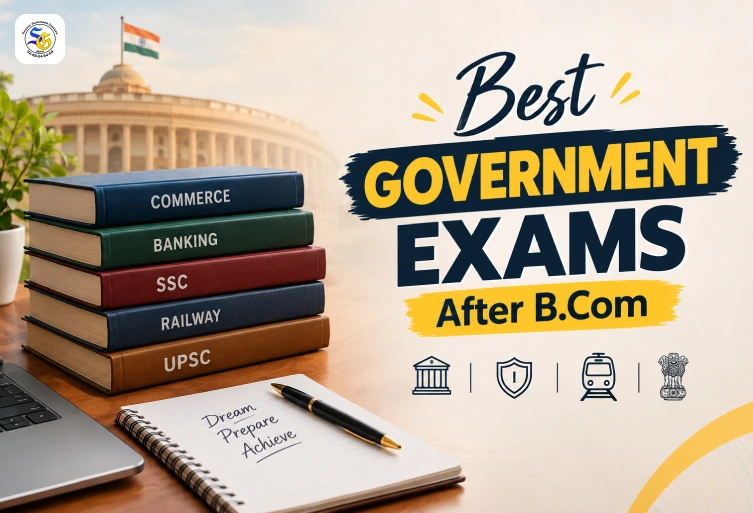
After completing B.Com, many students start looking for a stable career with good growth and long-term opportunities. Government jobs are one of the popular choices because they offer different career paths in banking, taxation, accounts, administration and finance. If you are searching for Exams After B.Com , you have several options to explore. A B.Com degree can be useful for many graduate-level competitive exams. Your knowledge of accounts, economics, business and finance can help in some areas, but most government exams also require preparation for reasoning, mathematics, English, general knowledge and current affairs. So, choosing the right exam and following a proper study plan is important. For students in Ajmer, exams such as SSC CGL, IBPS PO, SBI PO, RBI Grade B and UPSC Civil Services can be considered after graduation. Each exam has a different syllabus, selection process and job profile. Before starting preparation, understand what each exam offers and choose the one that matches your career interest.
B.Com is not limited to private accounting or finance jobs. After graduation, students can apply for many competitive examinations where a bachelor’s degree is the main educational requirement. This gives commerce graduates more choices when planning their careers. Students who have studied accounting, economics, taxation and business may already have some useful background for finance and banking-related careers. However, government exams test many other skills as well. Regular practice in mathematics, reasoning, English and general awareness is therefore important. Another benefit is that several competitive exams have overlapping subjects. For example, banking and SSC examinations both require preparation in areas such as reasoning, quantitative aptitude and English. With a well-planned study routine, students can prepare for more than one related examination without completely changing their preparation every time. The first step should be to understand your career interest. If you like banking, look at banking exams. If you are interested in taxation and government departments, SSC CGL can be researched. If you want a wider administrative career, UPSC can be considered. For students searching for Exams After B.Com in Ajmer , knowing these differences can make the preparation process much clearer.
SSC CGL is one of the major graduate-level government examinations conducted by the Staff Selection Commission. It provides recruitment opportunities for different Group B and Group C posts in central government departments and organizations. For most posts, a bachelor’s degree from a recognized university or equivalent qualification is required. For a B.Com graduate, SSC CGL can be an interesting option because some posts are related to areas such as accounts, taxation, auditing and administration. Your commerce background may help you understand some financial concepts, but the examination requires preparation across several subjects. Students generally need to work on quantitative aptitude, reasoning, English and general awareness. Speed and accuracy are also important because questions must be solved within a limited time. If you are interested in a central government career and want to explore Exams After B.Com , SSC CGL should be included in your research. Always check the latest SSC notification before applying because post availability, eligibility and other conditions can change between recruitment cycles.
Banking is another popular career option for commerce graduates. B.Com students already study areas related to finance, business and economics, which can give them a useful academic base for banking preparation. IBPS PO, SBI PO, SBI Junior Associate and IBPS Customer Service Associate are some of the examinations that graduates can explore. The exact eligibility and selection process varies between examinations, so candidates should read the latest official notification before applying. Banking exams usually require strong preparation in reasoning, quantitative aptitude and English. General awareness and banking-related knowledge are also important for several recruitment processes. Students should not depend only on their B.Com knowledge. Competitive exams require regular question practice, mock tests, revision and time management. If your goal is to work in a bank and build a career in financial services, banking examinations can be an important part of your list of Exams After B.Com .
IBPS PO and SBI PO are popular choices for graduates who want to enter the banking sector as Probationary Officers. Both are graduate-level opportunities, but their recruitment processes are conducted separately. A B.Com graduate can apply when the candidate meets the current eligibility requirements. The role can provide experience in banking operations, customer services, financial products, credit and other areas of banking. Preparation should begin with the common subjects. Build your basics in quantitative aptitude, reasoning and English first. After that, add banking awareness, current affairs and regular mock tests to your routine. SBI conducts its own PO recruitment, while IBPS conducts recruitment for participating banks. Therefore, students should follow the official websites for current notifications, dates and eligibility rules. For students in Ajmer who are interested in banking careers, both examinations can be researched before selecting the main preparation target.
RBI Grade B is another option for graduates who have a strong interest in banking, economics and finance. The Reserve Bank of India recruits Grade B officers through a competitive selection process, with eligibility requirements specified in each recruitment notification. For B.Com graduates, subjects such as economics, finance and accounting can provide useful background knowledge. However, RBI Grade B requires focused preparation and should not be considered an exam that can be cleared only with graduation-level knowledge. Candidates need to understand the complete syllabus and selection process before starting preparation. The General stream also has specific educational requirements and minimum marks, so students must check the latest RBI notification carefully. This examination may suit students who are interested in the financial system, economics, banking and regulatory work. If these areas interest you, RBI Grade B can be added to your list of Exams After B.Com .
B.Com graduates can also prepare for the UPSC Civil Services Examination if they are interested in public administration and broader government services. A graduate degree is the basic educational qualification, subject to the other conditions mentioned in the current UPSC notification. UPSC preparation is different from banking or SSC preparation because the syllabus is much wider. Students need to study subjects such as Indian polity, history, geography, economy, environment, science and technology, current affairs and other areas included in the syllabus. A commerce background can help with economic concepts, but students must develop knowledge across many subjects. Preparation also requires regular reading, writing practice, revision and answer practice. UPSC is generally a longer preparation journey, so students should understand the commitment before choosing it. For B.Com graduates who want to explore administrative and public-service careers, UPSC can be another important option among Exams After B.Com .
There is no single government exam that is right for every B.Com graduate. The best way to choose is to first understand the type of job you want. If you are interested in taxation, auditing, accounts and central government departments, you can research SSC CGL. If you prefer banking and financial services, compare IBPS PO, SBI PO and other banking examinations. If economics and finance interest you strongly, check the eligibility and syllabus of RBI Grade B. If you are interested in administration and public service and are ready for a broad syllabus, explore UPSC Civil Services. Also consider your preparation time and current level. Some students may be more comfortable with aptitude-based exams, while others may prefer exams with a broader general studies syllabus. Do not select an exam only because your friends are preparing for it. Read the syllabus, understand the job profile and check the latest eligibility before making your study plan.
Start your preparation by selecting one main examination. Read the latest official notification and write down the syllabus, eligibility, selection stages and important dates. This simple step will help you avoid studying unnecessary topics. Next, divide your day between learning and practice. Spend time on quantitative aptitude, reasoning, English, general awareness and the subjects required for your selected examination. Practice questions every day instead of only reading books. Once your basics are clear, start taking mock tests. Check every wrong answer and understand why you made the mistake. Revision is equally important. Keep short notes for formulas, vocabulary, important facts, current affairs and difficult topics. Revise these notes regularly. Students preparing for Exams After B.Com in Ajmer should also maintain a fixed routine. A few hours of focused study every day can be more useful than studying for long hours without a clear plan.
Students in Ajmer looking for Exams After B.Com can also consider structured coaching support while preparing for competitive examinations. A proper coaching environment can help students follow a syllabus, attend regular classes, practise questions and take mock tests. SG Classes provides a place for students to explore competitive exam preparation and build a regular study routine. Before joining any coaching programme, students should check the course content, faculty, study material, test series, class schedule and support provided for their chosen examination. Coaching should be treated as support for your preparation, not as a replacement for self-study. Regular revision and practice at home are still necessary. Students should also choose a course according to their target examination. A clear goal makes it easier to select the right study material and follow the right preparation strategy. For students in Ajmer, combining structured guidance with regular self-study can make the preparation process more organized.
One of the biggest mistakes students make is trying to prepare for too many examinations at once. SSC, banking, RBI and UPSC have different patterns and requirements, so it is better to select a main target first. Another common mistake is collecting too many books and online resources. Choose a few reliable resources and spend more time practising instead of constantly changing study material. Do not ignore mock tests. They help you understand your speed, accuracy and weak areas. Analyse your mistakes after every test and work on the topics where you lose marks.Students should also avoid leaving current affairs for the last few weeks. Follow important news regularly and revise it in a simple way. Most importantly, do not compare your progress with other students. Every candidate has a different starting point. Focus on your own preparation, practice and improvement.
There are many career options available when you start searching for Exams After B.Com . SSC CGL can be explored for central government roles, while IBPS PO and SBI PO are useful options for students interested in banking. SBI Junior Associate and IBPS Customer Service Associate provide additional banking pathways. Students interested in finance and economics can research RBI Grade B, while those interested in wider administrative careers can explore UPSC Civil Services. The right choice depends on your interests, eligibility, preparation time and career goals. Before applying, always check the latest official notification because eligibility, vacancies, dates and selection rules can change. If you are preparing in Ajmer, make a simple study plan, practise questions regularly and revise your weak areas. With the right target and consistent preparation, your B.Com degree can open several competitive career opportunities. For students looking for structured guidance in Ajmer, SG Classes can help you explore suitable competitive exam preparation options and build a focused study routine.
Have questions? We’ve answered some of the most common queries to help you understand the topic better
SSC CGL, IBPS PO, SBI PO, RBI Grade B and UPSC Civil Services are some major options to explore.
Yes. Most SSC CGL posts require a bachelor’s degree, subject to the specific post requirements.
Yes. B.Com graduates can explore IBPS, SBI and other graduate-level banking examinations if they meet the current eligibility rules.
B.Com graduates may be eligible for RBI Grade B General if they meet the educational and other requirements in the latest notification.
It depends on your career interest. Compare SSC, banking, RBI and UPSC based on their syllabus, job profile and eligibility before choosing.
The IBPS PO Exam 2026 is one of India’s most sought-after competitive examinations for candidates…
In today’s competitive world, government jobs remain one of the most secure and respected career…
Government jobs continue to be one of the most reliable and respected career options in…
Preparing for government jobs is a journey that demands discipline, consistency, and the right strategy.…