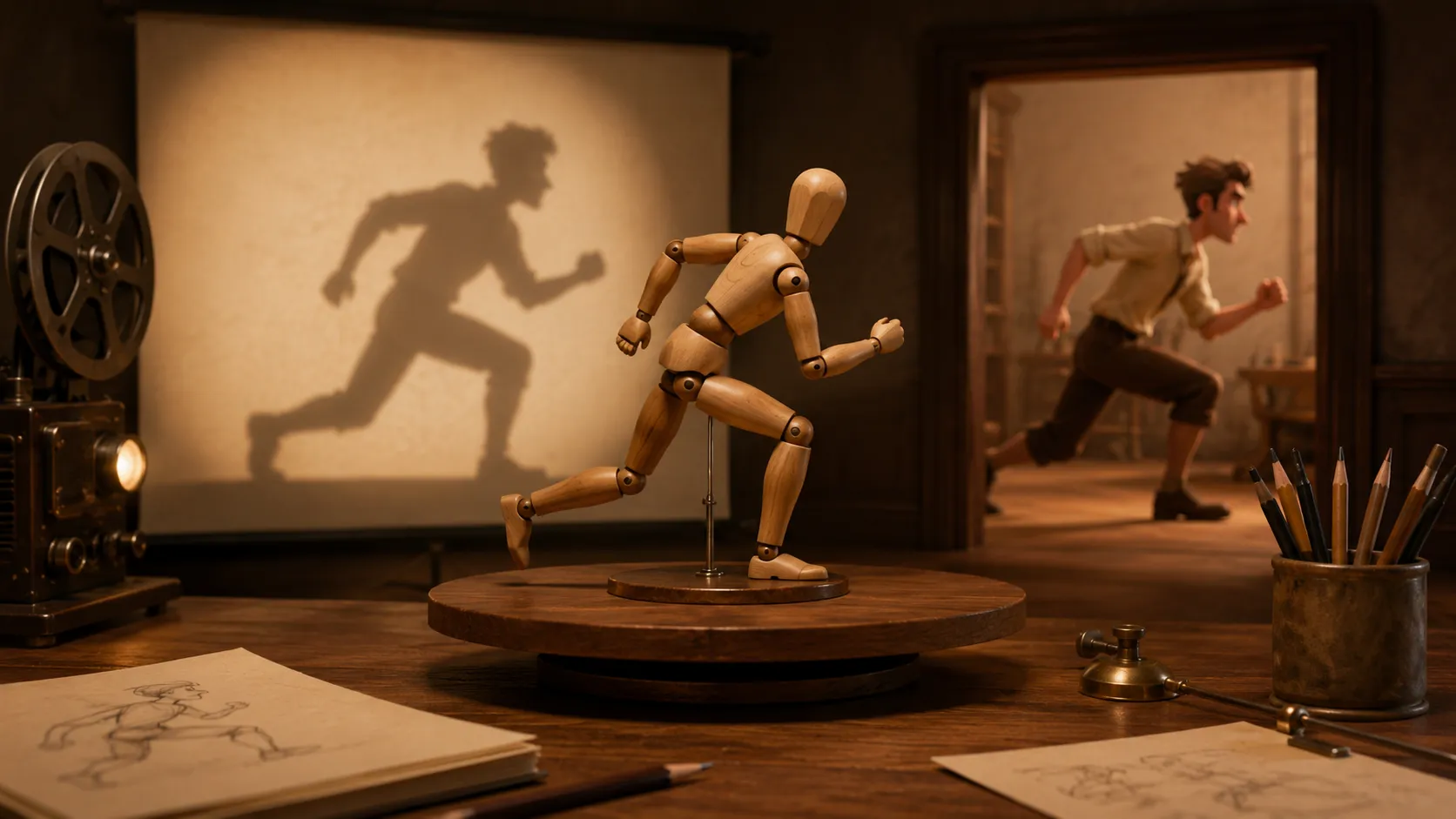
The 3D animation workflow has been stable for a long time. Gather reference, block the shot, spline it, polish it. Every studio runs a variation of that, and every animator recognises it.
Generated motion does not replace that pipeline. It replaces one stage of it, and the interesting question is what that does to the stages either side.
This is a stage by stage account of what actually changes, including the parts that do not.
Four stages, each answering a different question. Worth restating properly, because the swap only makes sense against the original.
Blocking is the expensive one in terms of decisions, and historically also expensive in hours. That combination is why animators defend their first blocking pass, and why shots stop improving after the first review.
Here is what happens to each stage when a generated pass enters at blocking. Two stages change substantially, one changes in character, and one does not move at all.
Notice that the total work does not drop as much as the blocking saving suggests. It redistributes. What you gain is not a shorter schedule so much as more attempts inside the same one.
Because cheap versions get replaced and expensive ones get defended. That is a fact about people rather than about tools.
The clearest recent evidence is from Sony Pictures Imageworks, whose Unreal Engine spotlight on rebuilding previs and layout describes sequence exports dropping from hours to minutes, and the overall process running roughly a quarter faster.
That is not a rendering improvement. It is an improvement in how often somebody is willing to say let us try it differently.
Physically, in the order the movement happens. This is a genuine skill and it is closer to directing a performer than to prompting an image tool.
Most weak descriptions name a mood. A confident entrance gives a model nothing to act on and returns the average of its training data. The fix is to describe the body rather than the feeling.
Four things make a description work, and they map onto what you would tell an actor.
Run those four and a vague request becomes a specification. A heavy two handed shove, steps in with the right, connects, staggers back a step, settles into a low guard, leaves very little room for the model to substitute something generic.
One habit matters more than phrasing, though. Generate several takes and choose, rather than rewriting until one lands. The spread between takes from the same description is usually wider than the difference between two carefully worded descriptions, so selection beats iteration on the prompt itself.
PINOC occupies the blocking slot and hands over at splining. It produces the base layer from either a clip you filmed or a written description, then exports it and gets out of the way.
Both input routes matter at this stage for different reasons. Filming works when you can perform the move and have an opinion about its feel. Text to motion works when the move exists only in your head, which at the blocking stage is most of the time.
Underneath is JST, Viggle’s in house model, trained with physical priors rather than pure pose data. For a blocking pass the practical effect is that weight and ground contact arrive roughly right, so the polish stage starts from something plausible rather than something floating.
It does not spline, does not polish, and does not make timing decisions. That scope is deliberate, and it is why the stages downstream are unchanged.
PINOC’s own capture-to-export walkthrough, posted by @Viggle_PINOC on X.
Take a character shouldering through a door and stumbling on the far side. Here is the whole shot with timings.
The polish figure is the one to notice. It has not changed, and it now represents the overwhelming majority of the shot. That is the correct outcome, since polish is where the shot becomes specific.
On why AI does not replace the animator, from DANI (@alittledani). View the original reel on Instagram .
One warning about that twenty minute blocking figure: it assumes your retarget mapping already exists. Blender still ships without retargeting of its own, so plan on the free Retarget extension (Blender 5.0 or newer) or Auto-Rig Pro’s Remap module. Unreal covers this with the built in IK Retargeter . Build the mapping once per character and every shot after the first inherits the twenty minutes. Build it per shot and the schedule quietly doubles.
The stages are identical. The handoffs are where the difference lives, and handoffs are where team adoptions usually fail.
A solo animator has no handoff problem. They know what state a pass is in because they made it. A team does not, and a generated pass creates a specific risk that a hand blocked one does not, which is that it looks more finished than it is.
One opinion stated plainly. The workflow change that matters is not that blocking got faster. It is that blocking stopped being a commitment. When a base layer costs a minute, an animator will genuinely try the version they were not sure about, and that is where better shots come from. Save your keyframes for the hero shots, and spend the freed time on more attempts rather than on finishing early.
It replaces the construction part, not the judgement part. A generated pass gives you key poses and coarse timing in about a minute, but deciding whether that reads correctly and correcting it is still blocking work. What changes is that you are editing a proposal rather than building from an empty timeline, which is faster and psychologically very different.
Splining and polish, which together are the majority of a finished shot. Contact frames, arcs, overlapping action and secondary motion all remain hand work, and none of them get faster because the base layer improved. Any workflow plan that assumes savings in polish will be wrong.
The blocking stage compresses dramatically, but total shot time drops far less because polish dominates. The more reliable gain is iteration count rather than schedule. Studios adopting real time pipelines have reported layout and previs processes running roughly twenty to twenty five percent faster, which is meaningful without being transformational.
Film it when you can perform the move and have a specific feel in mind. Describe it when the move exists only in your head, which at blocking stage is most of the time. Filming carries feel more reliably. Describing covers everything you cannot physically do, and it is faster for generic movement.
Less well, and it is worth being clear about that. Models trained on real capture pull toward realism, so exaggerated or heavily stylised work fights the base layer rather than building on it. For stylised projects, generated motion is more useful as reference than as a blocking pass. Realistic and grounded work benefits most.
Present it deliberately rough and label it explicitly. Generated motion has smooth interpolation and plausible weight, which reads as further along than it is, so directors approve it and editorial cuts to it. Keeping passes grayscale and unlit, and putting the word generated in the file name, prevents most of that.
The pipeline did not get shorter. One stage got cheap, and everything downstream stayed exactly where it was.
What that buys is attempts. A blocking pass you can regenerate is a blocking pass you will actually replace, and shots improve when somebody is willing to throw away the first idea.
Reference, block, spline, polish. Same four stages. Save your keyframes for the hero shots.