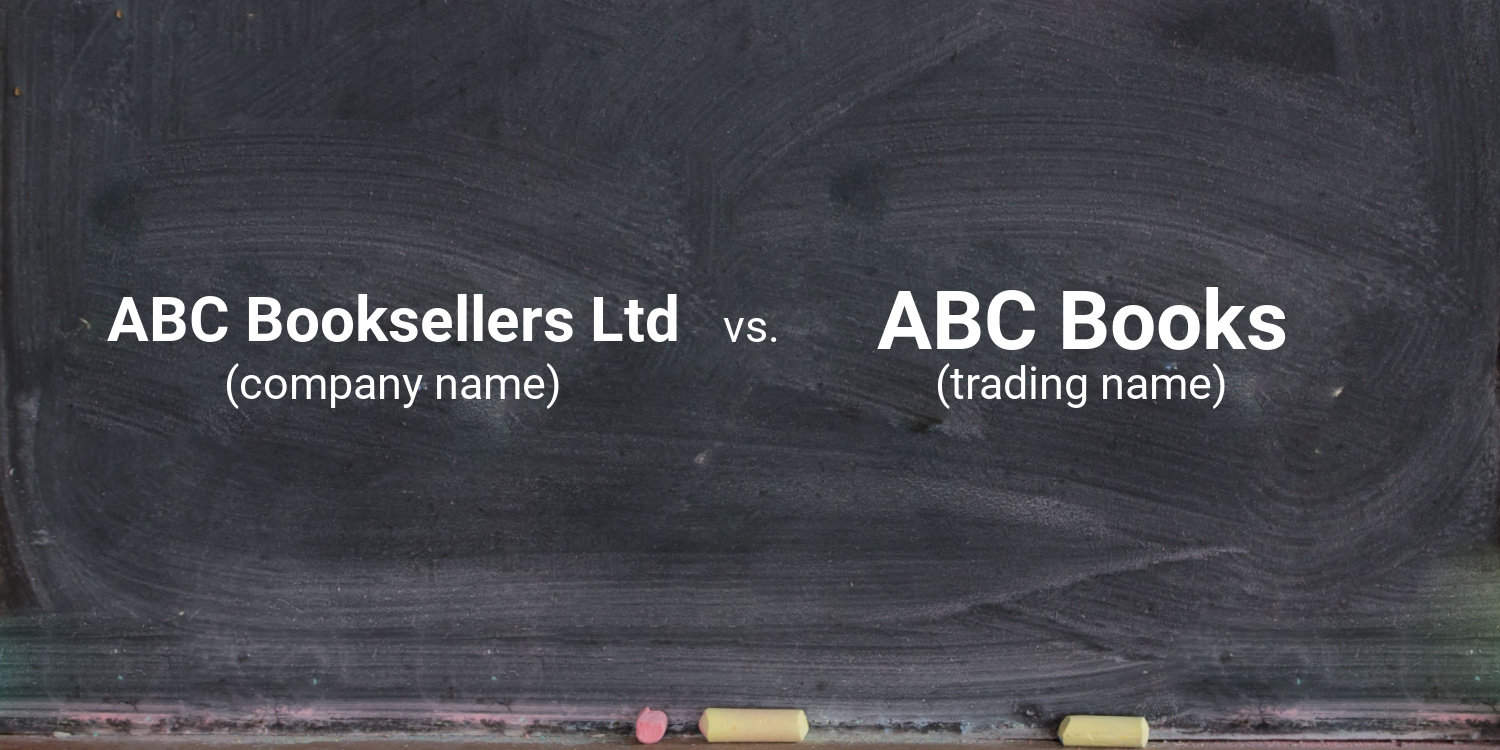
It’s not uncommon for a company to operate under a different name from the one registered at Companies House. This alternative is known as a ‘trading name’, and the registered name is known as a ‘company name’.
We explain the difference between the two, why a limited company may decide to start doing business under one or more trading names, and the potential benefits and drawbacks of doing so.
A company name is the name that a company is registered under at Companies House. It must include ‘Limited’ or ‘Ltd’ at the end (unless an exemption has been granted) if it is a private limited company. A public limited company must have ‘public limited company’ or ‘plc’ at the end of its name.
This official, registered name appears on the certificate of incorporation, memorandum of association, articles of association, and any share certificates issued to shareholders. It’s also disclosed on the public register at Companies House. This is free to access and search online.
A company name must be unique and cannot be too similar to any others on the register. This is one of several company name rules that exist to prevent businesses from misleading or harming the public.
Even if a company uses a trading name, it must continue to disclose its registered name, together with the other required information, on official business stationery, including websites, invoices, and letters.
A trading name (sometimes known as a ‘business name’) is the name under which someone carries on business. A company may adopt a trading name (or multiple) as an alternative to operating under its official name.
When a company uses a trading name, its website and other official stationery should contain a statement such as: ‘ B.Smith Limited trading as Billy Smith Plumbing’. The abbreviation ‘T/A’ is sometimes used instead of ‘trading as’.
In this example, the business is registered at Companies House as ‘B.Smith Limited’, but the owner prefers to use the alternative ‘Billy Smith Plumbing’.
Unlike the company name, there is no requirement to register a trading name at Companies House or anywhere else. There is no register of trading names.
While trading names are not registered under the Companies Act 2006, many of the rules in the act still apply, including restrictions on:
If you adhere to the above rules, you can adopt and start using a trading name at any point. However, you should let certain parties know about this, including HMRC, your bank, suppliers and service providers, and existing clients. This will help you avoid any tax confusion and payment problems.
Whilst you can publish the trading name on your website, letters, and other business materials, you must continue to publish your company name too. Generally, this will appear in a less prominent location, such as your website’s footer.
There are several scenarios where a business may benefit from using one or more trading names rather than its official name. Here are some examples:
If an established business decides to introduce vastly different products or services, its original company name may be unsuitable or potentially confusing for this segment of the market. In such instances, trading names can help differentiate new elements of the business and target specific audiences.
Companies often choose names that reflect the nature of their business activities. However, if a business decides to pivot and change its overall direction, its registered name may be incompatible with its new activities or objectives. Again, adopting a trading name offers a solution.
Using one or more trading names can be an effective way to establish a local presence in different geographical locations, target new customers, and test or expand into new markets simultaneously without registering multiple new companies or changing the main brand .
Following an acquisition, a parent company may decide to continue running the new subsidiary under its established trading name rather than rebranding. This can be an effective way to ensure stability, maintain business momentum, and leverage customer trust. Ultimately, though, the acquired business will sit under the ‘umbrella’ of the parent firm.
While changing a company name is usually straightforward, it can be an administrative headache if you need to order new official stationery, change signage, and update bank accounts and contracts. If it’s no longer suitable and you want to stop using it day-to-day, you can simply start doing business under a trading name rather than changing your registered name.
Trading names offer greater flexibility, but they are not automatically protected by law to the same extent as registered company names. This has the potential to cause certain issues, for example:
Using trading names without careful consideration and planning could also confuse customers, mislead the public, or harm your brand reputation.
To protect a trading name from these potential issues, you can:
You may also wish to consider registering your trading name as a domain name. This will help strengthen brand recognition and further minimise any potential risk of passing off.
We hope you have found this article useful. Please comment below if you have any questions about this post, our company formation packages , or our range of corporate services.