Regularly cleaning your refrigerator every three months helps you maximize storage space, stay organized and maintain a fresh environment for your groceries. Avoid using abrasive cleaning tools or harsh cleansers, flammable fluids, bleaches or cleansers containing petroleum products. Read on for simple techniques to clean the interior, exterior and condenser coils of your refrigerator. Maytag also has tips on how to clean your ice maker so you can keep all of your refrigeration appliances looking their best.
Place perishables on the counter or in a cooler for safer storage. Don’t let food sit outside the refrigerator for more than two hours to help avoid spoilage. Dispose of any expired items and clean out leftover storage containers that may be lurking in forgotten corners of your fridge.
Allow shelves and drawers, including crisper drawers, to adjust to room temperature to avoid possible cracking from a swift change from cold to hot. Once at room temperature, soak them in a solution of dish soap and hot water to dissolve any stubborn spills. Then, hand wash and dry thoroughly.
Use a mixture of diluted dishwashing soap and warm water, or a vinegar solution, with a clean cloth or sponge. Be sure to wipe all surfaces again with clean water to remove any soapy residue if using dishwashing soap.
Use warm water and a clean cloth to remove any sticky residue on the sides and bottom of items before placing them back in the refrigerator.
Allow all surfaces to dry completely before replacing shelves and drawers, then place food items back inside. To help maximize storage and keep food fresh, explore our guide to refrigerator organization .
Harsh disinfecting and cleaning products may leave a residue that can contaminate food or cause lingering chemical smells in your refrigerator . For an alternative to commercial cleansers, make a solution of one part white vinegar to two parts hot water and apply with a spray bottle, clean cloth or sponge. Tackle dried spills by mixing baking soda and water to make a paste.
Though using soap and water is the suggested method for cleaning regular painted or colored refrigerator exteriors, care does vary depending on the finish of your fridge. For the optimal appearance and longevity of a traditional stainless steel finish, clean with a stainless steel appliance cleaner, like affresh ® Stainless Steel Cleaning Spray . It’s designed to gently clean fingerprints, smudges and other residues on all stainless steel surfaces. If a stainless steel cleaner is not available, follow the steps below. Avoid the use of chlorine compounds to clean exterior doors, as it can promote corrosion.
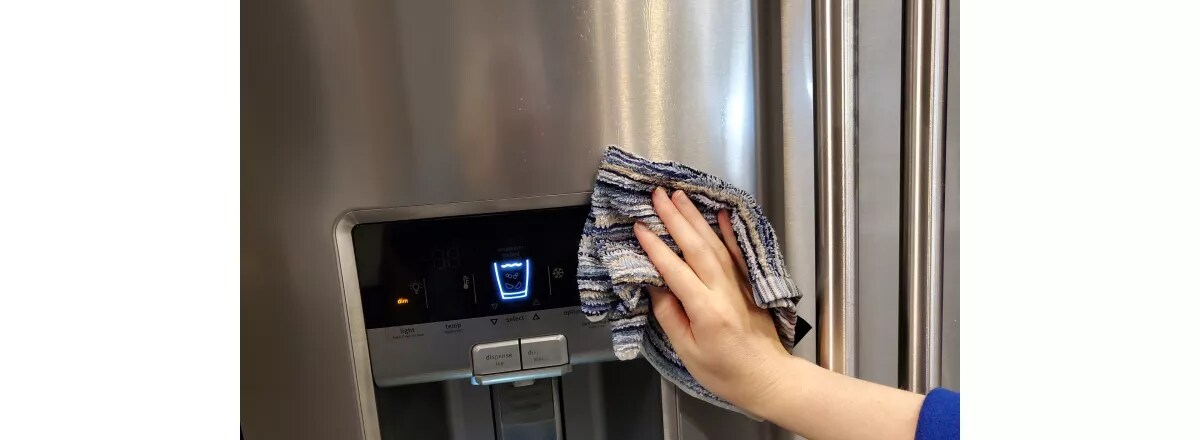
For stainless steel surfaces, spray affresh® Stainless Steel cleaner on a clean microfiber cloth and wipe in the direction of the grain. If not available, wash as you would a painted or colored exterior, with a solution of dishwashing soap and water on a soft cloth or nonabrasive sponge.
Wipe down with clean water and a cloth to remove any soapy residue, if using dishwashing soap.
Use a clean, dry towel to thoroughly dry the surface. For stainless steel, dry immediately to avoid water spots and polish the surface in the direction of the grain until it shines. Water that is not completely dried off can cause discoloration.
Changing your water filter is a quick process that helps keep your water tasting its best. Easily find out which filter fits your refrigerator model or learn how to replace your refrigerator water filter . You can even subscribe to receive your water filter automatically at the frequency you choose through our water filter subscription program .
Dirty condenser coils can cause your refrigerator to make a loud humming noise . Condenser coils are most often accessible across the bottom front of the refrigerator or in the back. See how condenser coils work in your refrigerator. There is typically no need for routine condenser cleaning in a normal home operating environment. However, if the environment is particularly greasy or dusty, or there is significant pet traffic in the home, the condenser should be cleaned every 2 to 3 months to ensure optimal operation.
Before attempting to clean your condenser coils, start by referencing your Use and Care Guide. Some models do not require the condenser coils to be cleaned and other models can only be cleaned by a certified technician. To avoid risk of electrical shock, always disconnect power before cleaning condenser coils.
You may need to move your refrigerator away from the wall to unplug it.
Place your hands along the ends of the grille and push in on the top of the grille while pulling up on the bottom.
Clean the grille, the open areas behind the grille and the front surface area. A refrigerator coil brush can also be used.
Line up the grille support tabs with the metal clips and push the grille firmly to snap into place.
While the refrigerator is away from the wall, sweep or vacuum the open space.
Move your refrigerator back in place if pulled away from the wall.
Maytag ® refrigerators won't stop working to keep temperatures in line. With features on select models like PowerCold ® that keeps internal temperatures low even when the door is open and the EvenAir ™ cooling tower that effectively distributes cool air throughout the appliance, you can trust that your groceries will stay at the right temperature.
Your subscription was successful
Thank you for signing up. Keep an eye on your inbox for our next newsletter.
Enjoy articles like this? Get helpful guides and appliance care tips sent straight to your inbox.