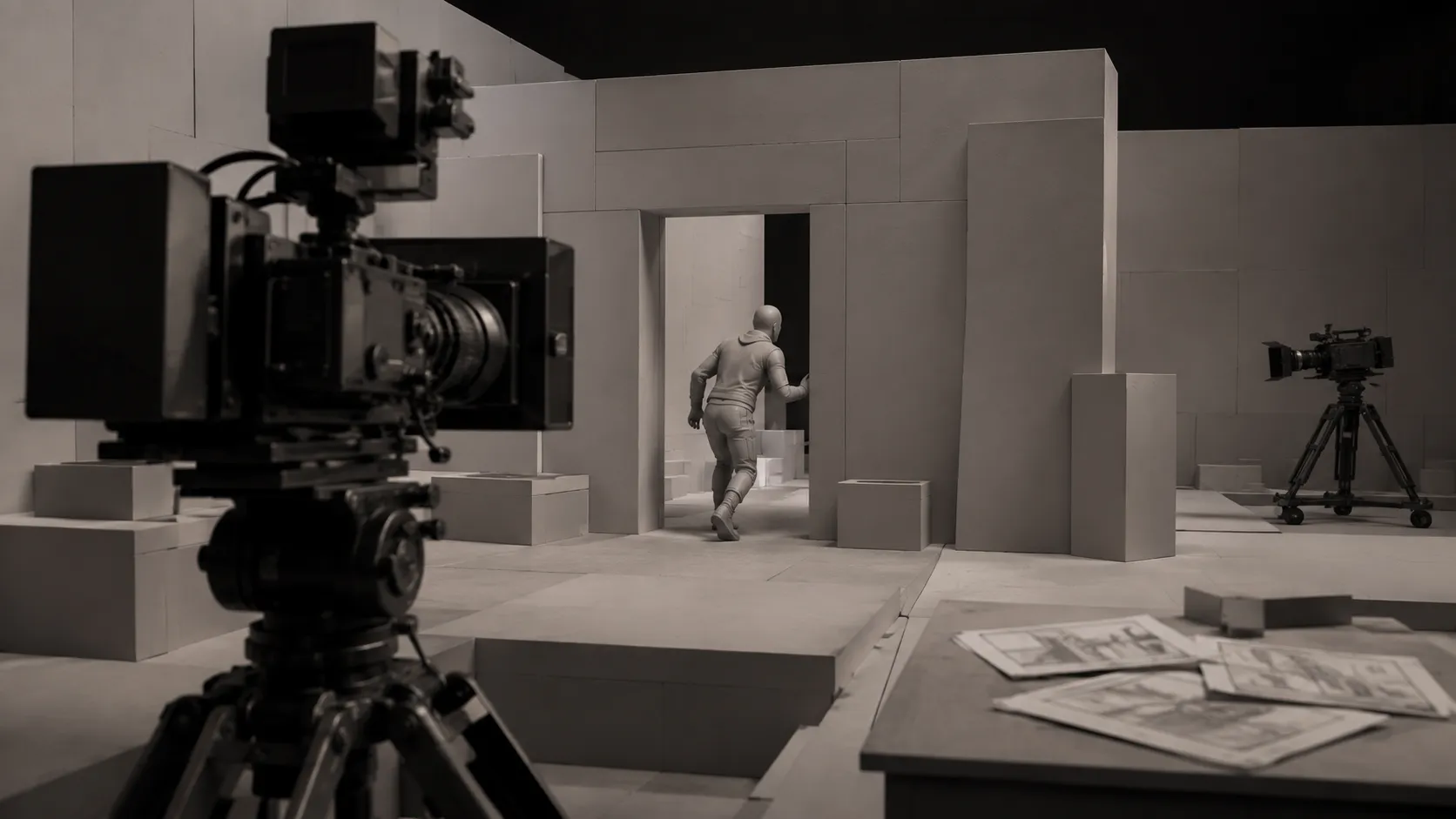
Previz has one job. Answer questions about staging, timing and camera before anybody spends real money finding out the hard way. It is a thinking tool, and the currency it runs on is speed rather than fidelity.
Which is why the technology shift that matters here is not better rendering. It is the collapse in the cost of getting a character moving at all. When blocking a beat takes two minutes instead of two hours, you stop defending your first idea and start testing your fourth.
This is a practical workflow for building previz around generated motion. One sequence, carried from shot list to reworked version, with the parts that actually change called out.
Previz is editable 3D blocking of camera, staging and timing before principal photography. A storyboard is static illustration. The difference that matters is that previz has real lens and camera data in it, so it answers questions a drawing cannot.
The visualization family is worth separating properly, because using the wrong one is a common and costly error.
An editorial piece on previs tooling in 2026 put the failure mode bluntly, describing the most common and expensive mistake as over previsualizing shots that only needed a storyboard. That is worth pinning above your desk.
Because previz is a conversation, and a slow conversation produces worse decisions. Every hour a version takes to produce is an hour of pressure not to change it.
The clearest recent evidence comes from Sony Pictures Imageworks. In an Unreal Engine spotlight published in February 2026, real time pipeline supervisor Jonghwan Hwang described initial export times of six to eight hours per sequence, reduced to thirty minutes, and eventually to five minutes. Head of visualization Adam Holmes reported the resulting layout and previs process running twenty to twenty five percent faster.
Those are not rendering improvements. They are iteration improvements, and they change what the team is willing to try.
Start with the shot list, generate motion per beat, stage cameras around it, then review and replace whatever is not working. The order matters, because staging a camera around a T posed character tells you nothing useful.
Take a worked example. A three shot sequence. A character enters a room, notices something off screen, and backs out fast.
The iterate step is where this workflow differs most from traditional previz. Reworking a beat is a prompt change and a short wait, not a re block. That is what makes it worth running four versions of the retreat instead of accepting the first.
PINOC’s own walkthrough of turning a 3D-viewport motion preview into camera-staged reference footage. Posted by @Viggle_PINOC on X.
PINOC produces the motion layer that previz sits on top of, from either a written description or a reference clip, and exports it into Blender, Unreal, Maya or Unity as FBX or GLB.
For previz specifically, the text to motion route usually matters more than capture, because at the blocking stage you rarely have footage of the thing you are trying to describe. You are inventing the sequence, not reproducing one.
Writing a motion description well is a skill worth developing, and it is closer to direction than to prompting. Physical instructions beat adjectives. State the body part driving the action, the weight and speed, the order of the beats, and where the motion ends. Steps in with the left, weight dropping, stops sharply, holds. That returns something usable far more often than a dramatic mood word.
What leaves the tool is a performance on a skeleton, not a finished character. For previz that is usually irrelevant, since grayscale blocking is the point. If you want your actual character in the shot, you can upload the mesh, have it rigged and retarget the motion onto it inside the tool.
PINOC’s own build of a full chase-and-parkour sequence, stitched and camera-staged in Blender before driving the final render. Posted by @Viggle_PINOC on X.
Previz stays useful only while it stays cheap to destroy. Four conditions keep it that way, and a previz asset failing any of them has quietly turned into production work.
Run a sequence against these four before review. Failing regenerable is the common one, and it usually means somebody hand keyed something they should have regenerated.
Enough motion to answer the question you are asking, and no more polish than that requires. A rough animated version wins the conversation far earlier than a beautiful still.
This is where previz earns its budget outside of large productions. An indie team pitching a sequence, a studio proposing a trailer beat, a game developer showing a publisher how a set piece plays. In all three the alternative is a description, and a description loses to twelve seconds of moving blocking every time.
One opinion, stated without hedging. Most teams under invest in previz not because it is expensive but because it is embarrassing. Rough blocking looks amateurish next to a rendered frame, so people skip it and go straight to something presentable. That instinct costs far more than it saves, because presentable work is work you have already committed to.
Decisions, not assets. The camera choices, the timing, the coverage and the shot count survive. The files generally should not.
That said, the boundary has moved. Real time engine pipelines have made previz assets more reusable than they were, with layout and camera data flowing through into production rather than being rebuilt. The Imageworks example is exactly that, previz and layout treated as one continuous process rather than two.
The risk is drift, which the Storyflow piece describes precisely. When the plan and the previz live in different places they diverge, and you end up with polished previz of shots that changed two revisions ago. Whatever you hand off, hand off the shot list alongside it.
A storyboard is static 2D panels, while previz is editable 3D with real camera and lens data and actual timing. The practical distinction is that previz answers questions about motion, staging and pacing that a drawing cannot, because you can watch it play. Storyboards remain faster and cheaper, so most dialogue scenes never need previz at all. Reach for previz when the question is about movement.
Unreal Engine has become the dominant choice at studio scale, with Maya and Blender widely used for blocking and rigs, and USD as the interchange format between them. Smaller teams often work entirely in Blender. There is also a growing set of dedicated previz tools aimed at indies. The engine matters less than the iteration speed you can achieve in it.
It can produce the motion layer and speed up blocking substantially, but it does not make the directorial decisions, which are what previz exists to inform. Generated motion is most useful at the beat level, giving you a character actually moving so you can stage cameras around it. Camera choice, coverage and pacing remain judgment calls. Treat it as a way to iterate more, not a way to skip the thinking.
Short enough that revising it feels cheap, which is a better test than any fixed number. If a single beat takes a day to block, the sequence will not get revised properly and previz has become production. Studios have pushed sequence turnaround from hours to minutes precisely to protect the iteration loop. Measure your per beat cost and drive it down before worrying about quality.
Only for sequences where movement or staging is genuinely uncertain. Action, chases, complex blocking and anything with a set piece benefit enormously. Straightforward coverage of two people talking rarely does. The most expensive mistake in this area is building 3D previz for shots that a storyboard panel would have resolved in ten minutes.
Sometimes, if it was exported on a standard skeleton rather than trapped in a previz scene file. Motion generated for blocking can carry forward as a base layer that gets refined rather than replaced, which saves real time on secondary and background characters. Hero shots almost always get rebuilt. Decide which category a shot is in before deciding whether to keep its previz motion.
Previz has always been limited by one thing, which is how expensive it is to change your mind. Every improvement that matters in this area, from real time engines to generated motion, is an attack on that single cost.
The workflow follows from it. List the beats, generate the motion, stage the cameras, cut it, then throw away whatever is not working and run it again. Four versions of a beat you can regenerate beats one version you hand blocked and now feel obliged to defend.
Good previz looks unfinished on purpose. If yours looks finished, you probably spent the budget answering a question nobody asked.