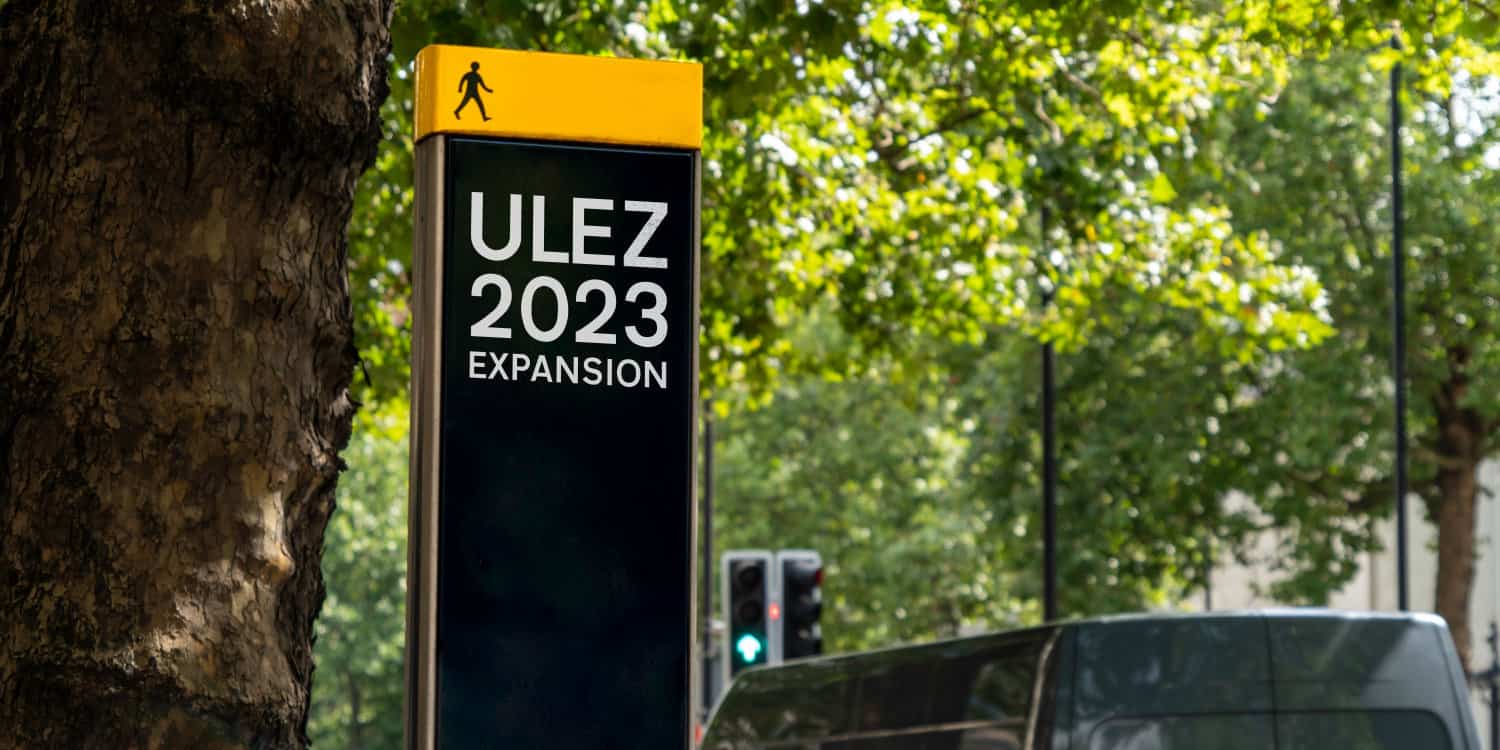
HMRC have confirmed that people who file tax returns for Self Assessment can now claim tax relief on the ULEZ charge as a business expense.
For small business owners, the daily charge for entering the zone is a cost that can quickly stack up and heavily impact their company’s profits.
In this article, we discuss the impact of ULEZ on small businesses, the ULEZ scrappage scheme, and how to claim tax relief on this charge at the end of the tax year.
The Ultra Low Emission Zone is an area in London where an emissions standard based charge is applied to non-compliant vehicles on roads. It is designed to clean London’s air by reducing the number of polluting vehicles in the capital.
In August 2023, the ULEZ area expanded and now applies to all London boroughs (excluding the M25) at all times except Christmas Day. This means that any vehicles that do not meet the ULEZ emission standards (including non-UK registered vehicles) when entering the zone face a daily charge of £12.50.
According to TfL, over 90% of cars in outer London were already compliant with the emission standards before the expansion last month. However, small business owners who can’t afford new and compliant vehicles have been facing eye-watering bills since the ULEZ was first introduced in 2019.
If you visit London every now and then, £12.50 may not sound like a lot, but for small business owners who are based in London or travel into the city regularly, the ULEZ charges can quickly stack up. Let’s say you travel to London 5 days a week, every week – that’s £3,000 a year in ULEZ charges.
What if you enter the congestion zone as well? You could be paying £6,600 a year (or more if you work on weekends) in total just for driving into London. It’s no wonder that nearly 30% of UK SME owners said they’d need to dip into their personal savings to cover growing business costs this year. An additional 20% are prepared to get a loan from friends and family.
These kinds of bills may go virtually unnoticed in large companies, but for small businesses that don’t have the funds to implement a sustainable business model, these additional costs are a burden, and could be the difference between success and failure.
To help alleviate some of the above costs, the Mayor of London has also introduced a scrappage scheme for Londoners. If you’re eligible, you can apply to scrap a polluting vehicle in exchange for a grant of up to £10,000, depending on the vehicle and your circumstances.
The scheme also gives you the option to retrofit a non-compliant van by fitting an emission-reducing device.
However, the scrappage scheme is not without its problems. It is limited to people who live in London; and unless you also claim benefits and have a wheelchair-accessible car, the grants are considerably lower.
The good news is that business owners who file Self Assessment tax returns, and have non-compliant vehicles, can now claim ULEZ charges as a business expense through their annual tax return; however, it has not been announced that ULEZ is tax-deductible against Corporation Tax at this time.
To claim tax relief on your Self Assessment tax return, HMRC says that the charges must be paid on time, and your journey must be “exclusively for the purposes of trade.” Commuting and non-business travel costs cannot be included.
You can claim the cost of ULEZ charges through your annual Self Assessment tax return as normal. If you’re doing a paper tax return, this must be submitted no later than 31st October after the end of the tax year. If you’re doing an online tax return, the deadline is 31st January after the end of the tax year.
HMRC will then assess your circumstances before advising if your ULEZ charges are tax-deductible.
Generally speaking, vehicles registered in 2015 and after already meet ULEZ standards. This includes petrol, diesel, hybrid, and electric vehicles.
The minimum emission standards are:
A small number of vehicles are exempt from the charge, such as agricultural vehicles, HGVs over 12 tonnes, and London-licensed taxis (maximum 12 years old).
Charities, small businesses with fewer than 50 employees, micro-businesses with up to 10 employees, and sole traders with a London-registered address, can apply for a short-term exemption if they are waiting for a new ULEZ-compliant van or minibus, or one to be retrofitted.
You can find more details on the qualifying standards and exemptions, and check your vehicle on the Transport for London (TfL) website .
Yes, this is a separate charge for entering the inner city. The congestion charge is £15 for all vehicles, and it operates 07:00-18:00 Monday to Friday and 12:00-18:00 on weekends and bank holidays. Charges do not apply between Christmas Day and New Year’s Day.
If you’re a limited company owner, you may be able to claim the ULEZ charge back in your personal Self Assessment tax return, if you drive a non-compliant vehicle for work.
We hope this article helped you understand more about ULEZ, and the new tax rules for business owners who are registered for Self Assessment. If you have any comments or feedback, please let us know in the comments below, or get in touch if you have any questions.