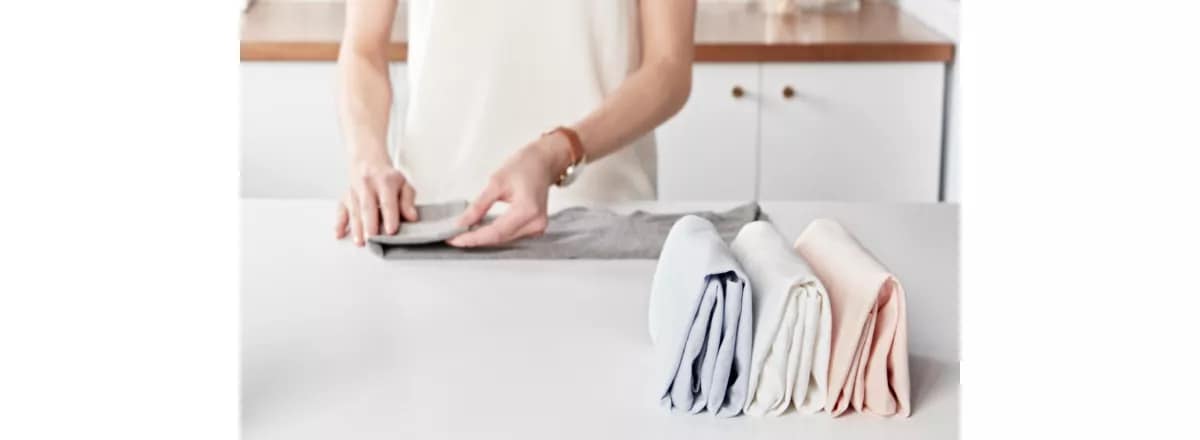
Folding clothes quickly and properly is an easy skill to learn that pays off big, helping you save time, cut down on wrinkles and maximize drawer space. Getting the job done fast starts as soon as you unload your dryer. Before beginning to fold, follow these guidelines to speed up the process:
Create a designated folding space that’s flat, clean and large enough to fit a pair of pants. This will make folding faster and easier.
Start folding as soon as you can , while the clothes are still warm. They will be more pliable so you’ll spend less time smoothing out bumps and wrinkles .
Separate what needs to be hung and what needs to be folded so you can power through your pile.
Fold similar clothing types together , like tops and bottoms, so you can get in a groove. Stack them in piles on your folding surface.
Keep reading to learn how to fold common clothing items as quickly as possible to help you power through laundry and keep your day moving.
There are a few different techniques that you can use to fold T-shirts quickly—the 2-second T-shirt fold and the classic T-shirt fold. Separate T-shirts from other items and choose a clean surface that’s large enough for a T-shirt to lay flat. Use either space-saving method to fold T-shirts fast.
While the 2-second T-shirt fold may seem a little tricky at first, once you practice this technique, you can quickly and skillfully fold a pile of T-shirts.
Lay your T-shirt face-up. Smooth out any bumps or wrinkles. On the left side of the shirt, use your right hand to pinch the top of the sleeve near the neckline. Move your left hand halfway down the shirt and pinch again. Use your right hand to pull the top of the shirt down to the bottom hem, keeping in line with your original pinch, and grip it.
The fabric should now be draped over your left hand with your arms twisted over each other. Now, lift up the shirt and untwist your arms. The shirt should hang naturally in a square shape with one sleeve hanging down.
As you place the shirt back down, fold the loose sleeve underneath it. If your T-shirt has a design, it should be face-up.
You’ll get the same great results with the classic T-shirt fold as the 2-second T-shirt fold. It just may take slightly longer.
Lay your T-shirt face-down. Pull on the edges with both hands and smooth out any bumps or wrinkles.
On the left side, create a vertical fold halfway between the neckline and the start of the sleeve. Repeat on the right side. The sleeves may overlap somewhat. Pull and smooth out the fabric as needed.
Fold the T-shirt in half by bringing the bottom hem up to the top. Flip it over and admire your work.
If you want to fold your T-shirt smaller, try a folding technique which simply adds more folds to the final step. For instance, fold your shirt in thirds or fourths instead of in half. You’ll end up with a small, compact shirt you can then prop up vertically in your drawer, like a file folder, to maximize space.
If you prefer to fold long-sleeve dress shirts and blouses rather than hanging them up, separate your shirts from other laundry items right out of the dryer to help minimize wrinkles. Then find a flat, clean area to work on and follow the steps below.
If your shirt has buttons, button it up in the way you would usually wear it. Lay it face-down and pull on the edges to smooth out any bumps or wrinkles. If necessary, iron the shirt before folding, or select a wrinkle prevent or steam option on your dryer the next time.
Pull the right sleeve across the back of the shirt, creating a fold halfway between the neckline and the start of the sleeve. Run your hand along the inside of the fold to smooth it out.
Fold the sleeve down so it lines up lengthwise with the edge of the shirt, creating a diagonal fold. Repeat steps 2 and 3 with the other sleeve. When you're finished, the sleeves may or may not overlap.
If your shirt has a tail, fold it up and tuck it in under the sleeves. Fold the shirt in half by bringing the bottom hem up to the top.
It can be easier to fold jeans and casual pants on a bigger flat, clean surface. When you have a larger area with more room to work, you can smooth out wrinkles to fold pants flat.
Lay your pants face-up. Fold one leg on top of the other. Make sure the hems and seams line up, and smooth out any bumps or wrinkles. Tuck the crotch in or fold it over if you’re looking for a perfectly square fold.
Fold by pulling the bottom hem of the pants up to the top of the back pocket. Place your hand in the fold as you go to prevent bunching.
Fold again by pulling the bottom of the pants (the fold you just made) up to the top of the waistband, lining up all the hems and seams. If you’re storing your pants in a pile, stack them with the pockets down to help keep them from falling over.
To save on closet space, you can fold dress pants instead of hanging them up. As with jeans and casual pants, you’ll want to find a clean, flat area with ample room to work so you can try to help prevent wrinkling.
Lay your pants face-up. Use two hands to pinch the waistband in the two spots directly above the creases.
Pull the pinched spots together, pushing the zipper inward to create a triangle fold. Hold the pants up with one hand and use the other to create a triangle fold in the back of the pants, mirroring the one in the front. Shake out the pants to prevent bunching. Lay them down, making sure all hems and seams line up.
Smooth out the pants and make sure all the folds and seams are aligned. Fold them in half horizontally, then repeat once more.
Folding shorts is similar to folding jeans and casual pants. Simply follow these instructions.
Lay shorts face-up. Fold one leg over the other lengthwise and line the seams up.
Smooth out any bumps or winkles. Tuck the crotch in or fold it over for a perfectly square fold.
Fold by pulling the bottom hem of the shorts up to the top of the waistband. Line up all the hems and seams.
While you may usually hang delicate dresses to prevent wrinkles, there can be times when you need to fold a dress. Whether storing dresses for the season or packing a dress for a trip, properly folding a dress can help to minimize wrinkles and save on space.
Lay the dress face-down and smooth out any bumps or wrinkles. Keep in mind that you want to create the shape of a rectangle and then fold or roll the dress.
If your dress has sleeves, create a vertical fold at the seam of each sleeve. Fold an A-line bottom, flared skirt or excess material in to create the straight lines of a rectangle shape.
Fold the dress in half horizontally at the center or the waist of the dress. Then fold vertically to create a smaller rectangle.
Continue to fold the dress in half or thirds from the bottom up depending on the length. You can also opt to roll your dress from the bottom up.
Rolling clothes for travel can help save on space and may minimize wrinkling that can be caused by folds and friction as items rub together. When you roll and pack clothing tightly together, you use more interior space in your suitcase and can easily access items at a glance.
You can also bundle clothing together by rolling smaller items with a larger clothing item. Keep in mind that it will be easier to fold certain items such as a bulky jacket or heavy sweater instead of rolling it. Simply fold larger items and place them on top of your rolled clothing.
Folding clothes properly can help you save time, minimize wrinkles and maximize space, while investing in the right washer and dryer can help keep clothes looking great. Maytag ® washers and dryers are designed for you to take control of laundry day with features that allow you decide when and how to wash. Explore features designed for performance, durability and control.
Your subscription was successful
Thank you for signing up. Keep an eye on your inbox for our next newsletter.
Enjoy articles like this? Get helpful guides and appliance care tips sent straight to your inbox.