Laundry day moves faster when the washer is sized for the load. This guide breaks down washing machine capacities in practical terms with an easy-to-scan capacity chart, what each size can hold, how front and top load models compare and straightforward answers to common washer capacity FAQs.
It’s easy to confuse washing capacity with washer dimensions, but they’re not the same. Capacity, measured in cubic feet (cu. ft.), refers to the space inside the drum and how much laundry you can wash at once.
Dimensions describe the washer’s height, width and depth , which help you determine whether it will fit your space. Two models can share similar exterior dimensions but offer different capacities depending on their internal design, such as whether they have an agitator or impeller .
Washing machine capacity is measured in cubic feet, and most residential washers fall somewhere between 1.5 and 6 cubic feet. In simple terms, that number tells you how much space is inside the drum for your laundry.
You can calculate your washer’s capacity by multiplying 3.14 x radius (ft.) x radius (ft.) x depth (ft.) of the washer drum, but there’s typically no need to do the math yourself. If you’re unsure of your washer’s capacity, check your owner’s manual or the model/serial number on your washer to help you track down the answer. And if you’re shopping for a new unit, most brands will display the capacity on the specs so you can easily find it.
Before you commit to a model, look for a washing machine that fits your family’s routines and laundry room’s layout . Use the chart below to determine if a small, medium or large capacity washer is right for your family.
General estimates. Some models may vary.
* Number of towels may vary by towel size. Based on 7-lb per basket.
You’ll find small through extra-large capacities in both top and front load washers , though top load models tend to offer the largest capacity models. However, because front load washers don’t have a central agitator or impeller, they can dedicate more of the drum to laundry. As a result, a front load model may share similar exterior dimensions with a top loader but provide more usable space inside.
Maytag ® washer and dryer sets help you pair convenient wash cycles with thorough drying for a seamless laundry day. Select Maytag ® washers feature the 16-Hr Fresh Hold ® Option that keeps clean clothes smelling fresh in the washer with an internal fan and intermittent tumbling that circulate air through clothes for up to 16 hours after the wash cycle ends. In select Maytag ® dryers, the Extra Power button boosts drying power on any cycle by extending time, heat and tumbling.
The right information makes all the difference when you’re choosing a washer. Learn more about standard washing machine sizes, how full your washer should be, how capacity influences performance and more, helping you design your laundry space with confidence.
Most washers you’ll come across fall into the medium or large capacity range, typically between 3.5 and 5 cubic feet. These models are designed to handle everyday laundry with ease, and they’re roomy enough to take on larger loads when needed.
In general, you can fill a washing machine about half to ¾ full with clothing. When loading your washer, aim for loose and breathable, rather than tightly packed. Clothes should have enough room to move freely in the drum so water and detergent can circulate properly. In top-load models especially, try to distribute items evenly around the drum to help keep the load balanced.
If the washer is overfilled, clothes can’t agitate the way they need to for a thorough clean. And if you notice shaking or wobbling during the cycle, that could be a sign the load is too heavy or uneven.
Washer size alone doesn’t determine cleaning power, but giving your laundry enough space does. When a drum is overfilled, even the most capable machine or wash cycle can struggle to deliver a thorough clean. Larger loads simply require larger capacity to perform at their best.
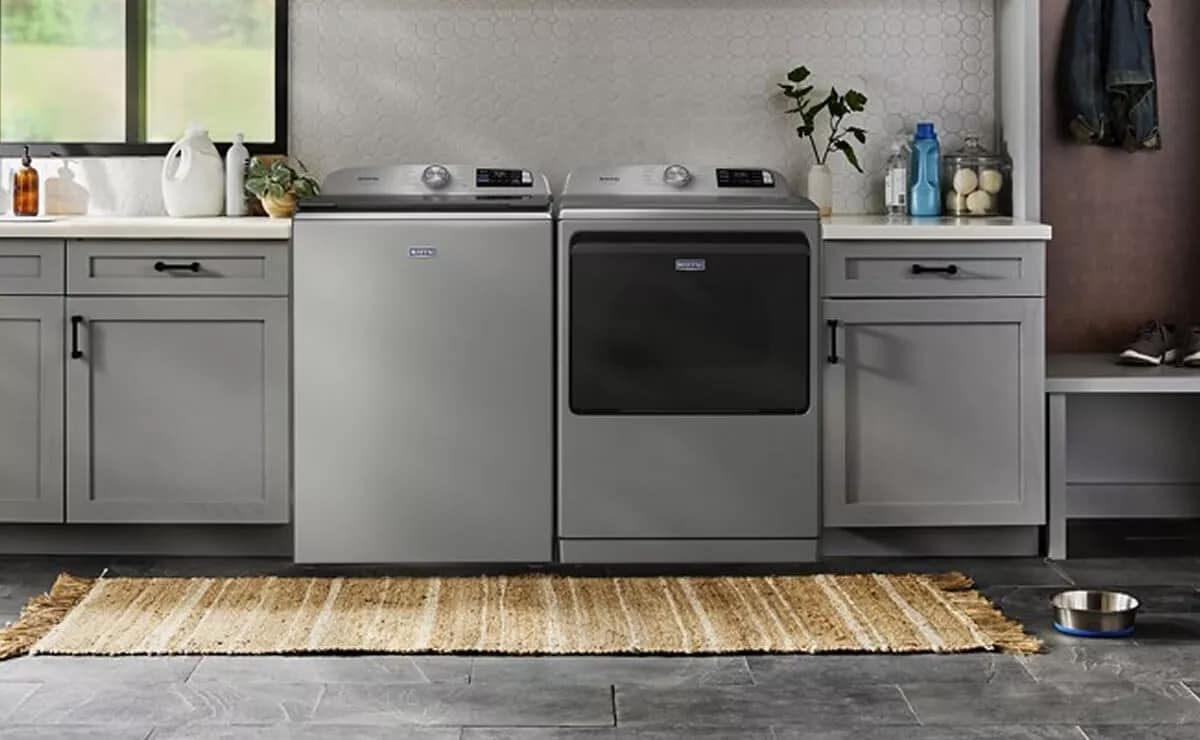
This Maytag ® large capacity washer is large enough to handle even your largest loads of laundry with ease
Large capacity washers are typically considered to be about 4.5 cubic feet or more. These washers are ideal for bulky items, large families or those who want to tackle more laundry in fewer loads.
A king-size comforter will need enough room to move freely in the washer, which may require about 5.0 cubic feet of capacity or more. Consider taking a king-size comforter to a laundromat if you find you have to pack it tightly into the washer drum, which can lead to poor cleaning.
The proper washer size for a family of five can depend on specific laundry habits. Generally, a washer with 4.5 cubic feet or more of drum capacity can help you keep up with clothing, bedding and linens for a large household.
Find a Maytag ® washer built to take on whatever laundry piles up. Select models, like this Maytag ® washer with 5.3 cubic feet of capacity , offer features that help make laundry day simple, like the Built-In Water Faucet that allows you to rinse, spot treat or soak clothes right in the washer.
1. Results may vary based on load size and type.
Your subscription was successful
Thank you for signing up. Keep an eye on your inbox for our next newsletter.
Enjoy articles like this? Get helpful guides and appliance care tips sent straight to your inbox.