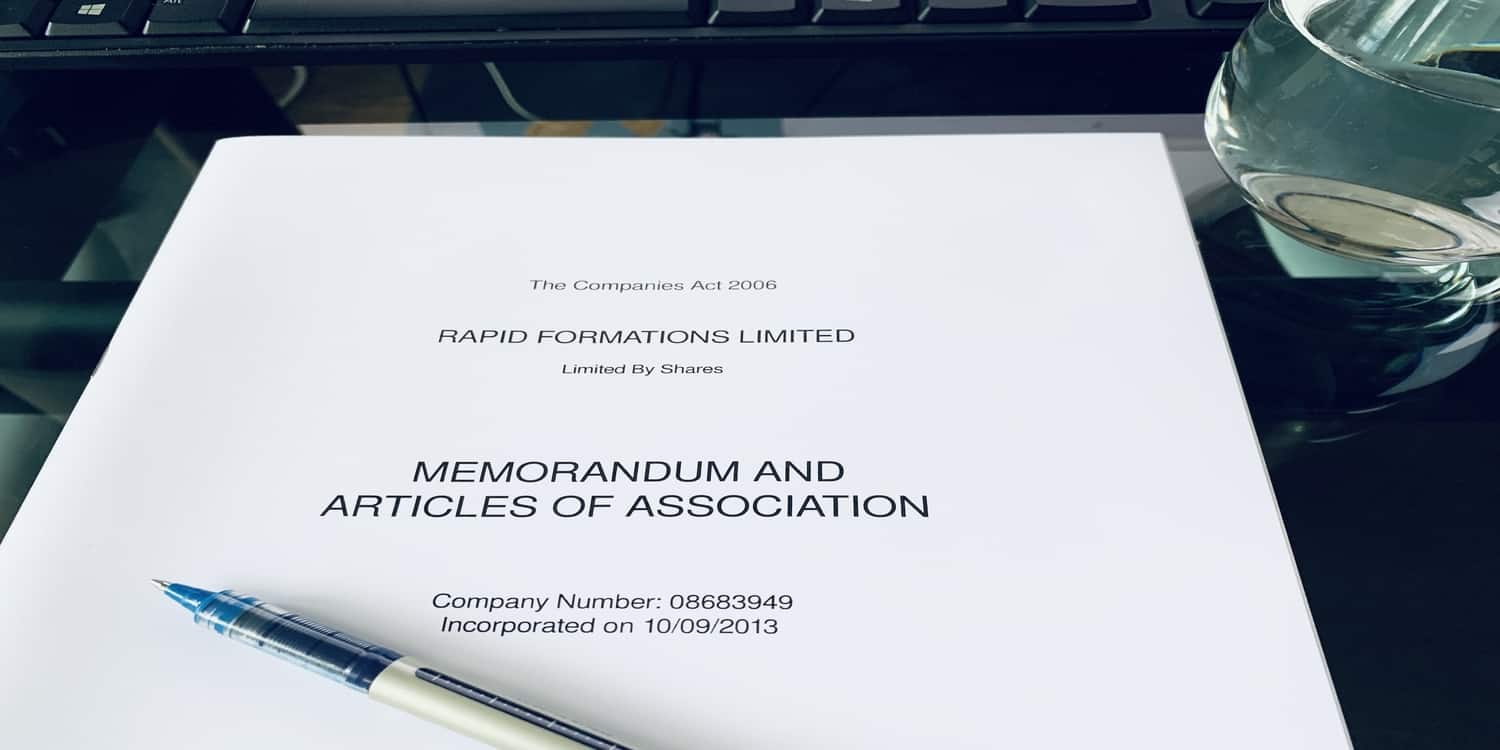
The memorandum and articles of association are two forms of documentation that all UK limited companies must have when they incorporate at Companies House. Together, the memorandum and articles create the basis of the company’s constitution.
The memorandum of association states the names of each subscriber (the founding shareholders or guarantors who join a company during its incorporation) and their intention to form and become members of the company.
In contrast, the articles of association is a governing document that outlines the company’s purpose, the rights and responsibilities of its members and directors, and how the company must operate as a whole.
Companies House creates the memorandum of association during the company formation process. It will contain the following information:
Any person or corporate body that subscribes (adds) their name to the memorandum becomes a subscriber and member of that company. They will continue to be members until they leave the firm.
Details of all members are registered with Companies House and displayed on the central public register. This information is available to view free of charge online.
The majority of new limited companies adopt model articles of association . This is the default version prescribed by the Companies Act 2006 and provided by company formation agents or Companies House.
However, if a company has specific needs that are not covered in the model articles, the members can alter this version or draft bespoke articles to reflect the company’s requirements and objectives.
The contents of the model articles include the following matters:
If you wish to issue any class of share other than ordinary, you’ll need to alter the model version or create bespoke articles. Likewise, if you want to deviate from the standard version by changing, removing, or adding any provisions, you must alter the document or create your own articles from scratch.
If you decide to adopt an amended form of the model articles, you’ll need to make the relevant changes yourself and include a copy with your company formation application.
If you choose to adopt the model articles, you won’t have to submit a copy for Companies House. Simply indicate on your registration application that your company is adopting model articles.
You can alter your articles of association at any time after setting up your company. To do so, the members must pass a special resolution agreeing to the changes (unless altering an entrenched provision—see below). A copy of the final document as altered must be submitted to Companies House within 15 days of the resolution being passed.
Sometimes, these changes can be as simple as granting more rights to directors. Other times, you may have to make more complicated changes, like creating more share classes or changing members’ rights. Whatever the reason, we advise seeking professional advice beforehand.
Most limited companies can amend their articles of association by passing a special resolution . This requires a 75% majority vote (based on members’ shareholdings) in favour of the resolution. However, a company can include additional clauses in its articles to make certain provisions more difficult to change than passing a special resolution.
Any clause that requires more than a special resolution to be amended is known as an ‘entrenched provision’ under section 22 of the Companies Act 2006, which states the following:
Entrenchment is uncommon in companies with only one shareholder. However, such restrictions can be beneficial in joint ventures where one or more shareholders collectively hold less than 25% of the voting rights. This affords minority shareholder(s) the same control as majority shareholders over specific changes to the company.
If an entrenched provision requires an absolute majority vote (100%) to be altered, minority shareholders have the power to prevent such changes.
Under the Companies Act 1985, it was possible to entrench certain aspects of a company’s constitution by including them in the articles of association with the provision that they could not be altered.
If your company was incorporated before 1 October 2009 under the 1985 Act, you will require a court order to change such entrenched provisions.
However, absolute entrenchment is not possible if your company was incorporated on or after this date under the Companies Act 2006. You may only entrench provisions in the articles on a conditional basis.
This means you can stipulate that certain provisions may only be altered if specific conditions are met or certain procedures are followed. For example, a provision that requires the approval of more than a 75% majority vote.
You’ll need to notify Companies House on the relevant form if you include or change any entrenched provisions in your articles of association, as outlined below.
If a company’s articles are adopted or altered to include entrenched provisions, Companies House must be notified on the prescribed form within 15 days of the amendment taking effect.
Use form IN01 upon incorporation or form CC01 in the case of amendment after incorporation.
The prescribed form should include a copy of the revised articles and the resolution agreeing to the amendment.
To remove entrenched provisions from a company’s articles of association, Companies House must be notified on form CC02 within 15 days of the amendment taking effect, together with the revised articles and corresponding resolution.
To alter entrenched provisions, a company must provide Companies House with a document making or evidencing the alteration. This should be accompanied by a Statement of Compliance (form CC03) to certify that the changes have been made in accordance with the company’s articles (including any provision for entrenchment). Or, where relevant, in accordance with any order of the court or other authority in force at the time of the amendment.
A company may not alter its articles in such a way that a shareholder is required to increase their shareholding or liability unless an agreement is made in writing before or after the alteration.
The purpose of the notification provisions is to ensure that Companies House and any person searching the public register of companies is on notice that the articles contain entrenching provisions and that special rules apply. You can find these provisions in sections 23 and 24 of the Companies Act 2006 ,
Companies House creates the memorandum during the incorporation process and attaches it to the articles of association. The information you provide during the company formation process will be used to prepare the memorandum.
You will only be required to provide your own articles if you do not adopt the model articles issued by your company formation agent or Companies House.
If you wish to alter the model version or create bespoke articles, you must upload the altered or bespoke version during the online company formation process.
The memorandum cannot be amended at any time, regardless of whether any subscribers leave the business or change their name. It is a historical document and must always remain in its original state.
As part of our online incorporation service, our company formation packages include a modified form of the standard model articles. These are suitable for most private companies limited by shares with only ordinary shares. If you wish to incorporate a company with multiple share classes, please contact us and we’ll be happy to guide you.