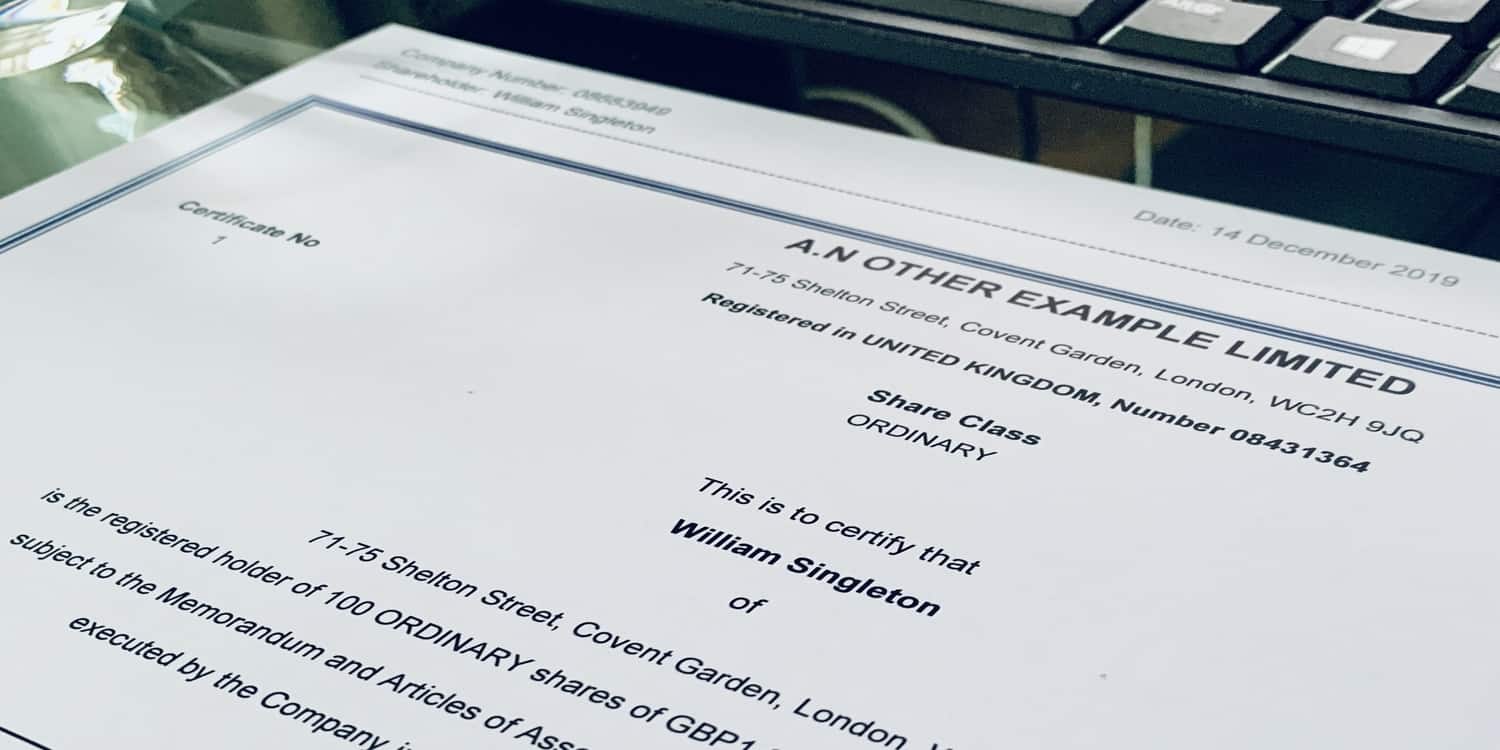
A share certificate is a document that a limited by shares company creates and distributed to its shareholders, the purpose of which is to prove ownership of shares in the company. Essentially, it is receipt of ownership, typically in the form of a single piece of paper or digital document.
Limited companies issue share certificates to their shareholders when they purchase or receive gifted shares at any point after company formation. The share certificate confirms ownership of a share (or shares) from the date of purchase or transfer.
A share certificate provides independent evidence of title to shares, as per s. 768 Companies Act 2006 . It enables its holder, known as a shareholder, to sell or transfer the share(s) to a new owner.
A share certificate should generally be issued within two months of the share(s) being allotted, i.e., no later than two months after the shares have been purchased or transferred.
According to section 24(1) of the model articles for private companies limited by shares ‘ a company must issue each shareholder, free of charge, with one or more share certificates in respect of the shares which that shareholder holds.’
Share certificates are normally required whenever company shares are transferred or sold. The person selling or transferring their shares is required to return their existing certificate to the company which will cancel this and issue a new certificate to the new owner.
Another circumstance in which share certificates may need to be provided is that of share restructure. If a company needs to restructure its share capital, existing share certificates may need to be returned and amended or replaced with new ones which reflect the new structure.
It may be necessary to change the share capital of a limited company by:
For more information about changing the share capital of a limited company see our separate blog Share capital – how you can change it .
If a shareholder changes their name through marriage or deed poll, they may request a replacement share certificate which reflects their new name. We will consider this further below.
The Companies Act 2006 prescribes that a company must issue a share certificate when any shares are allotted (issued).
It is common practice to issue share certificates to the subscribers (original shareholders) who set up the business and become members during the company formation process; however, there is no legal requirement to do so. This is because their details are recorded in the statement of capital and the memorandum of association.
There are certain details which must be included on every share certificate. Section 24 of the model articles for private companies limited by shares specifies the information which should be included on each share certificate.
The number of company shares which are owned by the bearer of the share certificate and defines the class of shares. Examples of class of shares include ordinary shares, non-voting shares, preference shares, deferred shares, etc.
The nominal value of shares is the minimum price at which they can be issued, for example 1p or £1, etc. Shares can never be allotted for less than this nominal value..
Traditionally companies had their own unique corporate seals, which originally used melted wax.
Some companies still use modern versions of seals to execute official company documents. But under section 44(2) of the Companies Act 2006 , an alternative to a seal for validly executing documents is a signature on behalf of the company ‘ by two authorised signatories, or … by a director of the company in the presence of a witness who attests the signature.’
So it is no longer necessary to affix a company seal to a share certificate.
According to section 24 of the model articles ‘no certificate may be issued in respect of shares of more than one class.’
If the shareholder owns more than one class of shares, a separate share certificate must be issued in respect of each different class.
Section 24 of the model articles states ‘if more than one person holds a share, only one certificate may be issued in respect of it.’
In the case of joint shareholders, all names can be included on one share certificate, with the address of the first named shareholder.
Banks and lenders may ask to see these certificates when you open a business bank account or apply for a loan. For this reason, you should ensure their safekeeping at all times. Consider storing copies of share certificates at your registered office or SAIL address with your company’s statutory records and registers.
Rapid Formations provides digital copies of share certificates as part of the company formation process. A PDF version of each one will be sent to you on the day of incorporation, so you can save them to your computer and print them at any time, or store them in the cloud.
Digital copies of a share certificate can be lost if the shareholder loses access to their computer or cloud storage (e.g., as a result of a lost password).
Meanwhile, physical copies can be misplaced, thrown away by accident, or damaged in a fire. If a share certificate is lost or damaged, it will be necessary to issue a replacement.
The general procedure for dealing with requests to replace lost share certificates is as follows:
Before issuing a replacement share certificate, companies will normally seek an indemnity from the shareholder. This is an agreement under which the shareholder is obligated to cover any losses incurred by the company in connection with the replacement of the certificate.
In certain cases, the company may request that a third party, such as a bank or insurance company, provides a guarantee in respect of the indemnity. In effect, the third party will countersign the indemnity provided by the shareholder, and they will be ultimately responsible for ensuring that any losses sustained as a result of the replacement certificate being issued are recovered.
In the event that a shareholder officially changes their name by marriage or deed poll, it will be necessary to issue them with a replacement share certificate to take into account their change of name. It is vital that evidence of the name change is obtained before issuing a replacement share certificate.
If a shareholder just changes their address, there is no requirement to issue a replacement share certificate.
There is no need to provide Companies House with copies of share certificates. However, a copy of each share certificate should be stored securely by the company.