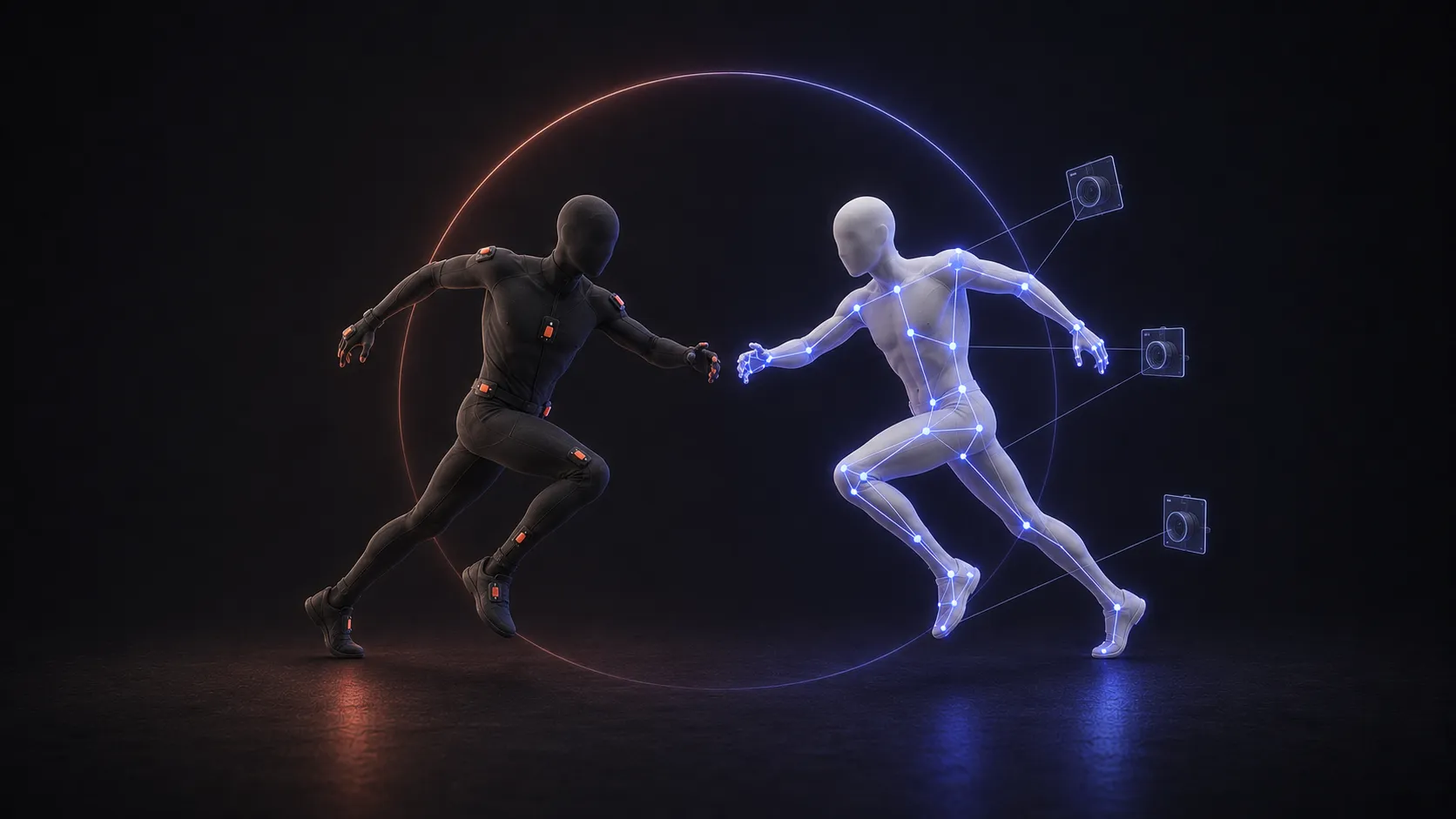
If you have researched serious motion capture, you have met Rokoko. Its bright Smartsuit is one of the most recognizable products in the space, and the brand pulls tens of thousands of searches a month. But the first thing most people want to know is simple. How much does it cost, and do I actually need it?
The honest answer is that Rokoko makes excellent hardware, and that hardware is not cheap. It is also not the only way to capture motion anymore, a point Rokoko itself proves by shipping a free AI tool alongside the suit.
This guide covers what Rokoko is, what it costs, when the hardware is genuinely worth it, and how free AI motion capture compares when you would rather not spend thousands on a suit.
Rokoko is a motion capture company that builds both hardware and software for recording human movement. It is best known for making professional mocap affordable enough for indie studios, not just film houses.
The ecosystem has a few core parts.
Rokoko spans free to several thousand dollars, depending on whether you buy the hardware. Here is the breakdown.
A full performance bundle, suit plus gloves plus face plus a Studio subscription, lands between $3,500 and $5,000, and you can see current numbers on the Rokoko pricing page. Independent mocap suit costs guides put Rokoko at the affordable end of professional hardware, which is true, but affordable professional still means thousands.
Pro tip. Price the whole system, not the suit. The headline number is the suit alone, and gloves, face capture, and the software subscription add up fast.
A suit is powerful, but it comes with friction that free AI capture simply avoids. Worth knowing before you spend thousands.
None of this makes a suit a bad buy for the right project. It just means the barrier is real. For a quick capture, a solo creator, or a tight budget, the friction often outweighs the accuracy gain, which is precisely the opening that Pinoc stepped into.
You need a suit when fidelity, volume, and budget all point the same way. If any one of them does not, Pinoc’s motion capture usually covers you. I use a quick check I call the Hardware Threshold.
Clear all three and a Rokoko suit is a great investment. Miss even one, and you are probably better served by an AI motion capture, which has closed a lot of the gap for everyday work.
The alternative is AI markerless capture, which reads motion straight from video with no suit at all. Rokoko itself offers one in Rokoko Vision, and Viggle PINOC is another option built around the same idea.
The trade is straightforward.
For a AAA cinematic, the suit still wins. For the vast majority of indie and creator work, AI capture is the practical choice, and it is where the next tool fits.
It helps to be realistic about the quality gap, because it is smaller than it used to be. A suit captures subtle weight shifts and micro movement that video can miss, and it holds up in poor lighting where a camera struggles. But once AI captured motion is retargeted onto a stylized game character and cleaned up, the difference is rarely visible to a player. The suit buys precision that film needs and most games do not, which is why so many indie teams now skip the hardware entirely.
PINOC is a markerless motion capture tool, which means no suit, no gloves, and no hardware bill. It captures a performance from any video, which is the whole pitch against a $2,495 suit. Its core strength is turning any clip into 3D skeletal animation.
The workflow needs nothing but a camera you already own. Film the movement, then let AI motion capture extract it as a 65 bone, Mixamo named skeleton animation. Because it uses a standard skeleton, the result retargets onto your character exactly like any other mocap clip.
That animation exports as FBX or GLB, ready for Blender, Unreal, Unity, Maya, and Cinema 4D. Be clear on one point. PINOC captures the motion, not the character model. You bring a rigged character and apply the captured performance on top.
PINOC also has an image to 3D character feature that rebuilds a character image as a Gaussian Splatting model in the browser, so you can preview the motion on your character before export. You can also export the character model itself as a static PLY file.
PINOC runs on JST, Viggle’s in house video to 3D foundation model. JST is trained with physical priors, so captured motion respects weight, contact, and timing instead of lifting flat 2D keypoints frame by frame.
Here is what it replaces from the hardware path.
The capture workflow lives inside Viggle PINOC , and it is free to try right now. If your project does not clear the Hardware Threshold, it is the fastest way to skip the suit entirely.
The Smartsuit Pro II starts around $2,495 for the suit alone. Adding Smartgloves at about $695 a pair, face capture, and a Rokoko Studio subscription brings a full bundle to roughly $3,500 to $5,000. Indie creator bundles offer some savings, but it is still a hardware investment.
Partly. Rokoko Studio is free to record with, and Rokoko Vision is a free AI mocap tool. The Smartsuit hardware and full software retargeting features are paid. So you can start with Rokoko for free, but the flagship experience is the paid suit.
Not for most work. A suit gives the highest accuracy, which matters for film, but AI capture from a single video is good enough for games, prototypes, and social content. Many creators never buy hardware and still ship believable animation.
For video capture, Rokoko Vision and Viggle PINOC are both strong options that need no hardware. PINOC is free to start and outputs a Mixamo named skeleton that retargets straight into your engine, which makes it an easy no cost starting point.
For frame accurate film work, a suit is still more precise. For everyday games and creator content, AI capture has closed most of the gap, and the difference rarely shows once motion is retargeted and polished. Match the tool to the fidelity your project actually needs.
Yes. Markerless AI tools capture motion from a normal video with nothing worn on the body. Viggle PINOC does this by turning any clip into a skeleton animation you can export and retarget, no suit or sensors required.
Like all inertial suits, the Smartsuit can accumulate drift over long takes, since it estimates position from motion sensors rather than fixed cameras. Rokoko Studio includes correction tools and shorter takes reduce it, but drift is a known trade off of sensor based capture that camera based methods avoid.
Rokoko earned its reputation by making professional mocap hardware that indie studios could almost afford, and for film grade, high volume work the Smartsuit is still worth its price. But the fact that Rokoko also ships a free AI tool tells you where the accessible end of the market went. If your project does not clear the Hardware Threshold, you do not need a suit at all. With a tool like Viggle PINOC, a plain video and a standard skeleton get you most of the way there for nothing. The question was never whether Rokoko makes good hardware, because it clearly does. It is whether your project needs to buy it, and for a growing number of creators the honest answer is no.