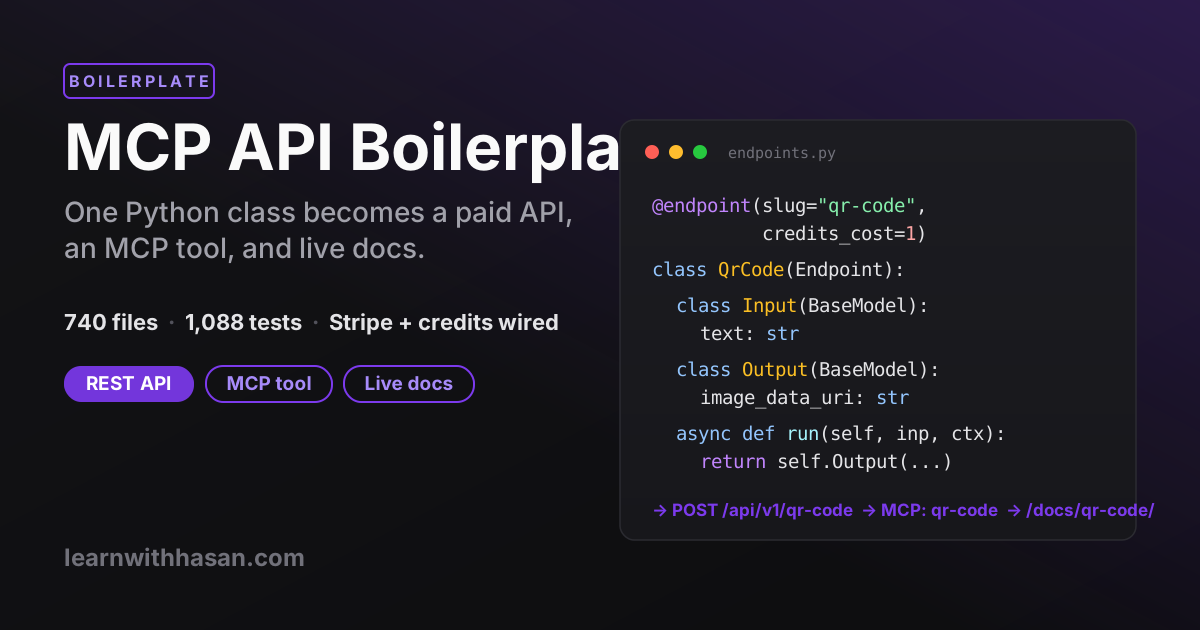
Django and FastMCP, with 673 lines of architectural contract your coding agent reads before it writes anything. One folder is yours to extend. Billing, API keys, OAuth and rate limits sit behind a boundary your agent is told not to cross.
Auth. Magic links, hashed API keys, and OAuth 2.1 with PKCE: the flow Claude.ai demands before it will even connect.
Billing. Stripe webhooks, a credit ledger that survives race conditions, refunds when your code throws.
Rate limits, dashboards, call logs, docs pages, deploy configs. Still zero endpoints shipped.
This is the codebase you wish you'd started with: all of it wired and tested, so day one is your actual product.
Not a README it might skim. CLAUDE.md is loaded as Claude Code's project context on every session, and it opens by fencing off the fourteen apps that run your billing, your API keys and your OAuth.
The boundary map gives your agent apps/app_endpoints/ and marks fourteen framework apps off-limits, billing, API keys and OAuth among them. Three of those boundaries are machine-enforced too: import-linter fails CI on the import rules that would blur them.
The authoring recipe numbers them, with the exact file names at each step. Step 0 tells your agent to ASK you whether your provider supports webhooks rather than choose for you, because switching that decision later is a refactor.
Five complete endpoints ship under apps/app_endpoints/ , covering the sync, credit-charging, background-job and webhook-completion shapes. Your agent copies one that exists instead of inventing a sixth.
A lookup table naming the exact module for eleven questions an agent would otherwise guess at, from how the REST view dispatches a request to where the credit charge actually happens.
Pick a system to see what's done. Endpoints, MCP, auth, billing, dashboards, and ops ship working. 1,088 tests say so.
Every screen below is the boilerplate running unmodified. Tap through the tour.
The Try-it panel firing a real call and returning a QR code The endpoint catalog your customers browse Customer dashboard: plan, credits, and every call logged API keys your customers mint, preview, and revoke themselves Claude calling a tool you wrote as one Python class Usage analytics: credits burned, error rates, per-endpoint latency
Against wiring it yourself, TypeScript MCP skeletons, or renting a metering gateway that takes a cut.
You have the endpoint idea. You do not have a month for auth, billing, and MCP plumbing. Skip to the product.
Every AI assistant can call your product over MCP. Ship the tool; the protocol, OAuth, and metering are done.
Bolt a metered, documented API + MCP layer next to your existing product without inventing billing twice.
You describe the endpoint and check four things. CLAUDE.md keeps Claude Code and Cursor inside your folder and out of the billing code.
Just this boilerplate, or a bundle that unlocks the courses and every other boilerplate too.
Django and FastMCP boilerplate for Claude Code: one Python class becomes a REST endpoint, an MCP tool and live docs, with billing, credits and OAuth wired. The stack behind ToolerBox.
The course + all 4 boilerplates.
Every course, boilerplate, and product I build, in one bundle.
An invite to the private GitHub repository with the full source: 740 files, 1,088 passing tests, 20 Django apps, 5 worked example endpoints, and 30 reference docs, plus lifetime updates via git pull, and step-by-step public docs that take you from clone to a deployed, paid, Claude-callable API.
Single-app commercial license, in plain English: build and sell ONE commercial product per purchase, with unlimited learning projects and prototypes on top. Modify anything, keep your fork private, deploy anywhere. The only hard rule is you cannot republish or resell the template itself. Everything you build on it is yours.
The walkthrough docs assume none of it: Docker runs everything (you never install Python), and the first endpoint you build is one you describe to Claude Code rather than type. The docs give you the prompt and the four things to check in what comes back, and the whole class is about 20 lines you can read in one sitting. Developers get a full dev setup and a 1,088-test suite on top.
The repo ships 673 lines of CLAUDE.md that Claude Code loads as project context on every session: a 6-step endpoint recipe, five worked endpoints to copy, an 11-row lookup table pointing at the module that answers each common question, and a boundary marking the fourteen framework apps your agent must not edit. The public docs walk you through building a QR-code endpoint that way, prompt first, and the reply shown on that page is the unedited one from a clean clone. Cursor and Copilot work too; they just need telling to read the file, because they do not load it by convention.
No. The credit system works standalone: you grant credits from the admin console and the framework enforces balances, charges per call, and refunds errors. Connect Stripe later and users buy subscriptions and credit packs themselves. There is a documented credit-only mode if you never want Stripe at all.
Three built-in ways: one-click OAuth from Claude.ai (they click Connect and approve on your domain (the OAuth 2.1 + PKCE + registration dance is done for you), API keys for developers and Cursor, and URL-token addresses for clients that cannot send headers. All three hit the same credits and rate limits.
Docker Desktop and Git. That is the whole list: one script boots the API, MCP server, worker, Postgres, and Redis (measured: 58 seconds from fresh clone to healthy on a warm machine). Python on your machine is optional, for developers who want the test suite.
Yes: ToolerBox.com sells its API + MCP layer on this exact boilerplate: credit-metered endpoints, async jobs, OAuth connects from Claude, real customers. The template is the generalized version of that production stack, and every walkthrough doc was executed end-to-end (including a real VPS deploy) before publishing.
The private repo is the distribution channel: git pull brings every improvement. The changelog marks [SECURITY] entries as pull-within-a-week and [BREAKING] entries ship with exact upgrade steps in UPGRADING.md, including the fork conflict-resolution playbook.
$79 once. Lifetime updates. One commercial app.