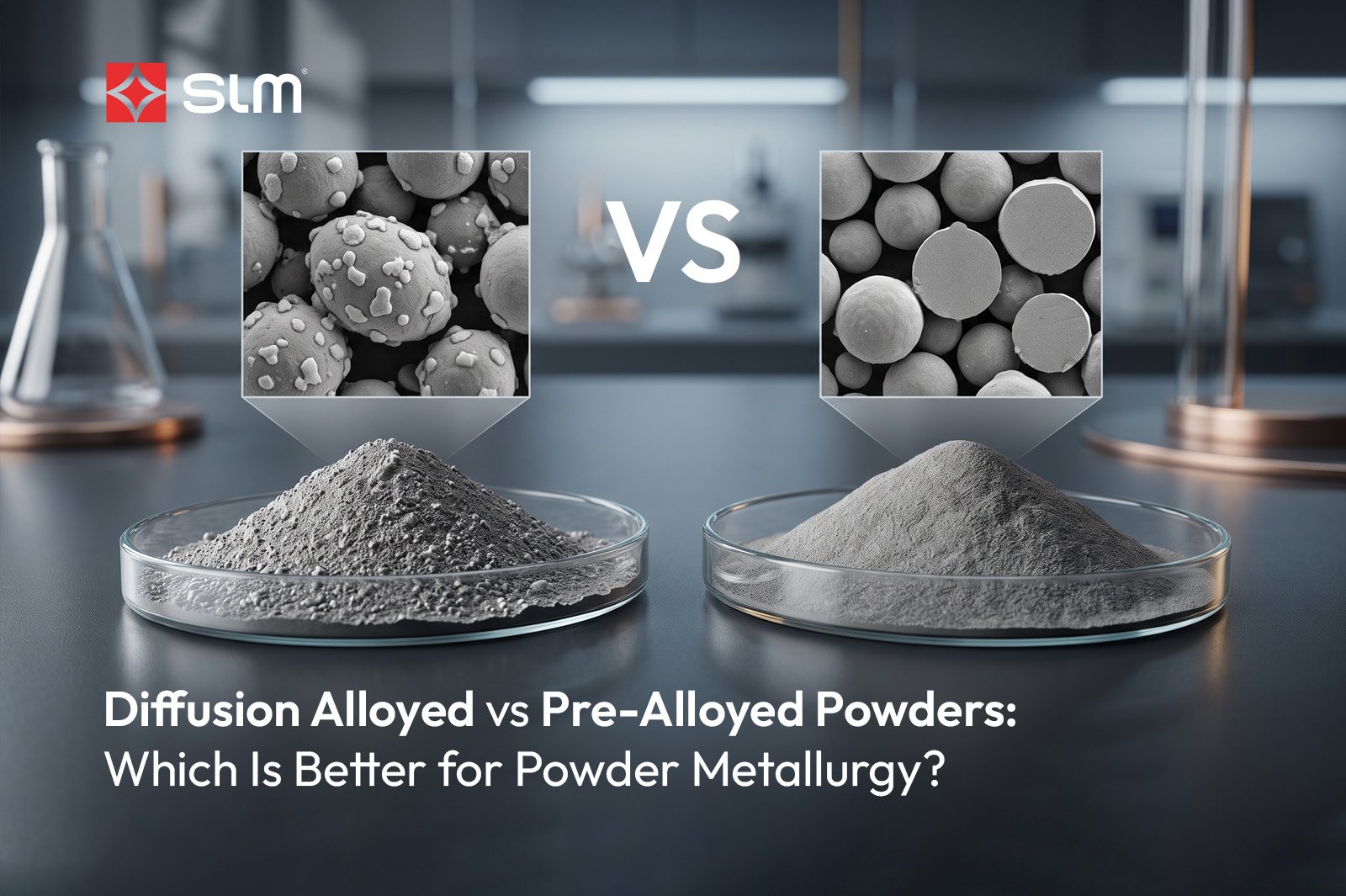
When choosing an alloyed iron powder for powder metallurgy , the question is rarely as simple as which powder is better. Diffusion alloy powders and pre-alloyed powders approach alloying in fundamentally different ways, and that difference affects compressibility, segregation, sintering behaviour and the final microstructure. Diffusion alloyed powders generally retain more of the compressibility of the iron base powder while reducing segregation compared with a conventional powder mix. Pre-alloyed powders provide more uniform chemistry within each particle, but alloying can reduce compressibility through solid-solution strengthening. The right choice depends on the component, required density, alloy system and processing route.
Diffusion alloy powders are produced by bonding alloying elements to the surface of iron powder particles through a controlled thermal treatment. The alloying elements do not become uniformly distributed throughout each iron particle as they would in a fully pre-alloyed powder.
This creates an important middle ground.
A conventional premix can suffer from segregation because particles of different size, density and morphology can separate during handling and filling. A fully pre-alloyed powder eliminates that issue at the particle level, but the alloying elements strengthen the iron matrix and can make the powder harder to compact.
Diffusion alloying aims to reduce segregation while retaining much of the base iron powder’s compressibility.
Research published in the Journal of the Japan Society of Powder and Powder Metallurgy found that diffusion-bonded Fe-Ni-Mo-Cu systems offered higher compressibility than comparable pre-alloyed powders, while providing the alloying needed for higher-strength PM components.
In a pre-alloyed powder, the alloying elements are introduced into the molten metal before atomisation. Each powder particle therefore has essentially the same alloy chemistry.
That uniformity is one of its biggest advantages.
During compaction and sintering, there is no need to rely on alloying elements moving from separate particles into the iron matrix simply to establish the intended bulk chemistry. This makes pre-alloyed powders particularly useful where consistent alloy distribution and predictable metallurgical behaviour are priorities.
The trade-off is compressibility. Alloying elements in solid solution can strengthen the powder particles, making them harder to deform during pressing. This can make it more difficult to achieve high green density at a given compaction pressure.
For a powder metallurgy manufacturer targeting high-density structural parts, that distinction can become a major process consideration.
The table shows why neither route can simply be called superior. The decision is about which material characteristic matters most to the component.
Compressibility is not just a powder-handling parameter. It has a direct relationship with the density that can be achieved during pressing.
SLM Metal’s current powder metallurgy information, for example, lists different atomised and sponge iron grades according to apparent density, green strength and sintered density. Its atomised grades include high-compressibility options for higher-density parts, while its sponge grades are positioned for applications where green strength and density requirements differ.
This is important because density has a strong influence on the mechanical performance of conventional PM parts. Higher density generally means less residual porosity, which can improve strength and fatigue performance.
Diffusion alloying can therefore be attractive when the alloy system requires strengthening elements but the manufacturer still wants to preserve the pressing characteristics of an iron-rich base powder.
Pre-alloyed powders become attractive when chemical uniformity is the priority.
Because every particle starts with the intended alloy composition, there is less dependence on diffusion between separate alloying constituents during sintering. This can be particularly useful for alloy systems where precise chemistry and homogeneous microstructure are important.
Pre-alloying can also make certain alloying elements easier to incorporate into the powder. Research on PM steels notes that pre-alloying can enable elements such as chromium, which are difficult to introduce through other alloying routes because of their high oxygen affinity.
The compromise is that the alloyed particles may be less compressible than an unalloyed iron base.
Diffusion alloying is particularly useful when a manufacturer needs a combination of alloying performance and good compactability.
A well-known example is the Fe-Ni-Mo-Cu family of diffusion-bonded powders used for structural PM components. Research comparing diffusion-bonded and pre-alloyed steels has reported higher compressibility for diffusion-bonded systems, while their alloying additions contribute to high-strength microstructures after sintering and, where required, heat treatment.
The benefit is therefore less about the powder being inherently “better” and more about preserving the manufacturing window.
A powder that compacts efficiently can help achieve the required green density without simply increasing pressing pressure. That can matter for tooling loads, component geometry and production economics.
The distinction between the two powders does not disappear once pressing is complete.
With diffusion alloy powders, alloying elements need to diffuse into the iron matrix during sintering. The resulting microstructure depends on the alloying element, particle characteristics, sintering temperature, time and atmosphere.
Recent work in the field continues to examine the behaviour of diffusion-alloyed and pre-alloyed steels alongside newer alloying routes. A 2025 review of alloying variants in powder metallurgy notes that diffusion-bonded powders typically retain a controlled heterogeneity, while full pre-alloying provides a more homogeneous chemical state within the powder particles.
That distinction matters when selecting a powder for a specific heat-treatment and performance target rather than simply comparing powder chemistry on paper.
The best choice starts with the finished component, then works backwards to the powder.
A manufacturer should consider:
Particle size and distribution matter as well. SLM Metal’s current product information highlights characteristics such as particle size, morphology, apparent density, surface area and purity when matching iron powders to applications.
This is why a powder should not be selected solely from its nominal chemical composition. Two powders with similar chemistry can behave differently during pressing and sintering because their physical characteristics are different.
For high-density components where compressibility is a major constraint, a diffusion alloyed system can offer a useful balance between alloying and compactability.
For applications where particle-level chemical uniformity and predictable alloy distribution are more important, pre-alloyed powder may be the more appropriate route.
There is also a third consideration: the quality of the base powder and the consistency of its physical characteristics. Alloying technology cannot compensate for uncontrolled particle size, density, purity or morphology.
This is where the capabilities of the powder metallurgy manufacturer matter. A supplier needs to understand not only the target chemistry, but also how the powder will behave in mixing, compaction and sintering.
Diffusion alloyed and pre-alloyed powders are designed around different metallurgical priorities. Diffusion alloy powders can reduce segregation while retaining better compressibility, making them valuable for applications where high green density and alloying performance need to coexist. Pre-alloyed powders provide more uniform chemistry within each particle, making them useful where consistent alloy distribution is the overriding requirement.
For manufacturers, the decision should therefore begin with the component’s density, strength, geometry and processing conditions. SLM Metal’s range of atomised and sponge iron powders, along with customised regular and bonded mixes, reflects this application-led approach to powder selection.
The better powder is ultimately the one that gives the required combination of compactability, chemistry, sintering response and final-part performance.
Diffusion alloy powders are iron-based powders in which alloying elements are bonded to the iron particle surface through controlled thermal treatment. They offer a balance between reduced segregation and good compressibility.
Yes. In a pre-alloyed powder, the alloying elements are incorporated into the powder particles during melting and atomisation, giving each particle a more uniform chemistry.
Diffusion alloyed powders generally offer better compressibility because the alloying elements do not fully solid-solution strengthen the iron particles before compaction.
Better compressibility can help manufacturers achieve higher green density at a given compaction pressure. This can influence the density, strength and performance of the finished PM component.
Pre-alloyed powder can be appropriate when uniform alloy chemistry and predictable microstructural behaviour are particularly important to the application.
Diffusion alloy systems can be designed around specific alloying requirements, but the appropriate composition and physical characteristics should be established according to the component and processing route.