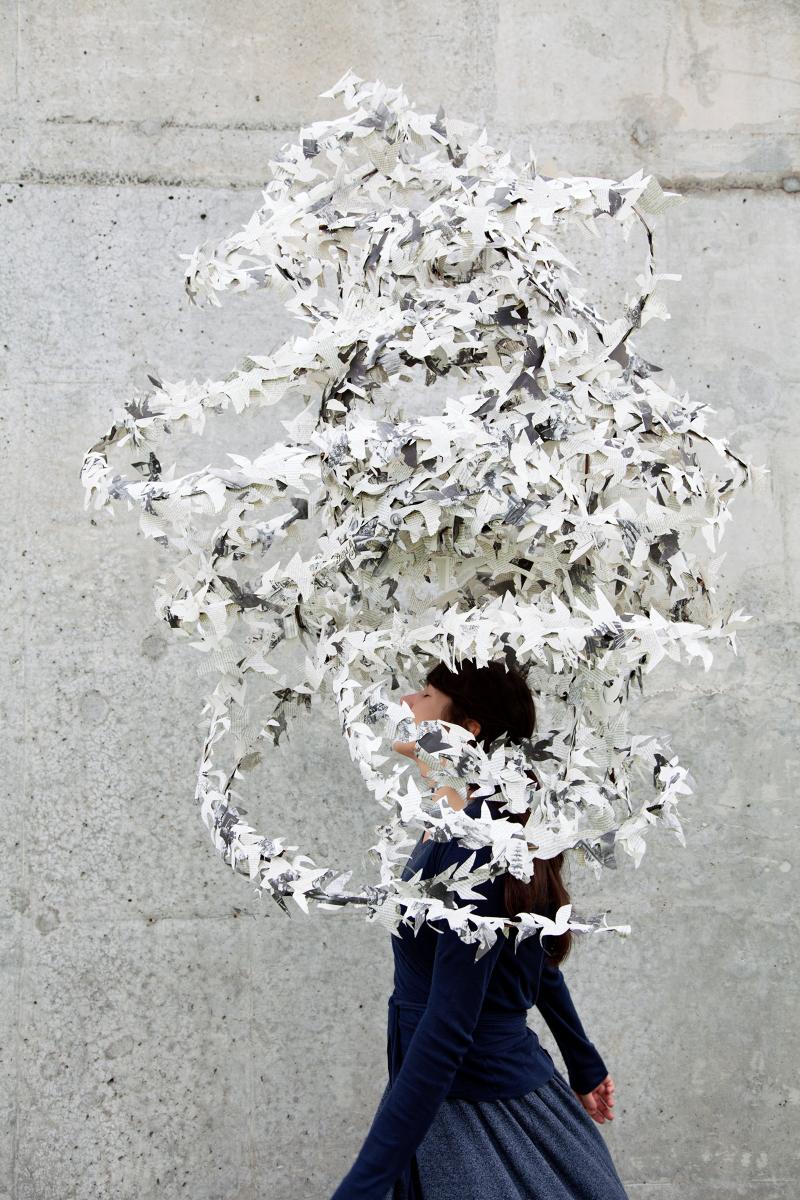
2014 Inkjet mounted to dibond 229 cm x 152 cm
Meryl McMaster (b. 1988, Ottawa, ON) quickly established a nationally recognized career, which is predominantly photography based. McMasterâs striking imagery often takes the form of self-portrait. Combining elements of performance and installation, McMaster highlights the tensions surrounding identity and heritage, especially her own as a woman of Indigenous (Plains Cree) and European (British/Dutch) descent. Within her practice, McMaster focuses on land, the natural environment, and migration. Making use of elaborate and ornate props, McMasterâs work frequently transports the viewer out of the ordinary into a space of beauty, contemplation, and introspection.
McMasterâs Murmur draws inspiration from the natural phenomenon of a murmuration, a mass of starling birds that collectively fly as one in-sync unit. In this work, McMaster enters the centre of the murmur and twirls to echo the form of the swirling birds. The resulting imagery feels fantastical and otherworldly. McMaster is interested in the aerial spectacle of these birds travelling collectively as well as in the bird itself as a symbol of freedom and boundlessness, and she underscores that poetic and imaginative gestures can bring new meaning to fixed ideas or even stereotypes.
McMasterâs overarching practice addresses themes that affect everyone in contemporary society, tensions between identity and heritage, and coming to terms with differing worldviews. The artist has noted that exploring her relationship with others and her place within the natural world is at the heart of her work.
Since graduating from OCAD University in 2010, McMaster has earned numerous accolades, including the Eiteljorg Contemporary Art Fellowship, a REVEAL Indigenous Art Award, and a Doris McCarthy Scholarship. In 2016, she was longlisted for the Sobey Art Award, and in 2018 she was named one of three inaugural winners of the New Generation Photography Award.
2022 Acrylic on canvas 182.88 x 167.64 cm
Native Art Department International (NADI) is a long-term, collaborative project created by artists Maria Hupfield (b. 1975, Parry Sound, ON) and Jason Lujan (b. 1971, Marfa, TX). First initiated in Brooklyn in 2016 and now based in Toronto, their multidisciplinary practiceâcomprising performance, sculpture, and videoâseeks to counter easy categorizations of Indigenous art through camaraderie, decolonial politics, non-competition, and a strategic veering away from identity-based artwork.
Notably, NADI uses any means and media in its mission against the classification and fetishization of art. Yet the Woodland Boogie Woogie series brings NADIâs core concerns into more traditional abstracted forms. Building on that formalism, NADI aims to destabilize the binaries that suggest any divide between Native and non-Native aesthetic worlds. Woodland Boogie Woogie #01 seems like a departure from the collaboratorsâ conceptual or curatorial work, presenting flat, swirling vortices of colour delineated by black lines that punctuate the geometric shapes. If the circulating forms, the core shapes and colours were paused, they would be widely recognizable elements from the Woodland School of Art, founded by the Anishinaabe artists Norval Morrisseau, Daphne Odjig, and Carl Ray, among others. The Woodland Schoolâs palette and stylistic motifs, such as the thick black outlines of human and animal figures, have been submitted to a collaborative painting process in which Hupfield and Lujan reconfigure the recognizable Woodlands style. The painted designs were executed in tandem, with each artist taking turns to render the paintings in a choreographed arrangement. In this painting, like their collaboration, the artistsâ roles are clearly defined. As implied by the starkly regulatory name of the duo, their collaboration employs administrative language to frame their area of expertise and responsibility, and signals a commitment to continue moving forward and expanding Indigenous discourse.
2022 Glass beads 33 cm x 33 cm x 33 cm
Nico Williams (b. 1989) is Anishinaabe and a member of Aamjiwnaang First Nation. He is a multidisciplinary artist who often works collaboratively to produce highly detailed, meticulously crafted sculptural beadwork. Using bright, tactile beads and forms, Williams looks at the ways we live through connections with objects, place, and language. His sculptures appear as sparkling abstracted geometric forms, usually resembling familiar objects. In that regard, the artist gravitates to objects that, like beadwork, relate to gratitude, trade and commerce, land, and language capacityâobjects such as caution tape, Ziploc bags, and lottery tickets. Here, the artist is interested in how translating everyday objects into beadwork reattunes their meaning, purpose, and function. Through the laborious process of beading everyday objects, some even refuse, Williams aims to shed light on the temporality of consumerism and overconsumption.
Williamsâs OH! Canada⦠depicts elements of the Canadian flag that are derived from folding lawn chairs with a maple leaf motif. The artist forms the beads into an icosahedron, a geometric polyhedron that consists of twenty faces, a shape that has been prevalent in Williamsâs practice. The artist purposely comingles Indigenous motifs within the Canadian flag to expand ideas of identity and ownership. With this work, he reflects on and challenges how Indigenous art, craft, and voices fit into contemporary stories and the history of Canada as a nation.
Williamsâs work has been exhibited internationally and across Canada, including at the Art Gallery of Hamilton, the MacKenzie Art Gallery, the Musée dâart contemporain de Montréal, the Montreal Museum of Fine Arts, the PHI Foundation for Contemporary Art, and in the recent group exhibition, Indian Theater: Native Performance, Art, and Self-Determination since 1969 , at the Hessel Museum of Art. His first public sculpture, Monument to the Brave , was commissioned in 2020 by the SickKids Foundation.
A stunning blend of nature and inspiration.
Discover More About The Carpet
A Land Acknowledgement is a formal recognition of the traditional territorial lands one is occupying as a sign of respect to Indigenous peoples and communities past, present and future.
Learn more about the Land Acknowledgment