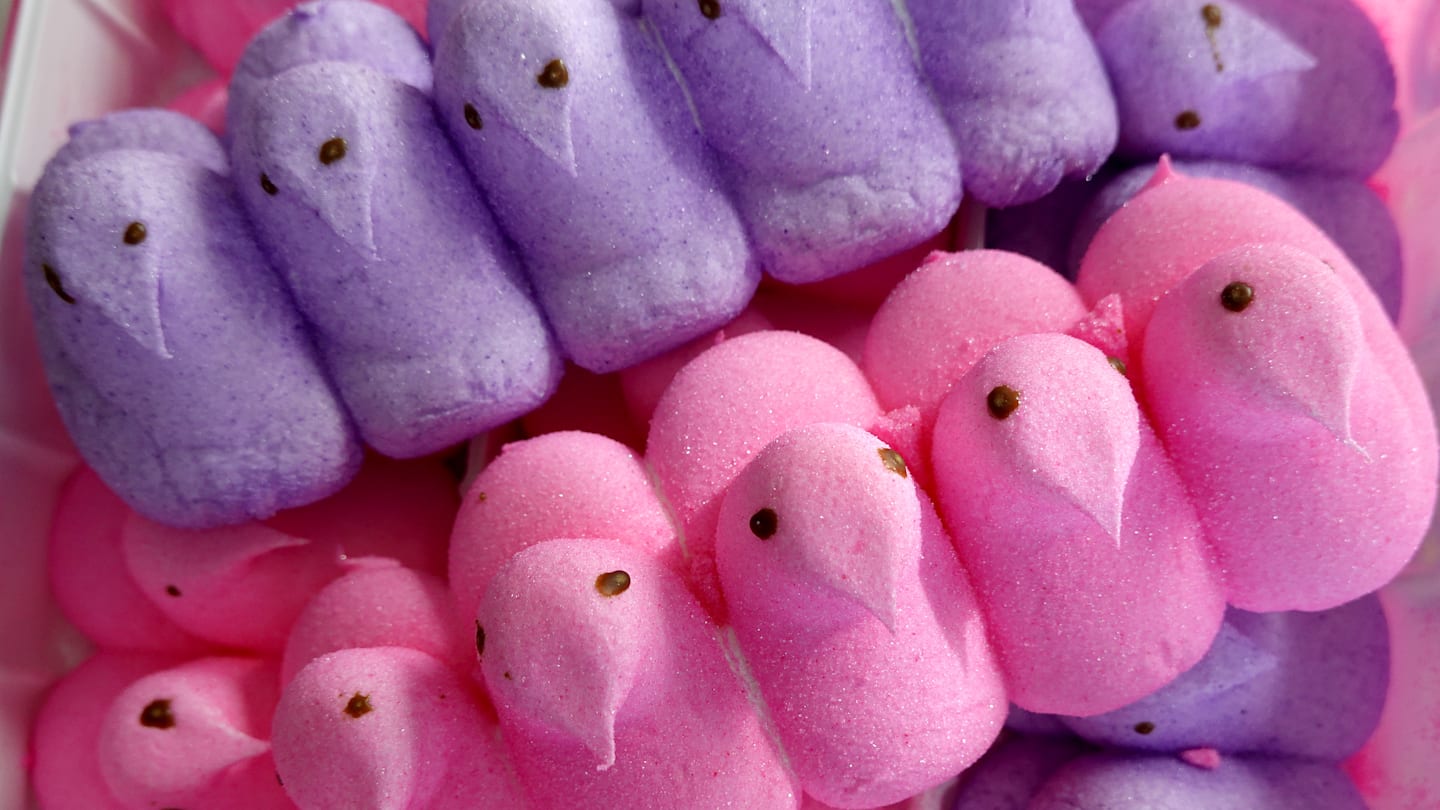
You know whether you prefer chicks to bunnies, fresh to stale, or plain to chocolate-covered. But thereâs a lot you may not know about Peeps, which have a pretty divisive reputation as far as non-chocolate Easter candies go. And whether you love them or hate them, thereâs no denying that these marshmallow treats are an iconic part of the holiday .
That was in 1953, when Sam Born acquired the Rodda Candy Company and its line of marshmallow chicks. Back then, each chick was handmade with a pastry tube. Just Bornâthe Born family candy companyâset about automating the process, so that it now takes just six minutes to make a Peep.
All of them at the Just Born factory in Bethlehem, Pennsylvania. In one year , the company makes enough Peeps to circle Earth twice.
Yellow bunnies are the second most popular color/shape combination. Pink is the second best-selling color.
The recipe begins with boiling granulated sugar, liquid sugar, and corn syrup together, to which gelatin and vanilla extract are later added.
Since Just Born turned Peeps-making into an automated process, the chicks have been carefully formed by a top-secret machine known as the Depositor. Created by Sam Bornâs son, Bob, the Depositor could manufacture six rows of five Peeps apiece in a fraction of the time it took workers to form them by hand. And that same machine that Bob built kept the Peeps flowing for several decades.
In 2014, the company announced that it was planning to renovate its manufacturing plant, including the Depositor. âItâs a little sad,â senior vice president of sales and marketing Matthew Pye told Candy Industry magazine at the time. âBob Born made it from scratch in 1954 and it allowed us to distribute and grow the brand nationally."Â
âThe investment in our marshmallow-making process will allow for more efficiency, more consistency, improved quality, and additional innovation capabilities,â co-CEO Ross Born told Candy Industry about the new Depositor, which will be able to produce a wider variety of Peeps in all sizes. âThe [old] Peeps line did one thing and one thing very wellâcranking out chicks day in and day out. Five clusters, just in different colors,â Born said.
They were clipped in 1955, two years after the first marshmallow chicks hatched, to give the candy a sleeker, more âmodernâ look.
The final flourish for all of these squishy balls of sweetness is adding the eyes, which are made of carnauba waxâa non-toxic vegetable wax (that is also found in some shoe polishes and car waxes, plus many other candies).
In 1999, a pair of scientists at Emory Universityâdubbed âPeeps Investigatorsââdecided to test the theory that Peeps are an indestructible food. In addition to Peepsâ performance in a microwave, the pair tested the candyâs vulnerability to tap water, boiling water, acetone, and sulfuric acid (they survived them all). When they upped the ante with some phenol, the only things that didnât disappear were the eyes .Â
You might not like them (in fact, a lot of people donât ), but for decades, the non-chocolate candy has dominated Easter baskets. With more than 1.5 billion Peeps consumed each spring, they have topped the list of most popular treats for the holiday for more than two decades.
Counterintuitive, we know. But in 2007, the first line of sugar-free Peeps hit store shelves. While they have zero fat, each Peep chick has 28 calories; bunnies have 27.5 calories.
Chocolate-covered Peeps hit the market in 2010. Today thereâs a full line of them for every occasion.
Color and shape (i.e., yellow and chick) are no longer the only ways to categorize a Peep. They now come in an array of flavors , including pancakes and syrup, gingerbread, cotton candy, root beer float, and chocolate pudding.
The drop is done with a traditional chick that flashes different colors at midnight.
That honor belongs to Mike and Ike. (Sorry, Peepsters.)
All over the country, Peeps have become the preferred media for a number of highly anticipated annual art contests . (You can check out some of the coolest creations from Westminster, Maryland,âs long-running PEEPshow here .)
A version of this story was originally published in 2020 and has been updated for 2024.