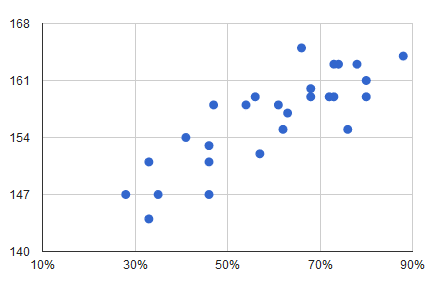
One of the hardest parts of preparing for the GRE is trying to assess your performance. Predicting your eventual GRE score can feel impossible at times. We’re here to help with everything you need to know about how the test is scored. We also have an interactive GRE score calculator to help you predict your test day performance.
The GRE consists of three main sections testing different skill sets : Quantitative, Verbal, and Analytical Writing. The Quant section is designed to test your ability to problem solve using mathematical models and numerical/measurable data. In the Verbal section you’ll show your ability to analyze and draw conclusions from written material. Finally, in the Analytical Writing section you’ll show off your ability to construct and convey strong arguments in essay form. While the sections test you on different material, there is one common denominator across the entire test. Fundamentally, the GRE is testing your ability to solve complex, and often confusingly constructed, problems under timed conditions. Yes, you’ll need to master vocab lists and math concepts to succeed. But in order to get your scores to the next level, you’ll need to master the unique nature of the GRE itself. Learning how it’s scored is one crucial step in this process.
The Verbal and Quantitative sections have the same score range. For the Verbal portion of the exam you will be asked to answer 27 questions in 41 minutes across two subsections. In the first you will answer 12 questions in 18 minutes. Then, you will answer 15 questions in 23 minutes. When it comes to Quant you will also answer 27 questions across two subsections, but you’ll have a total of 47 minutes. First, you’ll have 21 minutes to answer 12 questions. In your second section, you’ll tackle your remaining 15 questions in 26 minutes. Both Verbal and Quantitative are scored on a range that runs from the lowest possible score, 130, up to the highest score, 170. The 130 to 170 scale runs in 1-point increments.
The Analytical Writing section does things differently, giving you 30 minutes to complete one “Analyze an Issue” task. During this thirty-minute span you’ll be asked to read your prompt, brainstorm your essay, and write and proofread your draft. You’ll then be graded on a scale that ranges from 0.0 to 6.0 in half-point increments. The AW score does not factor into your overall composite score that some schools may ask for.
In doing your GRE research you’ve likely come across the terms “raw scores,” “scaled scores,” and “percentile rankings.” You may have wondered what differentiates these scores and, most importantly, which scores you should be focusing on. Luckily, it’s very easy to break down the differences between these terms. Let’s jump in!
On the GRE your raw scores are simply the number of questions you get correct in each of the Verbal and Quantitative sections . Each question within a section has the same point value as any other question. After your test, when you view ETS’s Diagnostic Service , you’ll be able to see the exact number of questions you got right in each section. This is your raw score.
If your raw scores are simply your number of correct answers, how do we get a score of 130-170? And why? Since not everyone takes the exact same GRE, ETS has to account for variations in difficulty caused by different tests and by section-level adaptability. Again, you may be asking why. But there’s a very good reason for this: to ensure that graduate schools can evaluate test takers on a level playing field. Through a process called equating, ETS turns your raw score into a scaled score to better measure your performance against all other test takers in a given time period. Most graduate programs are looking most closely at your Quant and Verbal scores. Programs that require you to deal with a lot of quantitative data, think economics, mathematics, and biological sciences, will value your Quant score more. Fields like English, History, and other humanities programs will likely put a premium on your Verbal score. Some programs will want to see a strong performance across both sections.
The final piece of the scoring puzzle is the percentile ranking . Your percentile shows directly how your scaled score stacks up against all other test takers during a specific time window. For example, a Verbal score of 156 has a percentile rank of 70. This means achieving a 156 Verbal puts your performance above 70% of all other test takers. There’s a wide disparity between sections though! The same scaled score of 156 on the Quant section has a percentile rank of only 39. That means a 156 on Quant puts you above just 39% of all other test takers. The takeaway: the same number means very different things on Verbal versus Quant, so always read your percentile by section.
Some programs will report on the percentile ranks of their admitted students rather than the scaled scores. So it’s important to research your targeted programs’ score requirements and preferences and then look at score and percentile charts.
What about overall scores? Some schools may say they are looking for a certain composite score, like 300. This is simply your Verbal and Quant sections added together. ETS does not release percentile ranks for the composite score, and it’s generally not as important as hitting your section benchmarks. However, as always, it is important to make sure you are diligently checking in with each of the programs you are applying to in order to set your score goals.
The tables below show the current GRE percentile ranks published by ETS. They reflect the reference group of everyone who tested between July 1, 2021 and June 30, 2024. For a deeper look at what different scores mean for your target programs, see our full guide to GRE score percentiles linked above.
One of the most frequently asked questions we hear at Magoosh is “how does difficulty work on the GRE?” This is a great question, and one that is at play on two different levels on the test. The first is on a question level.
Questions on the GRE fall into five different difficulty categories: Very Easy, Easy, Medium, Hard, and Very Hard. Furthermore, each of the two subsections that make up the Verbal and Quant sections will be classified as Easy, Medium, or Hard. A common misconception is that an Easy section won’t have any Hard questions. Or that a Hard section will be entirely composed of Hard questions. While it can feel like this on test day, that’s not how the sections are actually constructed. Let’s look more closely at each of the sections.
We’ve established that the GRE contains three difficulty levels for each section, but how does that work? What does it mean that the test is section adaptive? You can get a deeper dive here , but there are some basics to know before we dive into scoring.
First, the GRE is only adaptive from section to section. This means your performance on your first Quant or Verbal section, which will be at a Medium difficulty, will determine the difficulty level of your subsequent second section. It does not mean that the test will adapt to your performance within a section. Let’s look at two scenarios!
In the first scenario, you get six questions out of twelve right in your first Quant section. This means that you are extremely likely to get another Medium difficulty Quant section. This will somewhat limit your Quant score ceiling, but we’ll explore that more fully in a moment.
In the second scenario, you start your first Quant section by answering the first three questions in a row wrong. This will not change the difficulty of your remaining questions. The difficulty level of each section is locked in once you begin it. In this scenario, you could go on to answer your remaining nine questions correctly and secure a Hard second section.
The most important takeaway about scoring and difficulty is this: harder sections weigh more heavily in your score than easy ones . This means that you can only achieve a really great score if you do well enough on your first Medium section to get a Hard second section. The easier the second section, the lower your score ceiling will be.
Before we jump too far into scoring details, I have to make an important disclaimer. The details of the scoring system, including the equating formula and all other algorithms used in the GRE, are known only by ETS. They have never revealed exactly how their scoring system works. So how do we know what we know? Our calculators and score charts are estimations and approximations based on analyzing lots and lots of publicly available data like official score charts and score reports. You should always read scoring data from us, and other sources, knowing that we’re providing you the best estimations possible, but they are still just estimations.
You may be wondering just how to trigger that Hard second section in Quant. Here are the rough thresholds. Keep in mind that your first Quant section will always be of Medium difficulty.
Now let’s look at some broad score thresholds based on the difficulty level of your second Quant section.
Pro tip: The single most useful thing you can do before setting a Quant goal is establish your real starting point. Take a free GRE practice test under timed conditions, then use the calculator below to see what your current questions-correct count actually predicts.
How about the Verbal section? How do you trigger that Hard second section there? Here are the rough thresholds. Keep in mind that your first Verbal section will always be of Medium difficulty.
Now let’s look at some broad score thresholds based on the difficulty level of your second Verbal section.
The newer, shorter GRE only features one essay in the Analytical Writing section. These aren’t simply “right” or “wrong” questions like your other sections. So you won’t get a raw score that corresponds to a 40-point score range. Instead, the GRE AW essay is rated based on a rubric. The rubric’s score range is 0 to 6, and scores are calculated in half-point increments.
Instead of being adjusted for relative difficulty, AW essay questions are adjusted for differences between multiple scorers. Each AW essay is given to a human scorer. At the same time, the essay is also submitted to a computer scorer, ETS’s e-rater scoring engine . If the human score and the computer score for an AW essay are similar, the final score for the essay will be an average of the human and computer scores.
However, if the e-rater score is a lot different from the human score, a second human scorer will step in and give the essay an additional rating. In that case, the essay score will be the average of the two human scores.
While schools generally look more closely at your Quant and Verbal scores, your writing score does often matter. This is particularly true for programs where you are not submitting another writing sample, or if you are an applicant who does not speak English as your first language. Aim for at least a 3.0 unless your program indicates that you should have a higher score. Typically, programs that are very writing heavy, think humanities programs, will want to see higher AW scores. If you want feedback on practice essays before test day, Magoosh GRE prep includes an AI Essay Grader that scores your writing against the GRE rubric.
Ready to figure out your target GRE score? Use our interactive GRE calculator! If you took a free practice test , you can use those numbers to get an idea of your section and total scores. Simply adjust the sliders for each section to see both your section scores and your GRE total score. Once you have an idea of what score you are aiming for, you can refer back to our information about how many questions you can miss to form an action plan.
The best way to achieve your score goal is to do consistent, smart practice. Once you know your target from the calculator above, build backward from it: figure out the questions-correct count you need, then practice until you can hit it reliably under time. A focused study schedule keeps that work on track. You can start from one of our free GRE study plans , and if vocabulary is your bottleneck on Verbal, the Magoosh GRE Vocabulary Flashcards are a quick daily way to build it.
And of course, consider Magoosh GRE prep for tried-and-true study plans, step-by-step explanation videos, practice tests, and customized practice sections under test-like conditions. With a Magoosh plan you can set up a mock first Quant section and work on hitting that magic correct-questions number to reach your personal score goal.
Bhavin sets the vision and strategy for Magoosh, along with whatever else needs to be done. With a BS/BA in Economics and Computer Science from Duke University and an MBA from the Haas School of Business at UC Berkeley, he’s on a mission to change the way people learn and how they think about learning. Years ago, Bhavin played on several Nationals-level ultimate frisbee teams. Today, he’s our resident gelato connoisseur.