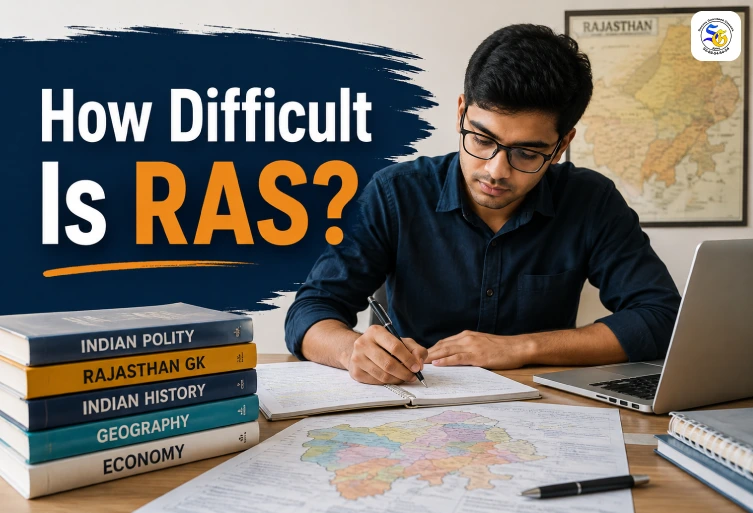
The Rajasthan Administrative Service (RAS) examination is one of the most competitive state civil service examinations in Rajasthan, and many aspirants begin with one important question: How difficult is RAS? The answer depends on a candidate’s preparation, consistency, subject knowledge, and ability to handle both objective and descriptive examination requirements. RAS is certainly challenging, but it is not impossible for a well-prepared student. The examination covers a wide range of subjects, including Indian history, geography, polity, economy, science, current affairs, and Rajasthan-specific history, culture, geography, and administration. The state-focused syllabus gives candidates a clear preparation direction, but it also means Rajasthan GK cannot be ignored. RAS Prelims tests knowledge and accuracy, while Mains requires candidates to present their understanding through well-structured answers. Students preparing in Ajmer can make the process easier by following a planned study routine, using reliable resources, practising regularly, and taking guidance when required. With consistent preparation, the difficulty of RAS can be managed step by step.
RAS is difficult mainly because of its large syllabus, high competition, and need for continuous revision and practice . Candidates have to prepare several subjects and remember both broad concepts and specific facts, particularly those related to Rajasthan. The challenge is not that every topic is extremely complicated; rather, students need to cover a large amount of information and retain it for the examination. Prelims requires accuracy and quick recall, while Mains tests understanding, analysis, and answer-writing ability. Current affairs also need regular attention because important developments can connect with subjects such as governance, economy, environment, and Rajasthan affairs. Students who study without a plan may find the syllabus overwhelming, whereas a structured approach can make it much more manageable. A good preparation strategy divides the syllabus into smaller targets and gives sufficient time to learning, revision, practice, and testing. For an aspirant preparing for RAS in Ajmer , maintaining a consistent routine is more important than simply increasing study hours. The examination is challenging, but disciplined preparation can significantly reduce its difficulty.
The RAS syllabus is extensive because it combines general studies with a strong focus on Rajasthan. Candidates need to study areas such as Indian history, Rajasthan history, geography, polity, economy, science and technology, environment, current affairs, and Rajasthan’s art and culture. Rajasthan-specific topics deserve special attention because they require precise knowledge of the state’s history, traditions, geography, economy, administration, and important developments. One of the common mistakes among beginners is treating Rajasthan GK as a small part of preparation and leaving it until the final months. Instead, it should be studied regularly along with the other core subjects. Candidates also need to understand that completing a chapter once does not mean the topic is fully prepared. Regular revision and question practice are necessary to improve recall. Limited and reliable study resources are generally more useful than collecting numerous books and online materials. By dividing the RAS syllabus into weekly and monthly targets, students can gradually cover the required subjects without feeling overwhelmed. This approach is particularly useful for beginners starting their RAS preparation in Ajmer .
RAS Prelims is an objective examination, but its competitive nature makes accuracy and preparation extremely important. Questions can test factual knowledge, conceptual understanding, Rajasthan-specific topics, and current affairs, with some options requiring candidates to distinguish between closely related facts. Knowing a topic generally is therefore not always enough; students must revise important information and practise applying it through questions. Rajasthan GK should have a regular place in the preparation schedule because state-specific knowledge can cover many different areas. Current affairs should also be studied consistently instead of being collected for last-minute revision. Solving previous-year questions can help candidates understand the nature and level of questions, while mock tests can improve speed and accuracy. However, taking tests alone is not enough. Students should analyse every test to identify incorrect answers, weak topics, guessing patterns, and time-management problems. Keeping short notes of repeated mistakes can make later revision more effective. A candidate who combines syllabus-based study with repeated revision, MCQ practice, and mock tests will generally be better prepared to handle the pressure of RAS Prelims .
RAS Mains can be more demanding for students who are not comfortable with descriptive answer writing because candidates must explain their knowledge rather than simply select the correct option. A good Mains answer needs to address the question directly and present information in a logical and readable manner. Candidates should develop the habit of understanding the demand of a question before beginning to write. Relevant facts, examples, balanced arguments, Rajasthan-specific references, and suitable conclusions can strengthen an answer when they are used naturally. Time management is equally important because candidates have to complete the paper within the prescribed time. One common mistake is waiting until after Prelims to start thinking about answer writing, which can leave too little time to develop the required writing speed and structure. Regular practice allows students to identify problems such as unnecessary introductions, repetition, weak conclusions, or incomplete answers. Feedback from teachers or experienced evaluators can also help candidates improve faster. For serious RAS aspirants, Mains preparation should therefore include both knowledge building and answer-writing practice. This makes the transition from reading material to writing examination-ready answers much smoother.
Rajasthan GK is an important part of RAS preparation because candidates need detailed knowledge of the state and not just general awareness of Rajasthan. Topics can include Rajasthan’s history, geography, art, culture, literature, architecture, folk traditions, economy, administration, important personalities, and current developments. Local familiarity can provide an initial advantage, but examination-level questions may require much greater accuracy and depth than everyday knowledge. Students should therefore study Rajasthan-specific topics systematically and revise them repeatedly. Making concise notes can help candidates retain dates, facts, personalities, locations, cultural details, and important developments without repeatedly going through large books. Practice questions are also useful because they show whether the information has actually been retained. Rajasthan current affairs should be connected with static subjects wherever possible so that preparation becomes more meaningful. For students preparing for RAS in Ajmer, giving Rajasthan GK consistent attention can prevent a major gap in preparation later. Rather than treating it as an additional subject, aspirants should consider it an essential component of their overall RAS study plan.
The competition is another major reason why RAS feels difficult to aspirants. A large number of candidates prepare for the examination, while the number of available administrative positions is comparatively limited. However, the real competition is strongest among candidates who complete the syllabus, revise regularly, solve questions, and consistently improve through mock tests. This means that merely registering for the examination or studying occasionally does not provide a realistic preparation advantage. Candidates need to build consistency over a long period and focus on measurable improvement. Instead of comparing their daily study hours with other aspirants, students should track their own progress through completed topics, revision cycles, mock-test scores, accuracy, and answer-writing performance. A low score in an early test should not automatically be viewed as failure; it can identify weaknesses before the actual examination. Students preparing in Ajmer can benefit from a structured learning environment that provides regular practice and guidance. Ultimately, the competitive nature of RAS means candidates need to prepare strategically, not simply study for longer hours.
Yes, an average student can crack RAS with consistent preparation, proper planning, and regular improvement . Academic marks alone do not decide success in a competitive examination because many of the skills required for RAS can be developed through practice. A student who is initially weak in Rajasthan GK, current affairs, general studies, or answer writing can improve these areas with focused effort. The key is to identify weaknesses instead of avoiding them. Beginners should understand the syllabus, choose dependable resources, create realistic daily targets, revise completed topics, and regularly solve questions. Mock tests can show where preparation needs improvement, while answer-writing practice can gradually improve clarity and speed. Students should also avoid believing that successful aspirants study perfectly every day. Consistency over several months is generally more valuable than occasional extremely long study sessions. Aspirants preparing for RAS in Ajmer should focus on building a sustainable routine that combines self-study, revision, practice, and suitable guidance. With the right approach, RAS can be a challenging but achievable goal rather than an examination reserved only for exceptionally talented students.
There is no fixed preparation period for RAS because every candidate starts with a different level of knowledge and preparation. A beginner may need more time to understand the syllabus and build strong foundations, while a student with previous competitive-exam preparation may progress faster. Instead of focusing only on the number of months, aspirants should focus on completing the syllabus, revising important topics, and improving their test performance. A practical study plan should include general studies, Rajasthan GK, current affairs, revision, MCQ practice, and Mains answer writing at the appropriate stage. Students should set weekly targets rather than trying to finish the entire syllabus quickly. Regular revision is particularly important because RAS covers a large amount of information that cannot be retained through one-time reading. Candidates preparing in Ajmer can also use coaching or guided study programmes if they need help maintaining a structured routine. The ideal preparation period is therefore the amount of time required to develop sufficient knowledge, accuracy, writing ability, and confidence for the examination rather than a fixed number of months.
Beginners should start RAS preparation by understanding the official syllabus and examination pattern instead of immediately collecting large amounts of study material. Knowing what needs to be studied helps candidates separate important topics from information that may not contribute significantly to examination preparation. The next step should be building basic concepts in subjects such as history, geography, polity, economy, and science while gradually introducing Rajasthan-specific subjects. Candidates should select a limited number of reliable resources and revise them several times instead of continuously changing books and notes. Current affairs should become a regular habit, but students should focus on relevant developments rather than trying to memorize every news story. Practice questions can be introduced after completing basic topics so that candidates can check their understanding and identify weak areas. Students looking for RAS Coaching in Ajmer can also consider structured guidance if they need help with planning, study material, tests, or difficult subjects. The most important thing for a beginner is to develop a routine that can be followed consistently for months rather than creating an unrealistic timetable that becomes difficult to maintain.
Effective RAS preparation requires more than reading books for several hours every day. Candidates should divide their preparation into four important activities: learning new topics, revising previously studied material, practising questions, and analysing mistakes. Revision should be scheduled regularly because the large syllabus makes it easy to forget information that was studied several weeks earlier. For Prelims, MCQs and mock tests can help improve accuracy, speed, and question-solving ability. For Mains, answer writing should gradually become part of the routine so that students learn to express information clearly within the required time. Rajasthan GK should receive regular attention alongside general subjects rather than being postponed until the end. Current affairs can be revised through short notes and linked with static subjects whenever relevant. Candidates should also maintain a record of difficult topics and repeated mistakes so that these areas receive additional attention. This approach makes preparation more measurable and helps students understand whether their performance is actually improving. For an aspirant preparing for RAS in Ajmer, combining self-study with suitable guidance and regular testing can provide a more organized path toward the examination.
Many aspirants make RAS preparation harder by following an inconsistent or overly complicated study strategy. One common mistake is studying without first understanding the syllabus, which can result in spending too much time on unnecessary material. Using too many books and online resources can create confusion and reduce the time available for revision. Some students also postpone Rajasthan GK and current affairs, only to face a heavy workload near the examination. Another common problem is reading repeatedly without solving enough questions, making it difficult to judge actual preparation. Candidates preparing for Mains may also delay answer-writing practice and discover later that they know the information but cannot present it effectively within the time limit. Frequent changes in study plans, unrealistic daily targets, and comparison with other aspirants can further affect consistency. A better approach is to select reliable resources, follow a practical timetable, revise repeatedly, and use tests to identify weaknesses. Students should treat mistakes as part of the learning process rather than becoming discouraged by low marks in early practice tests. Avoiding these common errors can make RAS preparation more focused and considerably more manageable.
RAS coaching can be helpful for students who want structured guidance, organized study material, regular tests, and support with difficult topics. However, coaching is not a substitute for self-study, revision, or consistent practice. Before joining any institute, aspirants should check whether its programme matches the current RAS syllabus and whether it provides useful support throughout the preparation process. Students should consider factors such as teaching methodology, faculty experience, Rajasthan GK coverage, current affairs support, test practice, doubt solving, and answer-writing guidance. A structured classroom or online programme can be particularly useful for beginners who are unsure how to divide the syllabus or select suitable resources. Students preparing in Ajmer can explore local coaching options and choose a programme based on their individual learning needs rather than simply following other candidates. SG Classes offers coaching support for aspirants looking for RAS Coaching in Ajmer , and students can visit the relevant page to learn more about the available preparation approach: RAS Coaching in Ajmer . Ultimately, coaching should support a candidate’s preparation, while regular self-study remains essential for building knowledge and confidence.
Consistency is one of the most important factors in long-term RAS preparation because the syllabus cannot usually be mastered through short periods of intense study. Aspirants may feel motivated at the beginning but struggle to maintain the same routine after several weeks, especially when progress seems slow. Setting smaller weekly goals can make preparation easier and provide a clear sense of achievement. Instead of focusing only on the final result, students should track practical improvements such as completing topics, increasing mock-test accuracy, improving revision, and writing better answers. A realistic timetable is also more sustainable than an extremely demanding schedule that cannot be followed regularly. Students should allow time for rest and maintain a healthy daily routine so that concentration does not suffer. Comparing personal preparation with another candidate’s study hours can create unnecessary pressure because every aspirant has a different background and learning speed. When a difficult topic appears, students should break it into smaller sections and seek clarification instead of avoiding it completely. Whether preparing independently or through RAS Coaching in Ajmer , steady progress over time is far more valuable than irregular bursts of preparation.
RAS is undoubtedly a challenging examination, but its difficulty does not make it unachievable. The major challenges include the broad syllabus, Rajasthan-specific knowledge, competitive Prelims, descriptive Mains preparation, and the need for repeated revision. However, these challenges can be handled through a systematic preparation strategy and consistent effort. Candidates do not need to master the entire syllabus immediately; they can build their knowledge step by step and strengthen it through revision and practice. Understanding the examination pattern, selecting reliable resources, solving questions, analysing mistakes, and developing answer-writing skills can gradually improve overall performance. Students preparing in Ajmer can also explore structured guidance if they need additional support in managing their preparation. The most important quality is not studying continuously without a break but remaining consistent and learning from mistakes throughout the preparation journey. RAS may be difficult, but a serious aspirant with realistic goals and disciplined preparation can approach the examination with confidence. The right question is therefore not only “How difficult is RAS?” , but also “How effectively can I prepare for it?”
The difficulty of RAS depends greatly on how a candidate approaches preparation. A large syllabus may initially seem overwhelming, but dividing it into smaller targets, revising regularly, and practising questions can make the process much easier to manage. Prelims requires strong factual and conceptual preparation, while Mains demands clear thinking and effective answer writing. Rajasthan GK should remain an important part of the preparation from the beginning, particularly for students aiming to build a strong foundation for the state civil services examination. Candidates should also avoid common mistakes such as collecting excessive study material, delaying revision, ignoring mock tests, and constantly changing their preparation strategy. For students in Ajmer, choosing suitable guidance and maintaining disciplined self-study can provide additional support throughout the journey. RAS is difficult, but it is achievable with the right preparation, patience, and consistency. Aspirants who are ready to study systematically should focus on gradual improvement rather than fearing the competition. With a clear plan and sustained effort, the goal of qualifying RAS can become a realistic and structured preparation journey.
Have questions? We’ve answered some of the most common queries to help you understand the topic better
RAS is challenging because of its broad syllabus, competition, Rajasthan GK, and multiple examination stages, but disciplined preparation can make it manageable.
Yes. An average student can crack RAS with consistent study, regular revision, practice tests, and a focused preparation strategy.
RAS has a strong Rajasthan-focused component, while UPSC has a wider national and international scope. Both require serious and systematic preparation.
Rajasthan GK is highly important because candidates need knowledge of the state’s history, geography, culture, economy, administration, and current affairs.
Yes. Students can explore RAS Coaching in Ajmer through SG Classes for structured guidance and examination-oriented preparation
The Rajasthan government has officially released its exam calendar for 2026, covering over 44 major…
The Rajasthan government regularly releases recruitment opportunities for candidates who want to work in the…
Preparing for a Rajasthan Government Exam is one of the most secure career paths for…
Computer literacy has become essential for students, job seekers, and professionals in Rajasthan. From filling…